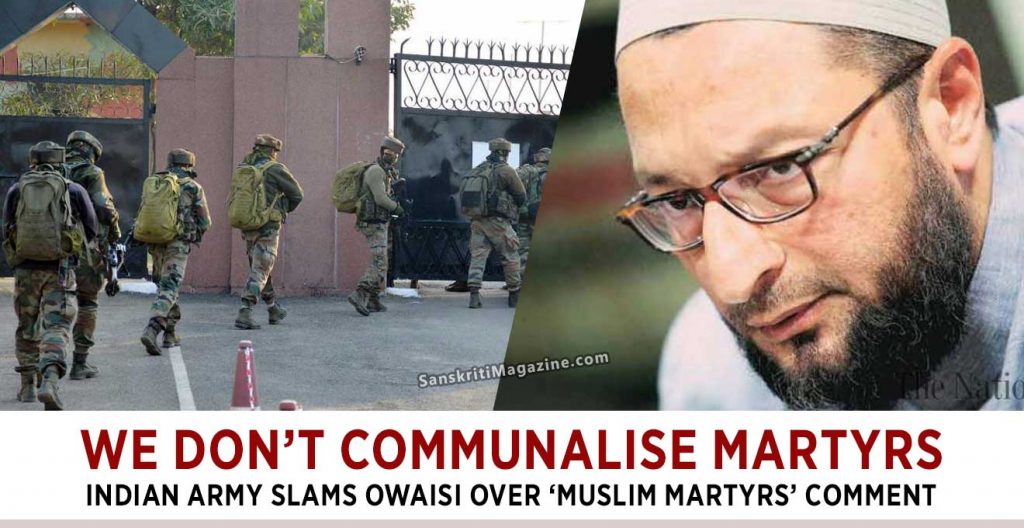
In an apparent snub to politicians and without naming AIMIM chief Asaduddin Owaisi, who tried to give a communal colour to the sacrifices of soldiers in Sunjuwan and Karan Nagar attacks in Jammu and Srinagar, Lt Gen Anbu said, ‘We don’t communalise our troops.’
The chief of the Indian Army’s Northern Command, Lt Gen Devraj Anbu, on Wednesday snubbed politicians for trying to give a communal colour to the militant attacks in Sunjuwan and Karan Nagar during the weekend and quoted media reports to say that 192 Pakistani soldiers were killed in Indian retaliation across the border in the last one year.
He said Pakistani media reports gave conservative figures but the Indian Army has inflicted “three times more casualties” on Pakistani army personnel.
Lt Gen Anbu said 185-200 militants in the south and 190-225 in north of the Pir Panjal range were waiting to infiltrate across the LoC and added that the Army will not be “cowed down by small incidents” like fidayeen attacks.
He also mentioned that Rs 364 crore has been spent on securing Army installations with new gadgets in addition to deployment of adequate personnel.
In an apparent snub to politicians and without naming All India Majlis-e-Ittehad-ul Muslimeen (AIMIM) chief Asaduddin Owaisi, who tried to give a communal colour to the sacrifices of soldiers in Sunjuwan and Karan Nagar attacks in Jammu and Srinagar, Lt Gen Anbu said, “We don’t communalise our troops.
Talking to reporters at the Northern Command headquarters in Udhampur, the general said that huge presence of Kashmiri people (during the funeral of soldier Mohammed Ashraf Mir) on Tuesday was a testimony against all those who wanted to communalise the army.
The Northern Command chief said the Indian Army respects all religions and goes by the doctrine “Sarva Dharm Sthal” at every army formation. In this context, he quoted Badami Bagh, Udhampur and his own residence where, he said, “all the deities are there”.
When asked if the tit-for-tat response to Pakistan firing across the LoC was paying off, he said that operations along the LoC were quite complex, very challenging and dynamic.
On terror outfits Jaish-e-Mohammed, Hizbul Mujahideen and Lashkar-e-Taiba, he said, “They are hand-in-glove with each other.” With respect to stone-pelting, he said, “We have devised a method where CRPF and police deal with stone-pelters, while the army carries out its CI (counter-insurgency) operations. That system works.”