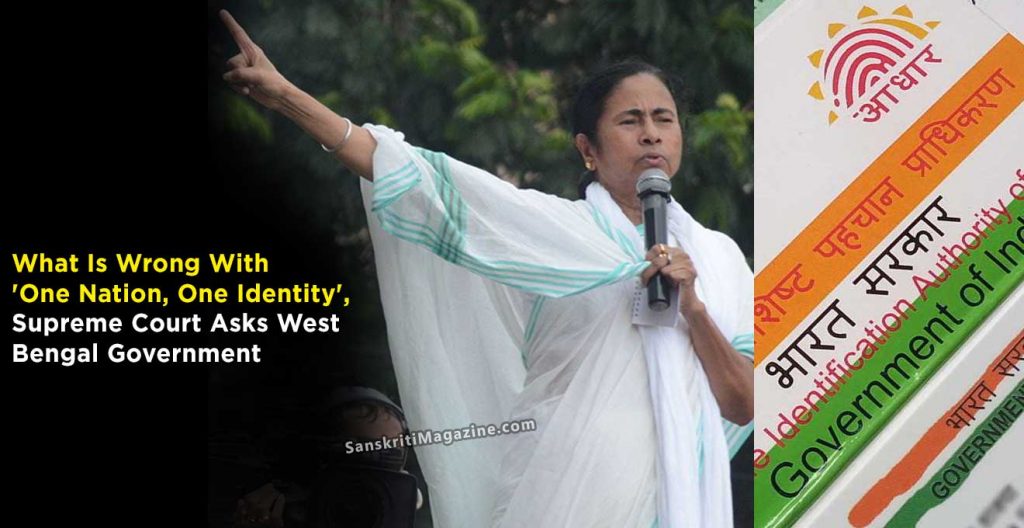
The Supreme Court on Wednesday questioned the West Bengal government for its stand against the Centre’s Aadhaar scheme, saying what was wrong in having ‘one nation, one identity’ for all Indians through the measure.
The Mamata Banerjee government, which had on Tuesday challenged the Aadhaar scheme and its enabling 2016 Act, told a five-judge Constitution bench headed by Chief Justice Dipak Misra that Indianness has nothing to do with a particular kind of identity.
The state government has attacked the scheme on grounds including that it would lead to ‘one nation, one identity’.
“Yes, we all are citizens of this country and Indianness has nothing to do with this kind of identity,” it told the bench which also comprised justices AK Sikri, AM Khanwilkar, DY Chandrachud and Ashok Bhushan.
The court questioned senior advocate Kapil Sibal, appearing for the West Bengal government, on what he thought about the concept of ‘one nation, one identity’.
“We are proud Indians and are passionately Indians, but everything is wrong with Aadhaar. Indianness has nothing to do with identity. Let us not go into this debate as it is more political than legal. We are more than this Aadhaar. That’s all,” Mr Sibal responded.
The senior advocate, who resumed arguments, read out the Aadhaar Act to say that it was a wrongly drafted law with respect to ‘alternatives’, because there was no scope of authentication of identity of an individual except Aadhaar.
The Aadhaar Act deals with no scope of other alternatives to establish identity of an individual, Mr Sibal said, adding banks say that they do not want any other information or card and ask only for Aadhaar number.
Giving an illustration, he said the United Kingdom, which initially started a biometric authentication mechanism, scrapped it because the system was vulnerable.
“I am not saying that the State will misuse my Aadhaar information, but how does this Aadhaar make everyone vulnerable? This vulnerability is where the violation of my right comes in,” he said.
Mr Sibal argued that his first submission is about the centralisation of data and said that Unique Identification Authority of India (UIDAI) claims that it is secure because it is federated — that is the database is broken and stored in multiple locations.
He cited a recent Reserve Bank of India report circulated among its staffers, which identified Central ID Repository is a “single target” for internal/external/indigenous/foreign attacks and also a “single point of failure”.
The bench said that theoratically every centralised database can be hacked, but this does not necessarily mean that it is vulnerable.
“It is acknowledgement of the fact that you need to take extra care and safeguards should be there to protect it,” Justice Chandrachud said.
Mr Sibal replied, “I need to be assured that my data is protected but in a digital world, there can be no such assurance and once my property (biometric information) is lost then in the physical world you may retrieve it but in the virtual world you cannot. This is the future world we are heading into,” he said and added, “In the digital world one knows more about you than one knows about himself”.
The bench replied, “In the digital world it is not necessarily true what is advertised”.
Mr Sibal said Aadhaar impacts federalism and exclusions caused due to it violates the right to equal treatment.
“It disproportionately impacts people who are aged, those who are engaged in manual labour and disabled people,” he said.
The hearing remained inconclusive and will continue tomorrow.
Yesterday, the West Bengal government used Prime Minister Narendra Modi’s recent speech at the World Economic Forum at Davos that one who controls data would control the world, to assail the ambitious Aadhaar scheme, saying the Centre would control personal information of citizens to have a grip over them.