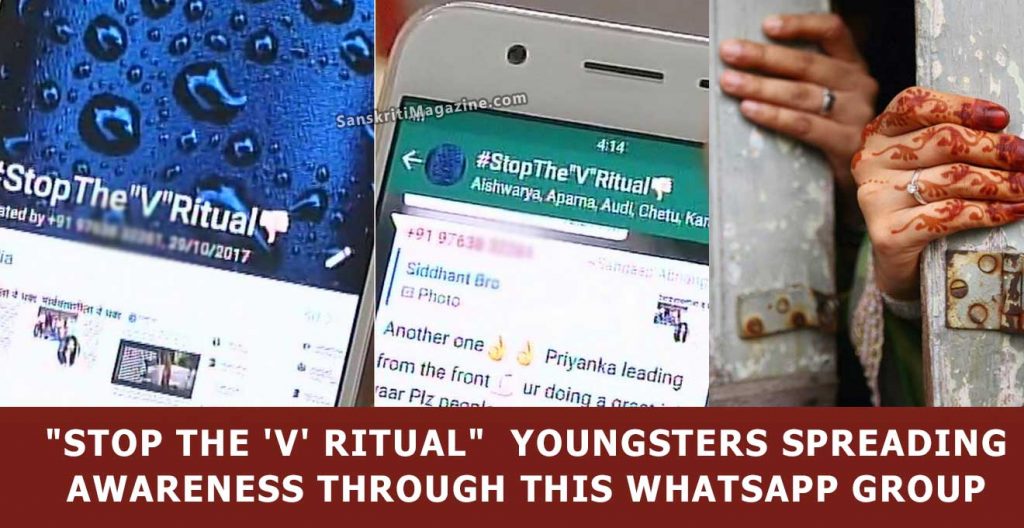
A group of youngsters from Kanjarbhat community in Pune have come together to form a WhatsApp group – “Stop the ‘V’ ritual” – to spread awareness against the practice of determining the virginity of a bride on the wedding night.
PUNE: A group of youngsters from Kanjarbhat community in Pune have come together to form a WhatsApp group – “Stop the ‘V’ ritual” – to spread awareness against the practice of determining the virginity of a bride on the wedding night.
The group of youngsters also filed a police complaint against the practice.
“We had shared some material on Triple Talaq and Right to Privacy on Facebook. Some like-minded people from our Kanjarbhat community gave a positive response. So we came together to protest against this atrocity,” admin of the WhatsApp group Vivek Tamaichekar said.
As per the custom, the village panchayat spreads a white-bed sheet on the first wedding night of a couple. If the sheet is found stained with blood, the woman passes the test otherwise she is accused of having had a physical relationship prior to her marriage.
These tests are reportedly often performed without even the woman’s consent.
A masters student at the Tata Institute of Social Sciences (TISS) in Mumbai, Tamaichekar said that the practice is against article 14 and article 21 of the Constitution.
“People here believe that this ritual should be done because it is our tradition and otherwise, our girls would be spoilt. We are protesting against that by spreading awareness,” he concluded.
MEET THE ‘STOP THE V RITUAL’ COUSINS WHO ARE FIGHTING THE KANJARBHAT COMMUNITY’S DEMAND FOR VIRGINITY TESTS ON BRIDES
Vivek and Priyanka Tamaichekar on fighting moral guardians and misogyny in the Kanjarbhat community.
 The video clip, now widely circulated, looks just like any poorly-shot wedding video: Bad lighting, unsteady pans and people walking across the screen. The part that has caused an outcry, however, shows the married couple dressed in their wedding finery, sitting off to one side while a group of older men argue, berate and talk loudly over each other in the foreground. Turns out this is the all-important wedding ritual in Pune’s Kanjarbhat community: The haggling over a price to conduct a virginity test on the bride. At some point in the clip, thick wads of currency are thrown down, then picked up, to later be distributed among the Kanjarbhats’ ‘caste panchayats’, self-styled moral guardians of the community. The Kanjarbhats were a nomadic tribe from Rajasthan who migrated to various parts of India more than a century ago.
Last weekend, when three youngsters tried to shoot a similar set of negotiations between the elders and the family of a bridal couple at another wedding, they were beaten up. The incident blew the lid off the outrageous and archaic practice of virginity tests, in which panchayat members examine the wedding-night bedsheet of a couple and, if not suitably blood-stained (to prove the bride’s virginity), have the right to invalidate the marriage. Social permissiveness be damned. But in their benevolence, the panchayat has, however, found a way out of this problem: A quick ‘cleanse’ for the right price.
Now, two youngsters from the Kanjarbhat community in Pimpri, Pune, have started a protest against these rituals. Cousins Vivek Tamaichekar, 28, and Priyanka Tamaichekar, 26, are spearheading ‘Stop the V Ritual’ on Whatsapp, Facebook and Instagram to attract other, like-minded, youngsters to end this forcible virginity testing.
“I’m supposed to get married in May,” says Vivek. “When my fiancée and I told our families we didn’t want the virginity-test ritual, they initially agreed, but later went back on their word. That’s when I took to Facebook to protest.” While his posts received overwhelming support from outsiders, only a handful from within the community wrote back in solidarity. One of them was Vivek’s paternal cousin Priyanka. He immediately enlisted her help — mainly to get the female veto on this practice — and both have been working in tandem since. “It’s important to bring the women on board since they are the ones being subjected to the test,” says Priyanka, who is employed with a realty firm in Pune. Not that the panchayat ever considers their side of the story, she adds.
In one case, when a sportsperson tried to explain to them that her hymen may have ruptured during training, the panchayat refused to accept the union — until they were suitably compensated, says Priyanka. “The rare instances when a woman is asked who she had sexual relations with before marriage, have also led to manipulation,” says Vivek. “The family’s business rivals have sometimes been framed.”
The ‘Stop the V Ritual’ group has found a way to stay just above the radar. While meetings are frequent, and held in secret, on one occasion Vivek and Priyanka invited an advocate to come and speak about the members’ legal rights and recourse. They have also tied up with non-profit organisations to spread the word among a large group, both within and the outside the community.
Vivek, who’s doing a course at Mumbai’s TISS, scouts for sympathisers and influential allies in the city, while Priyanka, who continues to live and work in Pimpri, keeps him updated about community happenings. They strategise together, even when it comes to cracking the toughest and most closeted group, the community’s women.
While the movement’s biggest target is the virginity test, the cousins are also against a host of restrictions on marriage set down by the panchayat, and contained in a 150-page document Vivek refers to as “the head-of-the-household handbook”. It allows marriage only between certain groups of people and forbids a union between people with the same last name, even though they may not be related; it instructs on how to calculate the monetary value of a bride or a groom, and the amount to be sought for a virginity test (determined by the family’s standing, of course). “They say these are all attempts to ensure the purity of a Kanjarbhat bloodline,” says Vivek. “That’s just rubbish.”
While Vivek and Priyanka both believe in a shock-and-awe campaign, they draw the line at storming weddings in protest. “We are activists, not an army,” says Vivek. The community’s elders have no such scruples. The protests have been met with crushing and — as last week’s incident showed — violent resistance from the panchayat. The two Tamaichekars and their families have been practically excommunicated by the rest of the Pimpri Kanjarbhats.
“We don’t get invited to any more weddings or social dos,” says Priyanka, “So it becomes harder to find supporters.” For her troubles, she’s harassed and browbeaten almost every day by neighbours because, unlike Vivek, she continues to stay in the same area where she grew up. “They post disgusting things about me on social media,” she says. “And these are supposed to be ‘honourable’ family men.” The cousins have decided their best option may eventually be to approach the courts. So they’re collecting all kinds of evidence to support their case, including the aborted videographing. “It’ll be hard, but we’re not giving up quite yet,” says Vivek.