IndianSanskriti
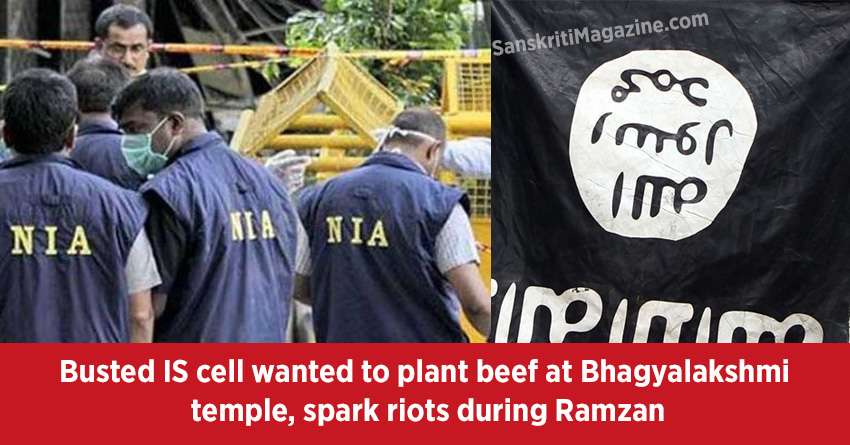
Busted IS cell wanted to plant beef at Bhagyalakshmi temple, spark riots during Ramzan

Busted ISIS cell wanted to plant beef at Bhagyalakshmi temple, spark riots during Ramzan

The National Investigation Agency (NIA) early on Wednesday busted an Islamic State (IS) module in Hyderabad, detaining 11 youths who were allegedly plotting powerful bomb blasts to target VVIPs and crowded places in the city and intended to trigger communal riots by placing cow and buffalo meat at the Bhagyalakshmi temple at the base of the iconic Charminar.

The IS module was, according to the agency, procuring the meat to be placed at temples to spark riots during the ongoing holy month of Ramzan. The arrested youths, who held regular jobs and were in touch with IS handler and chief recruiter for India, Shafi Armar, had been under the NIA’s scanner for the past 4-5 months.

It was a telephonic conversation on the evening of June 25 that prompted agencies to swoop down on the suspects. In the conversation, mentioned by an NIA source to TOI, a suspect asked the person on the other line to “bring four pieces of cow meat and four pieces of buffalo meat that day and seven pieces of cow meat the next day”. The attacks were likely to be carried out in the next few days and the module’s funds were being routed through Dubai.

The busting of the ‘Hyderabad module’ is significant as it is the first big, well-armed and organised IS-inspired group in India. While the previous Roorkee module had arms, the potency of the IED material recovered was not as worrying. Similarly, the panIndia module, headed by Mumbai man Mudabbir Shaikh, was yet to source weapons and had not perfected bomb-making when it was busted in January.

Five youths — Mohammad Ibrahim Yazdani, head of the module, Mohammad Ilyas Yazdani, Abdullah Bin Ahmed Al Amoodi, Habeeb Mohammad and Mohammad Irfan — were arrested on Wednesday evening while six others are being questioned. Almost all suspects are in their 20s and 30s, graduates and hold jobs, including some who are computer engineers. They hail from well-to-do families.

The telephonic conversation about cow meat prompted the NIA to act. “This was the clincher for us to pick up the module. Our assessment is that the IS-inspired youths, who were in touch with a Syria-based handler identified as ‘Amir’ but suspected to be Shafi Armar alias Yousuf al Hindi, were planning to carry out bomb blasts to target VVIPs and crowded places like malls and shopping centres, including around Charminar, while also planting beef at nearby temples. A possible target was Bhagyalakshmi temple,” said an NIA officer.

The idea, the officer said, was to create mayhem and communal tension at the same time during Ramzan. “We suspect that the bomb blasts were planned over the next one-two days,” he said.
You may also like

Search the website

Like us on Facebook

Get daily updates via Email

Enter your email address:

Recent Posts

Yogini Ekadashi 2026 — The Yaksha Who Missed the Morning Flowers, and the Ekadashi That Undid His Curse

On Friday, July 10, 2026, the rare Krishna Paksha Ekadashi of Nija Ashadha arrives. The Padma Purana tells the story of Hemamali — the Yaksha gardener of Bhagavan Kubera in Alaka, whose single morning of distraction with his wife Vishalakshi cost him his form, his wife, and his celestial city. Cursed to wander the earth of Bharata as a leper for a long time, he was at last shown the way back by Sage Markandeya — a single sincere keeping of Yogini Ekadashi.

Jamai Shashthi 2026 — The Story of Maa Shashthi, the Cat, and the Wife Who Was Forgiven

Jamai Shashthi 2026 — The Story of Maa Shashthi, the Cat, and the Wife Who Was Forgiven

On Saturday, June 20, 2026, Bengali households across Bharata will welcome their married daughters and sons-in-law home for the legendary jamai-aador feast and perform the Shashthi Vrata. But behind the warmth lies a story most Bengalis know by heart and most non-Bengalis have never heard — the wife who stole the hilsa, blamed the cat, lost six sons to Maa Shashthi’s wrath, and was finally forgiven. The Vrat Katha, the vidhi, the mantras, and the deeper teaching.

Vat Purnima 2026 — The Wife Who Argued Yama Into Returning Her Husband’s Life

On Monday, June 29, 2026, women across Maharashtra, Gujarat, and southern Bharata will tie red thread around banyan trees and hear the story of Savitri — the wife who walked behind Yamaraja Himself when He came for her husband, and out-argued the Lord of Dharma into returning Satyavan’s life. The Mahabharata’s Pativrata Mahatmya Parva, the vrat vidhi, and why the banyan witnessed everything.

Nija Jyeshtha 2026 — The Real Jyeshtha Begins, and the Calendar Resumes

Nija Jyeshtha 2026 — The Real Jyeshtha Begins, and the Calendar Resumes

With Adhik Maas now closed on the Somvati Amavasya of June 15, the long-postponed festivals of Jyeshtha return — Vat Purnima (June 29, the Savitri-Yamaraja katha), Jamai Shashthi (June 20, the Bengali festival of Maa Shashthi), Sankashti Chaturthi (June 28), Yogini Ekadashi (July 10), and Devshayani Ekadashi (July 16, opening the four-month Chaturmas of Bhagavan Vishnu’s yoga-nidra). A guide to what the next four weeks hold and what the household that kept Purushottam Maas now carries forward.

The Closing of Purushottam Maas 2026 — Adhik Amavasya and the Sealing of the Month-Long Vrat

On Monday, June 15, 2026 — a rare Somvati Amavasya — the intercalary month that bears Bhagavan Vishnu’s own name comes to its close. The Acharyas teach that a vrat is not measured by its duration but by its closing. Here are the Padma Purana’s instructions for sealing the month-long Purushottam Maas vrat: the morning snan, the closing puja with the Vishnu Sahasranama, the day of dana, the Somvati Amavasya gift, and the final sarva-arpana — the offering of all merit at the feet of the Lord.

css.php