IndianSanskriti
Rs 13,000 crore black money unearthed from overseas bank accounts

Rs 13,000 crore black money unearthed from overseas bank accounts

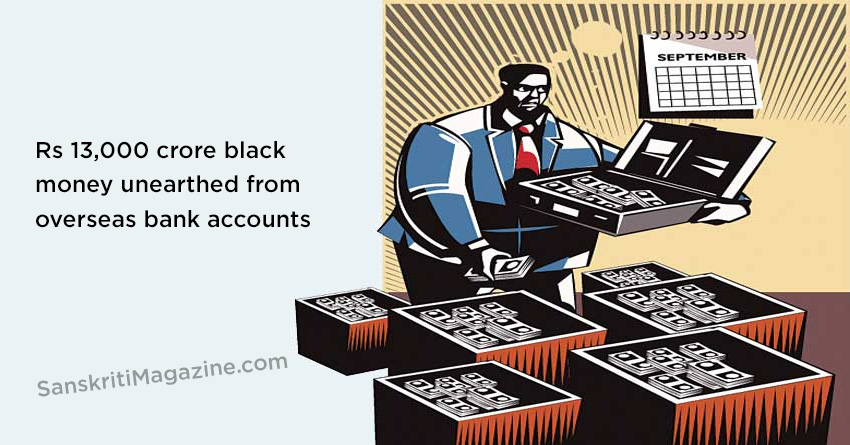
NEW DELHI: The government’s crackdown on those stashing undeclared income in overseas bank accounts has started yielding results with the Income Tax authorities having unearthed more than Rs 13,000 crore from just two sets of information received in 2011 and 2013.

In at least 400 cases of Indians with deposits in HSBC, Geneva, the details of which were received from the French government in 2011, the Income Tax (I-T) authorities have unearthed undisclosed income of Rs 8,186 crore, the highest disclosure ever from offshore bank accounts, and raised a tax demand of about Rs 5,377 crore against such account-holders till March 31, 2016, according to an I-T assessment report.

In the HSBC case, the government had received information about 628 bank accounts. Of these, at least 213 were found “not actionable” as they either had no money in them or they belonged to nonresident Indians. Also, in some cases, the entities remained untraceable. “Out of the actionable cases, assessments have been completed in 398 cases, including those settled by the I-T Settlement Commission as well as cases where assessment proceedings have been dropped,” according to the I-T report. A HSBC spokesperson declined to comment.

Based on another set of information disclosed in 2013 on the website of the International Consortium of Investigative Journalists (ICIJ), a Washington-based organisation, I-T officials have detected undisclosed income of Rs 5,000 crore in foreign bank accounts allegedly linked to 700 Indians.

So far, the I-T department has filed 55 prosecution complaints before criminal courts in the ICIJ cases on charges of wilful attempt to evade tax. The basis has been false statements made by these entities during the verification process. In the HSBC Geneva case, tax authorities have launched prosecution proceedings in 75 cases, a majority for wilful attempt to evade tax. The criminal courts have taken cognisance in most of these prosecution complaint cases, paving the way for the Enforcement Directorate to initiate actions under the stringent Prevention of Money Laundering Act (PMLA). The recently enacted Black Money Undisclosed Foreign Income and Assets Act has made the “wilful attempt to evade tax”as a predicate offence under the PMLA, giving the ED powers to attach and confiscate properties of an accused equivalent to the amount stashed abroad.

The I-T report said many Indians whose names appeared in the ICIJ cases had filed declarations under the black money declaration window scheme, which the government had launched for a limited period during 2015. However, those individuals against whom the department had already launched probe were not eligible for any relief.


You may also like

Search the website

Like us on Facebook

Get daily updates via Email

Enter your email address:

Recent Posts

Yogini Ekadashi 2026 — The Yaksha Who Missed the Morning Flowers, and the Ekadashi That Undid His Curse

On Friday, July 10, 2026, the rare Krishna Paksha Ekadashi of Nija Ashadha arrives. The Padma Purana tells the story of Hemamali — the Yaksha gardener of Bhagavan Kubera in Alaka, whose single morning of distraction with his wife Vishalakshi cost him his form, his wife, and his celestial city. Cursed to wander the earth of Bharata as a leper for a long time, he was at last shown the way back by Sage Markandeya — a single sincere keeping of Yogini Ekadashi.

Jamai Shashthi 2026 — The Story of Maa Shashthi, the Cat, and the Wife Who Was Forgiven

Jamai Shashthi 2026 — The Story of Maa Shashthi, the Cat, and the Wife Who Was Forgiven

On Saturday, June 20, 2026, Bengali households across Bharata will welcome their married daughters and sons-in-law home for the legendary jamai-aador feast and perform the Shashthi Vrata. But behind the warmth lies a story most Bengalis know by heart and most non-Bengalis have never heard — the wife who stole the hilsa, blamed the cat, lost six sons to Maa Shashthi’s wrath, and was finally forgiven. The Vrat Katha, the vidhi, the mantras, and the deeper teaching.

Vat Purnima 2026 — The Wife Who Argued Yama Into Returning Her Husband’s Life

On Monday, June 29, 2026, women across Maharashtra, Gujarat, and southern Bharata will tie red thread around banyan trees and hear the story of Savitri — the wife who walked behind Yamaraja Himself when He came for her husband, and out-argued the Lord of Dharma into returning Satyavan’s life. The Mahabharata’s Pativrata Mahatmya Parva, the vrat vidhi, and why the banyan witnessed everything.

Nija Jyeshtha 2026 — The Real Jyeshtha Begins, and the Calendar Resumes

Nija Jyeshtha 2026 — The Real Jyeshtha Begins, and the Calendar Resumes

With Adhik Maas now closed on the Somvati Amavasya of June 15, the long-postponed festivals of Jyeshtha return — Vat Purnima (June 29, the Savitri-Yamaraja katha), Jamai Shashthi (June 20, the Bengali festival of Maa Shashthi), Sankashti Chaturthi (June 28), Yogini Ekadashi (July 10), and Devshayani Ekadashi (July 16, opening the four-month Chaturmas of Bhagavan Vishnu’s yoga-nidra). A guide to what the next four weeks hold and what the household that kept Purushottam Maas now carries forward.

The Closing of Purushottam Maas 2026 — Adhik Amavasya and the Sealing of the Month-Long Vrat

On Monday, June 15, 2026 — a rare Somvati Amavasya — the intercalary month that bears Bhagavan Vishnu’s own name comes to its close. The Acharyas teach that a vrat is not measured by its duration but by its closing. Here are the Padma Purana’s instructions for sealing the month-long Purushottam Maas vrat: the morning snan, the closing puja with the Vishnu Sahasranama, the day of dana, the Somvati Amavasya gift, and the final sarva-arpana — the offering of all merit at the feet of the Lord.

css.php