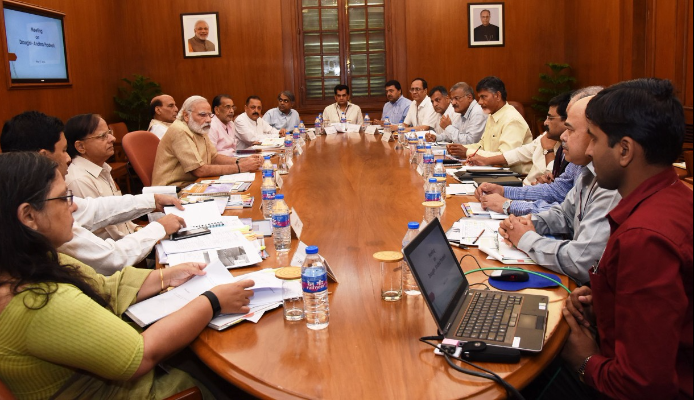
PM Modi holds talks with Chief Ministers of the drought affected states over last fortnight
PM Modi directs states for water conservation efforts and usage of existing water resource optimally and prudently
States to undertake a major drive for construction of farm ponds, adopt micro irrigation
PM Modi directs states to recycle waste water & use it for agriculture purpose in periurban areas
Pradhna Mantri Fasal Bima Yojana: State Governments to make use of technology to validate the crop cutting experiment
Agriculture and Farmers Welfare Minister, Shri Radha Mohan Singh appealed to the drought-affected states that they take immediate steps to fight drought and review it on week to week basis. The Minister said this while briefing the press reporters today.
Shri Singh said that for the first time in our country, Prime Minister sat with Chief Ministers of drought affected states for as long as two-hour and has shown such seriousness with giving immediate relief to the people suffering from famine , water – scarcity and had detailed discussions on agriculture .
Agriculture and Farmers Welfare Minister said that Prime Minister Shri Narendra Modi met Chief Ministers of the drought affected states over last fortnight. The last meeting of the Prime Minister was on May 17 with Chief Ministers of Andhra Pradesh and Chhattisgarh. Earlier, Prime Minister met chief minister of Telangana, Jharkhand, Uttar Pradesh, Gujarat, Maharashtra, Madhya Pradesh, Rajasthan and Karnataka.
Important points after discussion with Prime Minister and Chief Ministers of drought affected states.
The Prime Minister engaged the State Governments on issues that needed immediate resolution. The problems faced currently, action taken and the proposed steps- short term on weekly basis, long term mitigation along with drought proofing measures specific to individual States were discussed in detail.
Each State was requested to prepare an Action Plan on a weekly basis to tide over challenges like shortage and scarcity of drinking water, conservation efforts and usage of existing water resource optimally and prudently. For its preparation and implementation, the States were requested to use innovation/ technologies to address the challenge of water conservation and water security.
States were requested to undertake a major drive for construction of farm ponds, adopt micro irrigation and diversify into crops requiring less water. The States would promote water storage and water conservation practices and rejuvenate water bodies. While promoting dug wells and farm ponds, the State will incentivise solar pumps for irrigation.
Integrated action plan to be developed for water conservation, desiltation of irrigation tanks, rain water harvesting, ground water recharge, watershed development etc. Maintenance of check dams, percolation tanks, lining of canals, prevention of water leakage and pilferage in distribution network to be given priority.
Prioritize water use; promote recycling waste water & use it for agriculture purpose in periurban areas.
To cover sugarcane under micro-irrigation in a phased manner Farmers to be incentivised for its substitution.
Special emphasis on reviving defunct traditional/historical step wells in different parts of the country.
All water bodies to be numbered by assigning a unique identity.
Completion of the missing links of canals in command area by constructing underground pipelines will be encouraged. This will reduce evaporation losses besides dispensing with the requirement of land acquisition.
To tackle water scarcity, short term and long term measures, will be taken both by Centre and the State involving Local Self Government. It was decided that preparatory steps for water conservation would be completed before the onset of monsoon.
District wise Contingency Plans, information on weather, crop advisories will be made available to farmers on ‘mobile app’ in their language.
Remote Sensing, Satellite Technology will be used extensively for decentralised contour and ridge mapping and for locating ground water resource.
Analysis and use of Soil Health Card for mapping of regions and scientific advice for crops which best suit such regions.
Encourage the culture of seaweed, pearl and prawn culture in coastal areas.
Beekeeping to be encouraged along the milk route.
Rain water harvesting on building in urban areas to be made compulsory.
Apart from crop diversification, the States will consider value addition and promotion of alternate livelihood- dairy, poultry, fishery, bee-keeping, floriculture, timber farming etc.
On the issue of Pradhna Mantri Fasal Bima Yojana (PMFBY), the States were advised to make clusters of high risk and low risk Districts. While implementing PMFBY, it was also impressed upon the State Governments to make use of technology to validate the crop cutting experiment and eliminate the error between area sown and area insured under different crops.