LED Bulbs Procurement Price Drops to at All Time Low of Rs 54.90 for a 9 watt bulb; LED Bulb Price of Rs 54.90 is 83% lower from Rs 310 in 20 months; India’s share in world’s LED market climbs to 12% from 0.1% in 20 months….
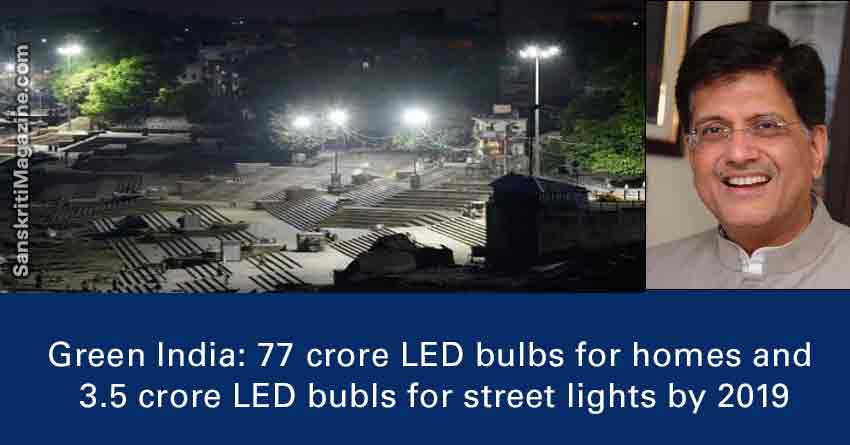
In what will reduce India’s energy consumption on the lighting side by as much as 112 billion units or 11,000 crore units by 2019., power minister Piyush Goyal is aiming to distribute 80 crore LED bulbs by 2019 —including 77 crore LED bulbs for home and 3.5 crore LEDs as street lights.
Indian households are rapidly adopting LED bulbs in a bid to make their homes energy efficient. According to Goyal efficient domestic lighting is one of the largest contributors to energy savings globally.
“Once we complete the LED programme by 2019, we would have distributed 770 million LED bulbs and reduced the energy consumption, only on the lighting side (Street and home lights), by 112 billion units or 11,000 crore units resulting in a savings of 40,000 crore for the consumers or about $6.5 billion in electricity bills of consumers,” Power and Coal Minister, Piyush Goyal said in an exclusive interview to the EnergyInfraPost.com
“Every person who switches to LED bulbs will help lighting up someone’s home through the energy savings.”
As on March 31, 2016, distribution of over 9 crore energy efficient LED bulbs across the nation has already been achieved. Alongside the savings in units, the country has also benefitted from daily CO2 emission reduction.
The programme of distribution of LED Bulbs is being done under the ministry’s scheme— UJALA (Unnat Jyoti by Affordable LEDs for all), with distribution of these LED bulbs is being carried out by Energy Efficiency Services Limited (EESL) that distributed 1 crore LED bulbs in 13 days
EESL has distributed over 9 crore LED bulbs across the nation with resulting in an estimated daily energy savings of 3.2 crore kWh. The average distribution during this period was about 8,00,000 LEDs per day.
The 9th crore bulb was distributed on the evening of March 31st 2016…in the presence of the power minister, Piyush Goyal.
The UJALA scheme is fully operational in Rajasthan, Maharashtra, Karnataka, Kerala, Uttar Pradesh, Himachal Pradesh, Delhi, Haryana, Bihar, Andhra Pradesh, Puducherry, Jharkhand, Chhattisgarh and Uttarakhand.
More states and union territories will be launching the national programme shortly, a statement said. The UJALA scheme-being implemented by EESL- has been widely accepted across rural and urban areas of the country.
“We are climbing new heights every day, the 9th crore is special for us because it reflects the commitment of the organisation, commitment of the government and the significant contribution of the consumers,” Goyal said.
“It is heart-warming to see scores of people come forward and participate in this scheme. I will urge more and more people to join the movement.”
The UJALA scheme – being implemented by Energy Efficiency Services Limited (EESL) – has been widely accepted across rural and urban areas of the country.
The primary reason for this mass adoption is the capability of LED bulbs to give consistent luminosity even in low voltage, where incandescent and CFL bulbs usually fail. Also, the LED bulbs distributed under the UJALA scheme is one third the market price and these superior quality bulbs also come with a three-year free replacement warranty.
Lighting sector accounts for about 20% of the total consumption in India. Currently, most of the lighting need in domestic and public lighting sector is met by inefficient, conventional, incandescent bulbs.
Ministry of Power under Piyush Goyal is committed to achieving its target of replacing all the 77 crore inefficient bulbs in India with LEDs.
This will result in reduction of 20,000 MW load, energy savings of 100 billion kWh and Green House Gas (GHG) reduction of 80 million tonnes every year. It is estimated that this is equivalent to establishment of roughly 5 large format thermal generation plants in the country. The country also stands to save Rs. 40,000 crore in electricity bills of consumers.