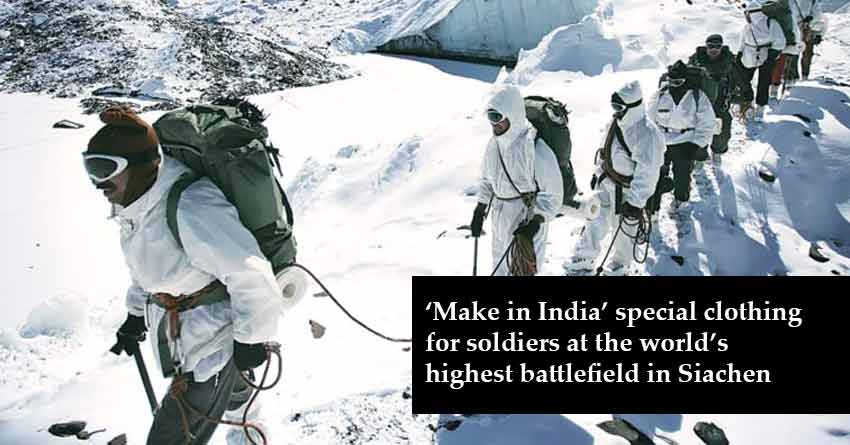
Army soldiers serving in the inhospitable, icy climates of Siachen glacier — the most dangerous battlefield in the world — could soon be using special jackets, trousers, boots, sleeping bags and other specialised extreme winter clothing items that are made in India. These clothes are designed to allow soldiers to operate in temperatures which go up to minus 55 degree Celsius. Since 1984, when India captured the Siachen glacier, the army has lost 869 soldiers in Siachen due to extreme climatic conditions and environmental factors.
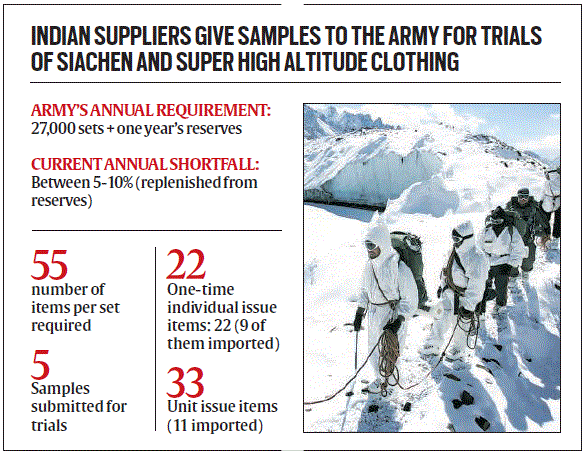
Indian suppliers have now, for the first time, given their samples to the army for trials in five items of Siachen and Super High Altitude clothing. Soldiers deployed beyond an altitude of 14,000 feet — in Siachen, Kargil, Drass, Arunachal Pradesh and Sikkim —are issued Siachen and Super High Altitude clothing which consists of 55 items.
Out of 55, 22 are one-time issue items, such as a down jacket or a sleeping bag, issued to an individual soldier and not recycled thereafter: nine of them are imported. The balance 33 items are unit issue items, such as special tents and ice axes: 11 of them are imported.
These imported items are mostly made in China, although they are supplied by around a dozen foreign firms from Switzerland, Italy, Australia, Canada, Singapore, Norway and UK.
The annual requirement of Siachen clothing for the army is around 27,000 sets. The army maintains a reserve for another year’s requirement. The average shortfall of items in Siachen clothing is between 5-10 per cent every year which is replenished from the reserves.
Besides ensuring that there is no depletion in reserve stock, once these items are produced under ‘Make in India’, the defence ministry is also concerned about other problems related to the import of Siachen clothing. The import process has a long gestation period and fluctuating foreign exchange rates further complicate it.
“The biggest issue for us is the China factor. Most of these items use bird feathers as a filling. Even though the items are certified for avian flu, we can never be sure about the Chinese products. Despite the quality check, we feel that we are still taking a chance of bringing infection to India,” a defence ministry official said.
As per defence ministry sources, the impetus to promote ‘Make in India’ in Siachen clothing came from a meeting last February with the Indian Technical textile Association (ITTA), the apex body representing technical textile manufacturers in the country. Army had displayed all the items of Siachen clothing at an exhibition-cum-seminar in Delhi and asked Indian manufacturers to bid for supplying the imported items.
“This first of its kind event was supported by the Ministry of Textiles and attended by Defence Forces, DRDO, DGQA and the domestic Industry. That interaction has now started showing results and the army is moving towards both product improvement and cutting down its import bill for textiles by working with Indian companies,” Sundaraman KS, vice-chairman of ITTA and executive director of Shiva Texyarn Ltd told The Indian Express.
Besides Shiva Texyarn, National Textile Corporation, Sara Sae, Key Tent and Sabre Safety Ltd are the other Indian companies who have deposited the samples of their items with the army. After the tenders are opened, these items will undergo 90 days of trials at Siachen in peak winters. The trial report shall be available to the defence ministry by April and based on technical evaluation and lab testing by DGQA, the suppliers will be finalised.
“Unlike earlier, we are not going for generic specifications, but going by user approved samples. For example, in the sleeping bag, we used to say 90 per cent down feather filling. Now we have changed it to ‘or any other suitable material’. At the end of this process, we will be able to fix new technical specifications for each item which will help Indian vendors indigenise these products,” an army official involved with the tender process explained.
(IE)