An exact value of the unit of length measurement, used in Ancient Indian Indus Valley Civilization, has been determined from the precise scale discovered by Ernest Mackay in the 1930-31 season excavation at Mohenjo-daro, and further correlated with the present day units of measurement.
The Precise Scale
In his 1930-31 season at Mohenjo-daro, Ernest Mackay discovered a broken piece of shell bearing 8 divisions of 6.7056mm each, with a dot and circle five graduations apart, which suggests a decimal system. However, attempts by Mackay, to relate such a unit to the dimensions in Mohenjo-daro, were not very successful and thus were abandoned.
Units of Length in Chanakya’s Arthashastra
Chanakya was the political mentor of the legendary Indian monarch Chandragupta Maurya of 4th century BC. He was a man learned in many disciplines and wrote the famous book Arthashastra. In Arthashastra, Chanakya mentions two types of Dhanushas as units for measuring lengths and distances. One is the ordinary Dhanusha, consisting of 96 Angulas, and the other Dhanusha is mentioned as Garhpatya Dhanusha and consists of 108 Angulas, used for measurement of roads and distances. Chanakya also mentions that a Dhanurgraha consists of 4 Angulas and a Yojana consists of 8000 Dhanushas.
Decoding the Mohenjo-daro Scale
If we keep 10 divisions of the Mohenjo-daro scale to be equal to a Dhanurgraha or 4 Angulas, the precise length of an Angula works out to be 16.764mm.
A Dhanusha of 96 Angulas = 96 x 16.764mm = 1.609344m
A Dhanusha of 108 Angulas = 108 x 16.764mm = 1.810512m
A Yojana = 8000 Dhanusha (of 108 Angulas each) = 8000 x 1.810512m = 14.484096km
14.484096km = 9 miles, (exactly!).
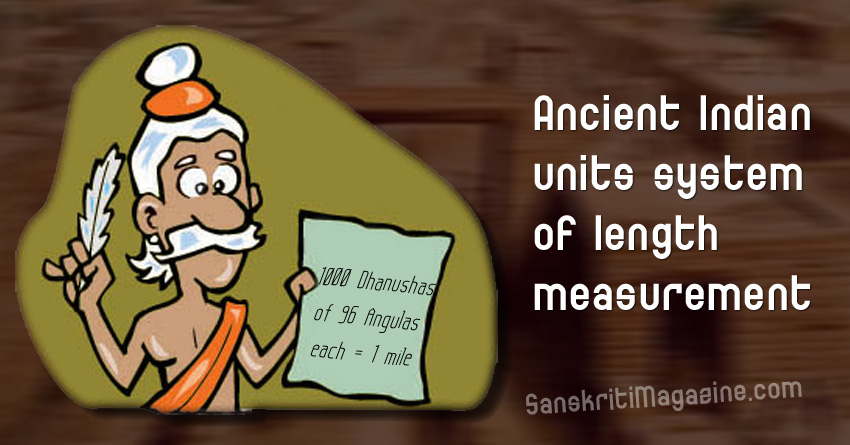
1000 Dhanushas of 96 Angulas each = 1 mile
Interestingly, when we look into the history of mile, we find that the word mile is derived from mille, which means a thousand.
The Indus Inch
The Indus civilisation unit of length, widely known as Indus Inch was 1.32 Inches which is exactly equal to 2 Angulas of 16.764mm each.
The Gudea’s Rule
The Gudea’s rule (2175 B.C.) preserved in the Louvre shows intervals in Sumerian Shusi of 0.66 inches, which is exactly equal to the Indus-Saraswati Angula of 16.764mm.
Temple Wall-Engravings
Two engravings on a wall of the temple at Tiruputtkali (12th Century A.D.) near Kanchipuram, show two scales one measuring 7.24 metres in length, with markings dividing the scale into 4 equal parts, and the second one measuring 5.69 metres in length and markings dividing the scale into 4 equal parts. It may be observed that each division of the first scale is precisely equal to a Dhanusha of 108 Angulas of 16.764mm each. Interestingly, the second scale is precisely equal to 71 times Dhanusha i.e. equal to the circumference of a circle with one Dhanusha as its Diameter.
It is interesting to note here that Mackay reports at Mohenjo-daro, a lane and a doorway having both a width of 1.42m, which is precisely equal to one division of the second scale at the Tiruputtkali Temple, indicating that both the scales were prevalent in Indus-Saraswati Civilization as well as in South India.
Correlation with Dimensions of Ancient Structures
Mohenjo-daro’s Great Bath
The height of the corbelled drain forming the outlet of Mohenjo-daro’s Great Bath is about 1.8m, which is equal to a Dhanusha of 108 Angulas of 16.764mm each.
Standard Street-Widths
Kalibangam, a city in the Indus-Saraswati Civilization (in Rajasthan, India) had street widths of 1.8m, 3.6m, 5.4m and 7.2m i.e. built to the standard dimensions being equal to 1 Dhanusha, 2 Dhanushas, 3 Dhanushas and 4 Dhanushas respectively. Such widths are found at other sites also. Bigger streets of Banawali another town in Indus-Saraswati Civilization (in Haryana, India) measure 5.4m i.e 3 Dhanushas.
Source Units of Length Measurement and Speed of Light in Ancient India by Dr M R Goyal