Dhyan- Blissful Meditative State:
Do you remember a time when you were totally absorbed in what you are doing? Hours may have passed yet it seemed like only a moment. Remember what a good feeling it was to be completely absorbed in those moments, how accurate your perception was, how clear your thinking was, and how alive you felt.
The simple example to illustrate Dhyan (meditation)
Principles of Meditation:
There is numerous methods of practicing meditation but select the one that fits your physical health, profession, nature and time available. Follow these principles whenever you meditate:
– Decorate your place of meditation with inspiring pictures of great saints, prophets, great teachers and your God.
– Wash your hands, legs and face before sitting in meditation.
– Early morning between 5 to 7 AM and in the evening between 6 to 8 PM is the best time to meditate.
The Different Types of Meditation:
a) OM Mantra Dhyan
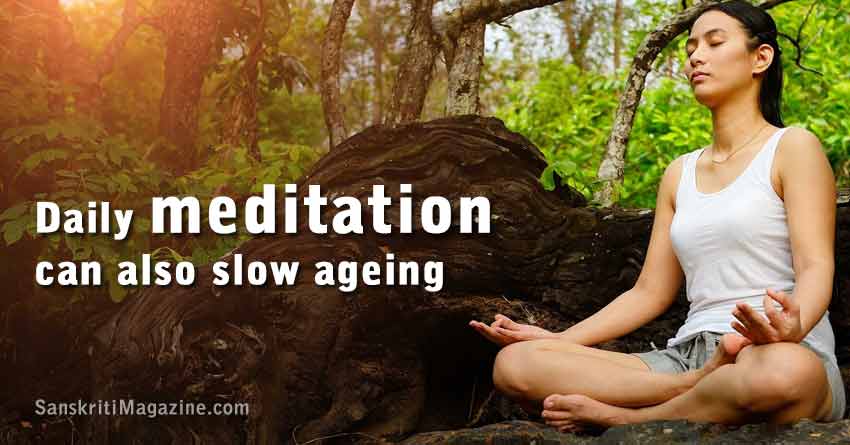
– Sit in a comfortable meditative pose with eyes gently closed.
– Keep your back straight and stretched up with the shoulders relaxed.
– Silently recite Om Mantra, focusing your mind on the rhythmic flow of mantra.
– Practice minimum for 10 minutes daily and slowly increase the time.
b) Jyoti Dhyan
– Sit in a comfortable meditative pose with eyes open.
– Keep a burning candle 4 feet from you with the level of your eyes.
– Initially watch the flame (Jyoti) without focusing too hard.
– After a while start gazing at the Jyoti as long as you can without blinking the eyes.
– After some time close the eyes and mentally watch the flame.
– Visualize the pattern and color of the Jyoti.
– Concentrate on flame for as long as your can hold your concentration.
– Do it daily minimum for 10 to 15 minutes.
Jyoti Dhyan is also one of the parts of “TRATAK SHATKARMA”.
c) Walking Dhyan
When you feel agitated or restless, walk minimum for 10 to 15 minutes down the corridor or at your work place or home or in the park. Try to harmonize your steps with your breathing. The repetitive and rhythmic motion of your legs and arms helps you to enter a meditative state which takes away the anxiety and anger.
d) Image Dhyan
– Place a picture of your God in front of you.
– Sit in a meditative posture concentrate gently on the picture till your eyes become watery.
– Keeping your head still, move your gaze on the various part of the picture like feet, legs, body and the crown of the head.
– Then close your eyes gently and visualize that picture.
– Repeat the same process as many times as you can.
e) Memory Dhyan
– Read two to three pages of a book.
– Then close the book and focus your mind on what you have read.
– Allow the mind to associate, classify, group, combine, and compare.
– If you attend to the subject on hand very carefully you will receive a clear impression.
– If the impression is strong you will have very good memory.
f) Dhyan on Thoughts
– Sit comfortably in any meditative posture.
– Keep your back upright neck and shoulder relaxed.
– Close your eyes gently.
– Concentrate on whatever thought comes to your mind.
– Let these thoughts come and go without trying to hold on to it and be judgemental.
– After some time thoughts will disappear and your mind will become completely quite and calm.
– To get better results starting with 15 to 20 minutes a day is good. Increase as per your comfort.
g). Naad Dhyan
– Sit in your favorite Asana.
– Gently close your eyes with your index and middle fingers and close the ears with your thumbs.
– Try to hear the Anahat sound (mystic sound).
– After practicing for two to three days you will hear various kind of sounds such as flute, thunder storm and humming of a bee etc.
– You will hear sounds in your right ear initially. Occasionally you may hear in your left ear also.
– Try to stick to the sound in one ear as this is an easy way to control the mind.
– Doing this repeatedly will lead to a state where you will not hear any sound.
h) Chakra Dhyan
This is an advance meditative practice in which the concentration is focused on the various energy centers or 7 chakras.
There are 7 chakras in human body and they are described corresponding to different endocrine gland.
(1) Mooladhara – Root Chakra
(2) Swadhisthan – Sacral
(3) Manipura – Solar Plexus Chakra
(4) Anahata – Heart Chakra
(5) Vishudha – Throat Chakra
(6) Ajna – Third Eye Chakra
(7) Sahasrara- Crown Chakra
– Hold your attention on each Chakra for as long as you pleased.
– Imagine you are breathing in and out from the chakras on which you are holding attention.
– Try this method of Dhyan for 10 to 15 minutes every day.
– Perception of these psychic centers will bring to development of the endocrine glands and corrects unbalanced psychosomatic and metabolic activities.
Benefits of Meditation:
1. Mental agitation and aggressiveness gets dissolved and helps develop reasoning abilities.
2. Improves mental poise and confidence and enhances your stress tolerance capacities.
3. Improves concentration level enhancing your ability to do tasks more efficiently and skillfully.
4. Helps control anger and improves your temperament.
5. Helps improve interpersonal and organizational skills.
6. Improves analytical and reviewing abilities.
7. Allows easy detachment from materialism and consumerism of modern life.
8. Makes us live in the present moment.
9. Provides preventive and herpetic problems in Cardiac problems, High B.P., Neck back pain,, ulcers, acidity etc.
10. Meditation larger benefits cover most of the diseases which are psychosomatic in nature.
~ By Yoga guru Suneel Singh