IndianSanskriti
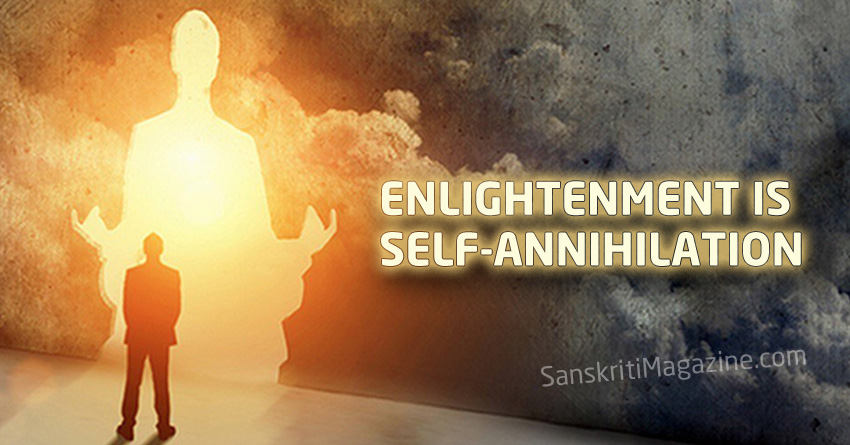
Enlightenment Is Self-Annihilation

Enlightenment Is Self-Annihilation

In India, enlightened beings have been referred to as dwijas, meaning “twice-born.” The first time, you were born out of your mother’s womb. It happened unconsciously; you did not make it happen, nature did it for you. When you were born, you came with a certain innocence and blissfulness, but since this did not happen consciously, anybody can corrupt it and take it away. For some people it was taken away by the time they were twelve, for many it happened even before they turned five. Children are becoming tense today because they lose their innocence so soon, depending upon the volume of influence that people have on them.

If you have to be born once again, you must die first. If you are not willing to die, the question of being reborn doesn’t arise. This does not mean dying physically. If you leave this body, some other nonsense will be waiting for you. But if you die the way you are, if you destroy everything that you called “myself,” then you are born once again. This kind of birth happens one hundred per cent consciously. Once again you become blissful and innocent, but fully aware. Now, this blissfulness cannot be taken away by anyone. So what you call ‘enlightenment’ means a conscious self-annihilation, which is completely different from seeking physical wellbeing.

Most people are not thinking of enlightenment. They want to live a little more peacefully, joyfully, efficiently and effectively. We can use Yoga for that also, but it is a poor way of making use of yoga because yoga is capable of delivering you to another dimension. The real benefit of yoga is that it changes the very fundamentals of who you are. It is an opportunity to recreate yourself the way you want. But right now, people are just trying to live a little better. It’s okay. Whatever people feel is missing in their life needs to be taken care of to some extent. Otherwise they will not seek anything higher. If you talk about enlightenment to someone who is hungry right now, it will not mean anything to him – he only thinks of food.

When we initiate people into Yoga kriya, it is transmitted in such a way that it gives a taste of another dimension, so that people will have the impetus to seek it. We don’t want to deny anyone enlightenment just because they don’t know it. At the same time, nothing forces itself upon you. You can use it anyway you wish. If someone were an ascetic and a “fulltime yogi,” he would be initiated in a completely different manner. Generally, the initiation is such that one can make use of it in many different ways.

So, if right now all someone wants is to be peaceful, happy, and do better in the activities they are doing – it is okay to have that. There is nothing wrong with it, but the longing for enlightenment has not come yet. Still, the basic longing is to live better.You want to live well. When you have lived enough and you know that living better is not going to get you anywhere, then you want to go beyond life.

For most people, it takes a certain amount of time and maturity to understand that whatever you make of yourself, however wonderful it is, in the end, it will never be enough. Only when who you are is no more, everything becomes wonderful.


~Sadhguru

You may also like

Search the website

Like us on Facebook

Get daily updates via Email

Enter your email address:

Recent Posts

Jamai Shashthi 2026 — The Story of Maa Shashthi, the Cat, and the Wife Who Was Forgiven

Jamai Shashthi 2026 — The Story of Maa Shashthi, the Cat, and the Wife Who Was Forgiven

On Saturday, June 20, 2026, Bengali households across Bharata will welcome their married daughters and sons-in-law home for the legendary jamai-aador feast and perform the Shashthi Vrata. But behind the warmth lies a story most Bengalis know by heart and most non-Bengalis have never heard — the wife who stole the hilsa, blamed the cat, lost six sons to Maa Shashthi’s wrath, and was finally forgiven. The Vrat Katha, the vidhi, the mantras, and the deeper teaching.

Vat Purnima 2026 — The Wife Who Argued Yama Into Returning Her Husband’s Life

On Monday, June 29, 2026, women across Maharashtra, Gujarat, and southern Bharata will tie red thread around banyan trees and hear the story of Savitri — the wife who walked behind Yamaraja Himself when He came for her husband, and out-argued the Lord of Dharma into returning Satyavan’s life. The Mahabharata’s Pativrata Mahatmya Parva, the vrat vidhi, and why the banyan witnessed everything.

Nija Jyeshtha 2026 — The Real Jyeshtha Begins, and the Calendar Resumes

Nija Jyeshtha 2026 — The Real Jyeshtha Begins, and the Calendar Resumes

With Adhik Maas now closed on the Somvati Amavasya of June 15, the long-postponed festivals of Jyeshtha return — Vat Purnima (June 29, the Savitri-Yamaraja katha), Jamai Shashthi (June 20, the Bengali festival of Maa Shashthi), Sankashti Chaturthi (June 28), Yogini Ekadashi (July 10), and Devshayani Ekadashi (July 16, opening the four-month Chaturmas of Bhagavan Vishnu’s yoga-nidra). A guide to what the next four weeks hold and what the household that kept Purushottam Maas now carries forward.

The Closing of Purushottam Maas 2026 — Adhik Amavasya and the Sealing of the Month-Long Vrat

On Monday, June 15, 2026 — a rare Somvati Amavasya — the intercalary month that bears Bhagavan Vishnu’s own name comes to its close. The Acharyas teach that a vrat is not measured by its duration but by its closing. Here are the Padma Purana’s instructions for sealing the month-long Purushottam Maas vrat: the morning snan, the closing puja with the Vishnu Sahasranama, the day of dana, the Somvati Amavasya gift, and the final sarva-arpana — the offering of all merit at the feet of the Lord.

Parama Ekadashi 2026 — The Other Rare Ekadashi of Purushottam Maas, and the Poor Brahmin Who Kept It

Two weeks ago, Vaishnavas across Bharata kept Padmini Ekadashi — the rare Shukla Paksha Ekadashi of Adhik Maas. Padmini has a twin. On Thursday, June 11, 2026, the Krishna Paksha Ekadashi of the same intercalary month appears: Parama — the Supreme Ekadashi. The Padma Purana names it the rarer and more secret of the two, and reserves it for those whose poverty or sorrow has refused to lift in spite of every other vrat already kept. The story of Sumedha and Pavitra of Kampilya, the rishi Kaundinya, the prince sent by Bhagavan Brahma — and the vidhi for the day.

css.php