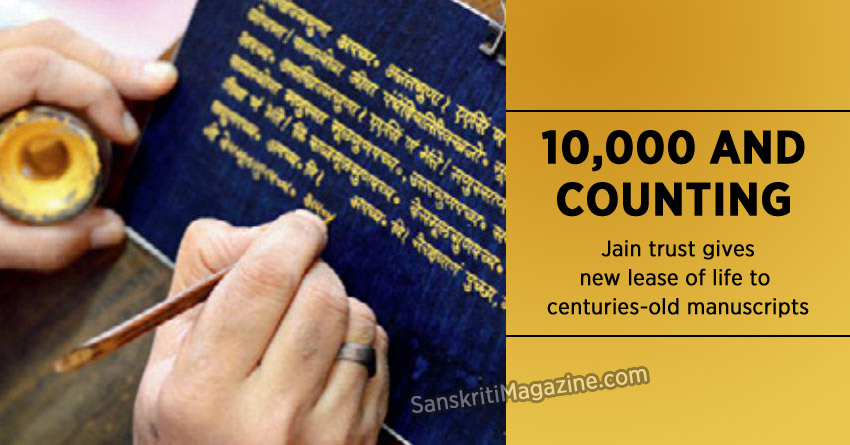
MUMBAI: Time travel comes easy in Kalbadevi. It’s down a bylane in Pathak Wadi and up three flights of rickety wooden stairs. There, inside a pocket-sized room, sit a dozen men in white kurta-pyjamas, hunched over sheets of jute paper. Carefully, with wooden quills and tiny pots of black or golden ink, they copy page after page of Jain shlokas from manuscripts dating back 3,000 years.
“Practice, practice, practice,” mutters Mohan Tanksali, when this reporter marvels at his handwriting. He sits back to proofread the page he has just completed. If there’s been an error, all he has to do is turn to his little pot of butterscotch correction fluid, which is the same shade as the handmade paper.
“All good,” Tanksali says, smiling. “Page number 190 is ready.” In another month, his handwritten copy of the 500-page manuscript will be complete. It will then be gently wrapped in cloth and moved to one of several cartons packed with such texts, piled in towering columns before him. From there, the manuscripts will make their way to derasars across the country, to be read by monks and pored over by research scholars.
The 500-sq-ft room in Kalbadevi has taken on a rather weighty responsibility. It is the head office of Shri Vardhaman Shrut Ganga, a trust that has been rewriting ancient Jain manuscripts since 2004. “The manuscripts are being remade to last for at least another 700 years,” said administrator Mahendra Ghelani. “Many Jain manuscripts had been destroyed in wars years ago or simply not preserved properly,” he added.
The ones that are left are crumbling and Shrut Ganga’s team is determined to rewrite as many as possible. So far, the trust has sourced about 15,500 manuscripts from across India, of which 10,000 have been rewritten at the Kalbadevi office and a branch in Girgaum. “The Jain dharma will last as long as the knowledge in these manuscripts does,” says Ghelani. “And we cannot photocopy them or use any kind of machine. They need to be written by hand.” The stress of the project is on ahimsa and the minimal use of non-renewable energy. The plan is for the texts to eventually be part of a huge library in Gujarat.
In accordance with Jainism’s tenet of non-violence, the transcribers use eco-friendly ink, wooden quill or baru and handmade paper. A Muslim family in Sanganer, near Jaipur, makes the paper from jute while the black ink comes from Visnagar in Gujarat. Each tome ranges from 100 to 1,000 pages-line after line of impeccably inked Sanskrit text in black or gold. The batches of golden ink are prepared on the premises, using varaq. These are saved for the most important texts, handled by the more experienced transcribers such as Tanksali. “Sonyachi asude kinva kaali asude…Vel lagto shikayla nakki (whether it’s gold ink or black ink, it definitely takes you a while to learn),” said Kailash Solkar, laughing. The commerce student is part of the writers’ team at Shrut Ganga’s Girgaum branch, and drops in after college every day. “I read a newspaper ad about this project and applied along with my friend Amol,” he said.
“They checked our handwriting and taught us how to use the traditional implements.” The part-time job is an additional source of income for his family, as it is for several other transcribers. For hearing and speech-impaired Ashwini Kumar, it is the only pay cheque. Neeraj Singh, administrator at the Girgaum office, recalls how Kumar had simply showed up with a packed lunch dabba after he came to know of a vacancy at Shrut Ganga. “It is a fairly complicated process and we weren’t sure how to explain it to him,” said Singh. “He actually learnt faster than the other writers and today, is among our best.”
The work is meticulous and long-winding. Writers at Shrut Ganga’s two offices usually spend about an hour working on a single page, which contains about ten lines of Sanskrit text. Margins are first drawn using ink prepared from crushed hinglo stones, and after the writing is complete, an agate stone is gently rubbed across the page, to help ‘laminate’ it. Each year, about 50,000 pages are rewritten, and readied to battle the elements for another few centuries. “After that, we hope future generations will take up the duty,” said Singh. “We have done our bit for the next 700 years,” said Singh, adding, “After that, we hope future generations will take up the duty,” Singh said.