IndianSanskriti
Murud-Janjira-Fort

Murud – Janjira Fort

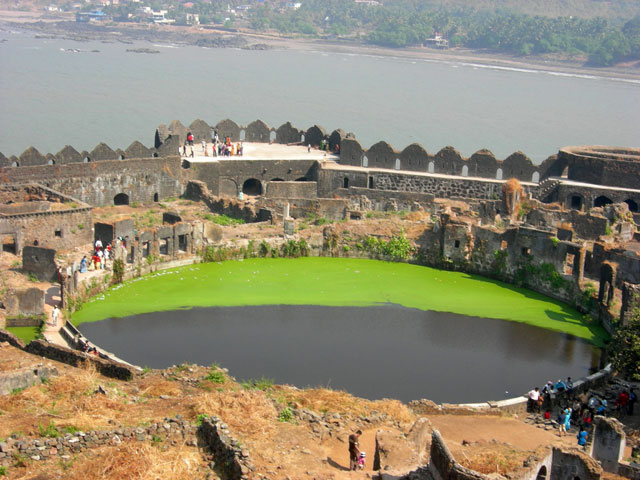
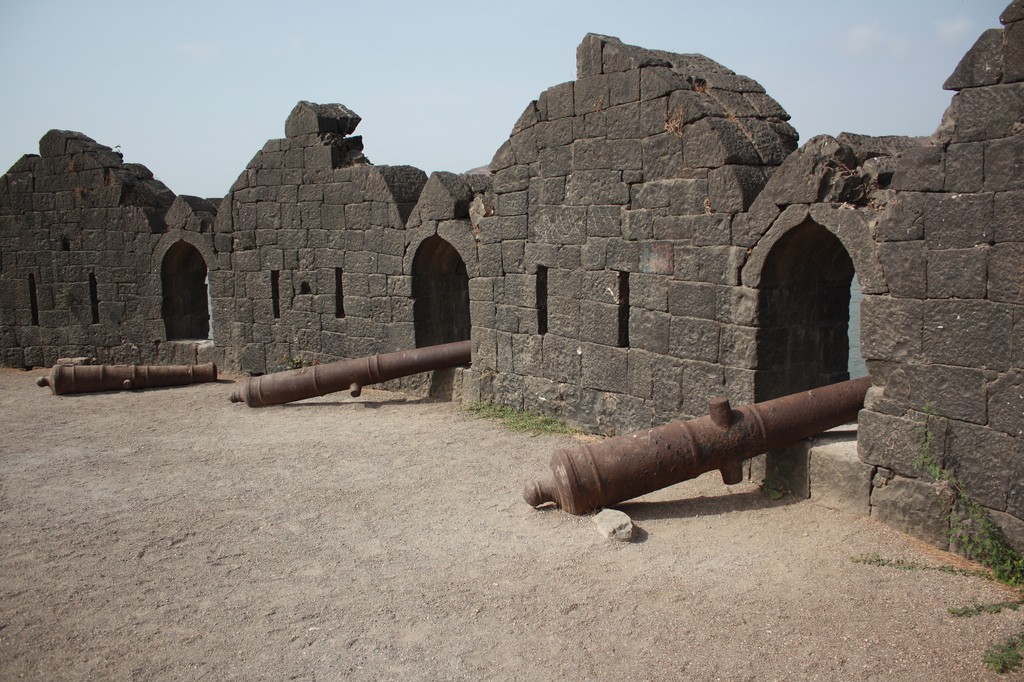
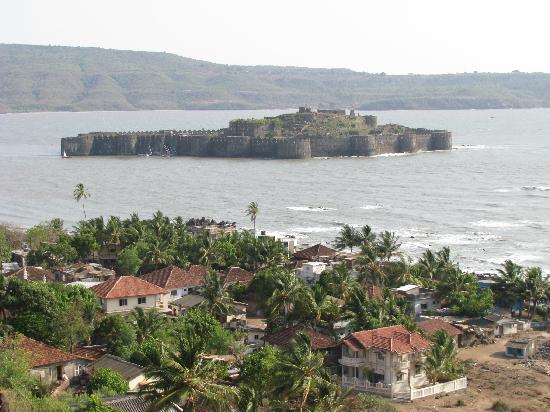
Situated on a rock of oval shape near the port town of Murud, 165kms south of Mumbai, Janjira is one of the strongest marine forts of India (the word ‘Janjira’ is a corruption of the Arabic word Jazira for island). The forts is approached by sailboats from Rajapuri jetty. The main gate of the fort faces Rajapuri on the shore and can be seen only when one is quite close to it. It has a small postern gate towards the open sea for escape. The fort has 19 rounded bastions, still intact. There are many canons of native and European make rusting on the bastions. Now in ruins, the fort in its heyday had all necessary facilities, e.g., palaces, quarters for officers, mosque, a big fresh water tank, etc. On the outer wall flanking the main gate, there is a sculpture depicting a tiger-like beast clasping elephants in its claws. This sculpture, its meaning difficult to interpret, appears on many fort-gates of Maharashtra.

Originally the fort was small wooden structure built by a Koli chief in the late 15th century. It was captured by Pir Khan, a general of Nizamshah of Ahmednagar. Later the fort was strengthened by Malik Ambar, the Abyssinian Siddi regent of Ahmednagar kings. From then onward Siddis became independent, owing allegiance to Adilshah and the Mughals as dictated by the times. Despite their repeated attempts, the Portuguese, the British and the Marathas failed to subdue the Siddi power. Shivaji’s all attempts to capture Janjira fort failed due to one reason or the other. When Sambhaji also failed, he built another island fort, known as Kansa or Padmadurg, just 9kms north of Janjira. The Janjira state came to an end after 1947. The palace of the Nawabs of Janjira at Murud is still in good shape.

murud-janjira-fort

janjira-fort-in-midst

Murud-Janjira

4662237007_29bc5775c6_b

You may also like

Search the website

Like us on Facebook

Get daily updates via Email

Enter your email address:

Recent Posts

Yogini Ekadashi 2026 — The Yaksha Who Missed the Morning Flowers, and the Ekadashi That Undid His Curse

On Friday, July 10, 2026, the rare Krishna Paksha Ekadashi of Nija Ashadha arrives. The Padma Purana tells the story of Hemamali — the Yaksha gardener of Bhagavan Kubera in Alaka, whose single morning of distraction with his wife Vishalakshi cost him his form, his wife, and his celestial city. Cursed to wander the earth of Bharata as a leper for a long time, he was at last shown the way back by Sage Markandeya — a single sincere keeping of Yogini Ekadashi.

Jamai Shashthi 2026 — The Story of Maa Shashthi, the Cat, and the Wife Who Was Forgiven

Jamai Shashthi 2026 — The Story of Maa Shashthi, the Cat, and the Wife Who Was Forgiven

On Saturday, June 20, 2026, Bengali households across Bharata will welcome their married daughters and sons-in-law home for the legendary jamai-aador feast and perform the Shashthi Vrata. But behind the warmth lies a story most Bengalis know by heart and most non-Bengalis have never heard — the wife who stole the hilsa, blamed the cat, lost six sons to Maa Shashthi’s wrath, and was finally forgiven. The Vrat Katha, the vidhi, the mantras, and the deeper teaching.

Vat Purnima 2026 — The Wife Who Argued Yama Into Returning Her Husband’s Life

On Monday, June 29, 2026, women across Maharashtra, Gujarat, and southern Bharata will tie red thread around banyan trees and hear the story of Savitri — the wife who walked behind Yamaraja Himself when He came for her husband, and out-argued the Lord of Dharma into returning Satyavan’s life. The Mahabharata’s Pativrata Mahatmya Parva, the vrat vidhi, and why the banyan witnessed everything.

Nija Jyeshtha 2026 — The Real Jyeshtha Begins, and the Calendar Resumes

Nija Jyeshtha 2026 — The Real Jyeshtha Begins, and the Calendar Resumes

With Adhik Maas now closed on the Somvati Amavasya of June 15, the long-postponed festivals of Jyeshtha return — Vat Purnima (June 29, the Savitri-Yamaraja katha), Jamai Shashthi (June 20, the Bengali festival of Maa Shashthi), Sankashti Chaturthi (June 28), Yogini Ekadashi (July 10), and Devshayani Ekadashi (July 16, opening the four-month Chaturmas of Bhagavan Vishnu’s yoga-nidra). A guide to what the next four weeks hold and what the household that kept Purushottam Maas now carries forward.

The Closing of Purushottam Maas 2026 — Adhik Amavasya and the Sealing of the Month-Long Vrat

On Monday, June 15, 2026 — a rare Somvati Amavasya — the intercalary month that bears Bhagavan Vishnu’s own name comes to its close. The Acharyas teach that a vrat is not measured by its duration but by its closing. Here are the Padma Purana’s instructions for sealing the month-long Purushottam Maas vrat: the morning snan, the closing puja with the Vishnu Sahasranama, the day of dana, the Somvati Amavasya gift, and the final sarva-arpana — the offering of all merit at the feet of the Lord.

css.php