IndianSanskriti
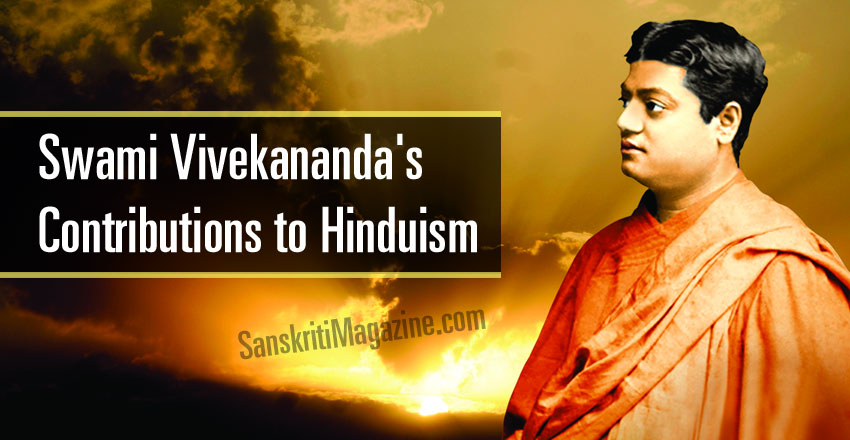
Swami Vivekananda's Contributions to Hinduism

Swami Vivekananda’s Contributions to Hinduism

IDENTITY

It was Swami Vivekananda who gave to Hinduism as a whole a clear-cut identity, a distinct profile. Before Swamiji came Hinduism was a loose confederation of many different sects. Swamiji was the first religious leader to speak about the common bases of Hinduism and the common ground of all sects. He was the first person, as guided by his Master Sri Ramakrishna, to accept all Hindu doctrines and the views of all Hindu philosophers and sects as different aspects of one total view of Reality and way of life known as Hinduism. Speaking about Swamiji’s role in giving Hinduism its distinct identity, Sister Nivedita wrote: “… it may be said that when he began to speak it was of ‘the religious ideas of the Hindus’, but when he ended, Hinduism had been created.”

UNIFICATION

Before Swamiji came, there was a lot of quarrel and competition among the various sects of Hinduism. Similarly, the protagonists of different systems and schools of philosophy were claiming their views to be the only true and valid ones. By applying Sri Ramakrishna’s doctrine of Harmony (Samanvaya) Swamiji brought about an overall unification of Hinduism on the basis of the principle of unity in diversity. Speaking about Swamiji’s role in this field K M Pannikar, the eminent historian and diplomat, wrote: “This new Shankaracharya may well be claimed to be a unifier of Hindu ideology.”

DEFENCE

Another important service rendered by Swamiji was to raise his voice in defence of Hinduism. In fact, this was one of the main types of work he did in the West. Christian missionary propaganda had given a wrong understanding of Hinduism and India in Western minds. Swamiji had to face a lot of opposition in his attempts to defend Hinduism.

MEETING THE CHALLENGES

At the end of the 19th century, India in general, and Hinduism in particular, faced grave challenges from Western materialistic life, the ideas of Western free society, and the proselytizing activities of Christians. Vivekananda met these challenges by integrating the best elements of Western culture in Hindu culture.

NEW IDEAL OF MONASTICISM 

A major contribution of Vivekananda to Hinduism is the rejuvenation and modernization of monasticism. In this new monastic ideal, followed in the Ramakrishna Order, the ancient principles of renunciation and God realization are combined with service to God in man (Shiva jnane jiva seva). Vivekananda elevated social service to the status of divine service.

REFURBISHING OF HINDU PHILOSOPHY AND RELIGIOUS DOCTRINES

Vivekananda did not merely interpret ancient Hindu scriptures and philosophical ideas in terms of modern thought. He also added several illuminating original concepts based on his own transcendental experiences and vision of the future. This, however, needs a detailed study of Hindu philosophy which cannot be attempted here.

~ BelurMath
You may also like

Search the website

Like us on Facebook

Get daily updates via Email

Enter your email address:

Recent Posts

Yogini Ekadashi 2026 — The Yaksha Who Missed the Morning Flowers, and the Ekadashi That Undid His Curse

On Friday, July 10, 2026, the rare Krishna Paksha Ekadashi of Nija Ashadha arrives. The Padma Purana tells the story of Hemamali — the Yaksha gardener of Bhagavan Kubera in Alaka, whose single morning of distraction with his wife Vishalakshi cost him his form, his wife, and his celestial city. Cursed to wander the earth of Bharata as a leper for a long time, he was at last shown the way back by Sage Markandeya — a single sincere keeping of Yogini Ekadashi.

Jamai Shashthi 2026 — The Story of Maa Shashthi, the Cat, and the Wife Who Was Forgiven

Jamai Shashthi 2026 — The Story of Maa Shashthi, the Cat, and the Wife Who Was Forgiven

On Saturday, June 20, 2026, Bengali households across Bharata will welcome their married daughters and sons-in-law home for the legendary jamai-aador feast and perform the Shashthi Vrata. But behind the warmth lies a story most Bengalis know by heart and most non-Bengalis have never heard — the wife who stole the hilsa, blamed the cat, lost six sons to Maa Shashthi’s wrath, and was finally forgiven. The Vrat Katha, the vidhi, the mantras, and the deeper teaching.

Vat Purnima 2026 — The Wife Who Argued Yama Into Returning Her Husband’s Life

On Monday, June 29, 2026, women across Maharashtra, Gujarat, and southern Bharata will tie red thread around banyan trees and hear the story of Savitri — the wife who walked behind Yamaraja Himself when He came for her husband, and out-argued the Lord of Dharma into returning Satyavan’s life. The Mahabharata’s Pativrata Mahatmya Parva, the vrat vidhi, and why the banyan witnessed everything.

Nija Jyeshtha 2026 — The Real Jyeshtha Begins, and the Calendar Resumes

Nija Jyeshtha 2026 — The Real Jyeshtha Begins, and the Calendar Resumes

With Adhik Maas now closed on the Somvati Amavasya of June 15, the long-postponed festivals of Jyeshtha return — Vat Purnima (June 29, the Savitri-Yamaraja katha), Jamai Shashthi (June 20, the Bengali festival of Maa Shashthi), Sankashti Chaturthi (June 28), Yogini Ekadashi (July 10), and Devshayani Ekadashi (July 16, opening the four-month Chaturmas of Bhagavan Vishnu’s yoga-nidra). A guide to what the next four weeks hold and what the household that kept Purushottam Maas now carries forward.

The Closing of Purushottam Maas 2026 — Adhik Amavasya and the Sealing of the Month-Long Vrat

On Monday, June 15, 2026 — a rare Somvati Amavasya — the intercalary month that bears Bhagavan Vishnu’s own name comes to its close. The Acharyas teach that a vrat is not measured by its duration but by its closing. Here are the Padma Purana’s instructions for sealing the month-long Purushottam Maas vrat: the morning snan, the closing puja with the Vishnu Sahasranama, the day of dana, the Somvati Amavasya gift, and the final sarva-arpana — the offering of all merit at the feet of the Lord.

css.php