The Need for Silence:
In the rush of activities and noise that have become a part of modern living, we often forget the calming effect of quiet time. We think it is alright if we are full of action and speed and postpone the soul’s hunger for peace and silence. We fail to realize the need to spend a few quiet moments daily, in our own company.
Sitting quietly is a powerful technique for self-improvement. It has great importance in learning process, especially in imbibing higher values of life. silence gives rise to deeper thoughts and knowledge. Sages and saints, seers and seekers, in all age and places, have sat in deep silence in order to search profound truths of life. In the depth of that silence the light of knowledge dawned on them.
It is rightly said, ‘Voice of God can be heard in the ocean of silence.’
Exercise in Quietness
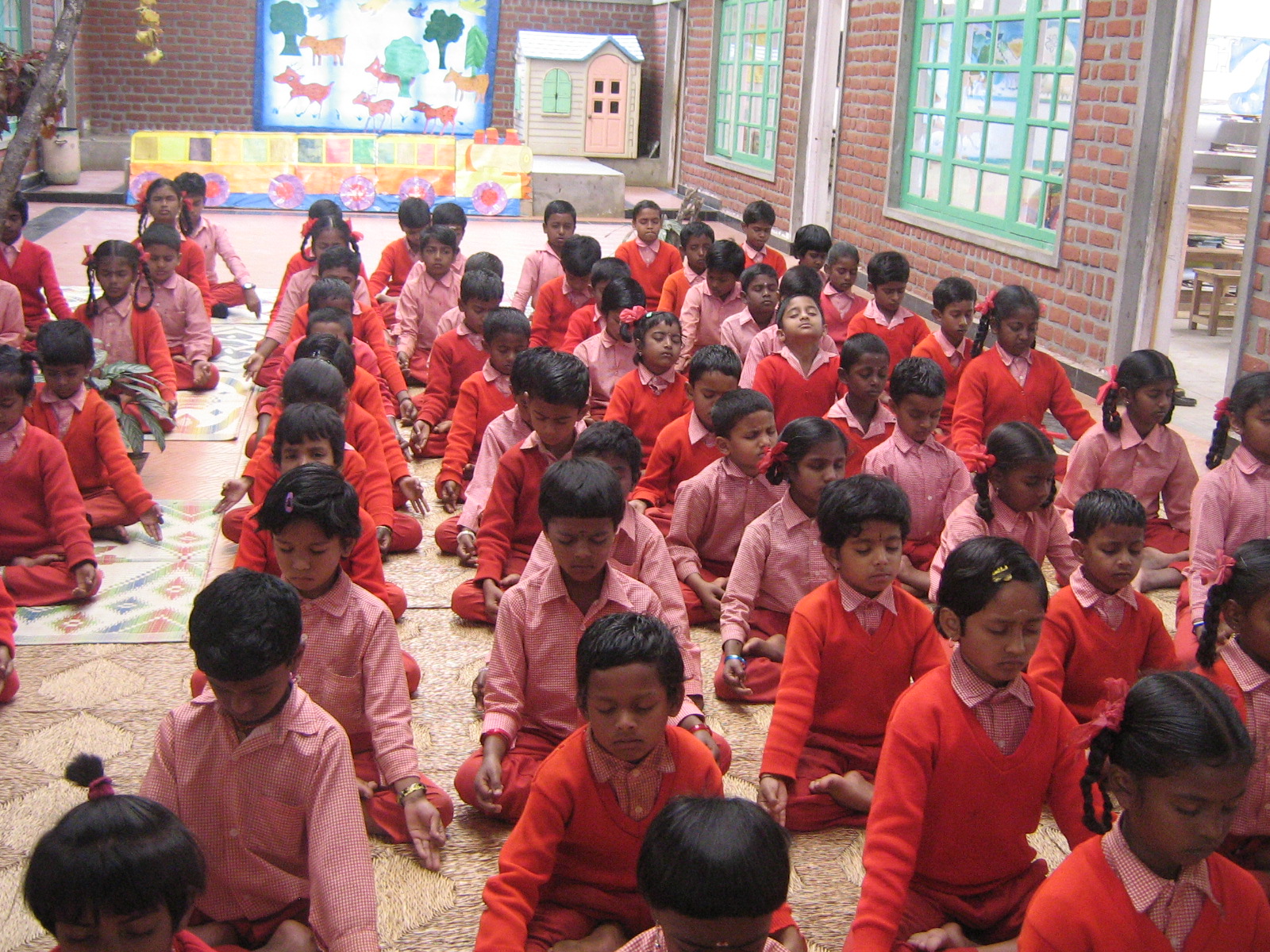 Although sitting silent is a challenge before all, it is especially a daunting task for students or young people. By nature they are full of energy and activity. With their growth graph at its peak, their minds joins with the outgoing mind and the result is what we see around us. Even when they are forced to remain silent, it is only the silence of closed lips while their minds go on chattering and jumping from one thought to another like a mad monkey. This is because the nature of mind is itself as mentioned in the Gita (6.34-35).
But another reason for this restlessness is that they are not made aware of the wonderful effect of silence. Most young students do not know how silence can be a source of greater concentration and happiness. We wish to present here a technique in visualization as a step to true silence. This will give the young minds an opportunity to taste the sweetness of silence. Here is how one can practice it:
This can be practiced in a classroom or home and is of special importance in urban situations where students hardly get a chance to be in touch with nature. Surrounded by traffic and noise, traveling through busy roads and lanes, students often miss the healing touch of silence and of nature.
Teacher/Parent: Welcome to the quiet time. Having been in an atmosphere of sound and activity, and of many study assignments, you now need to rest the body and mind. You need relaxation. Let us try to unwind and relax. Let us take a mental trip to a place of natural beauty and calmness. Please sit relaxed with eyes closed and listen to what I say and follow my footsteps to wherever I take you mentally. Now please close your eyes.
The teacher should speak clearly and slowly. He should be sincere and earnest and not do it as a matter of routine.
Let us mentally leave all things and start our trip. We are going out of classroom. Maybe we will go to a green hillside. It is all green and beautiful. There are a number of wild flowers, a variety of flowers. There are roses too. Let us go and touch them. The whole place is full of natural beauty. How beautiful! Let us sit amidst them. For a long time. Pay no attention to whatever sounds or thoughts that may knock at your mind’s door. Feel the presence of divinity in nature. Feel the bracing wind, the sound of birds, rustling of leaves and so on. Sit quietly without movement.
Now, having been in that healing touch of the nature, slowly trace your steps back to where we are and slowly open your eyes.
One can similarly take the children to seaside, or riverfront or waterfalls, or any place of quietness and natural beauty and ask the students to feel being there. One can use one’s creativity to add newer dimensions to it. It is truly inner ride to joy!
The quiet time may also be a trip to a place of holiness and worship. One can go the sacred Ganges in Himalayas. Or one can go to the banks of Narmada or any such place of holiness.
One can also think of a form of God one likes. The teacher can ask the students to feel the presence of Divine in their hearts. The formless Divine may take the form of a god or goddess or a sage and one can think of that. Or one can tell the children to visualize the flame of a burning lamp or candle and concentrate on it.
One may instruct the students thus:
Let us enter the inner sanctuary and see the burning flame there. Being present in the light of flame, one’s inner being is now full of light. All darkness has gone. All senses are full of light. Our eyes and ear divinised, one see divinity everywhere. Let us feel the presence of inner light and spread this light everywhere. It is bringing goodness and peace and joy wherever – within me, in my home, colony, state, country, whole world.
The practice
This kind of quiet time, or a light form of meditation, may be made a part of daily teaching sessions. The students may be encouraged to practice it in their houses as well. At home, one gets up early in the morning, even before leaving the bed they should sit silently on bed and thank God for last night’s peaceful slumber. Then they can think of the important or main activities of the day, followed by a prayer to God that the day’s activities are done well while God is there to guard and guide us at every step. Again in the night before sleeping one can sit on the bed and do a kind of self-audit of the activities one has done in a day. If everything has gone well, if any good work has been done, let us thank God for it. If there is anything wrong, beg apology and promise not to repeat it in future.
Needless to say, quiet time has many benefits. It increases concentration, sharpens intelligence improves mental alertness, self-confidence, inner equilibrium and makes one peaceful. Let us be quiet to know the joy of quietness!
~ Subhashish Chatterjee (The author is a staff member of Ramakrishna Mission Boys Home College, Rahara, West Bengal.)