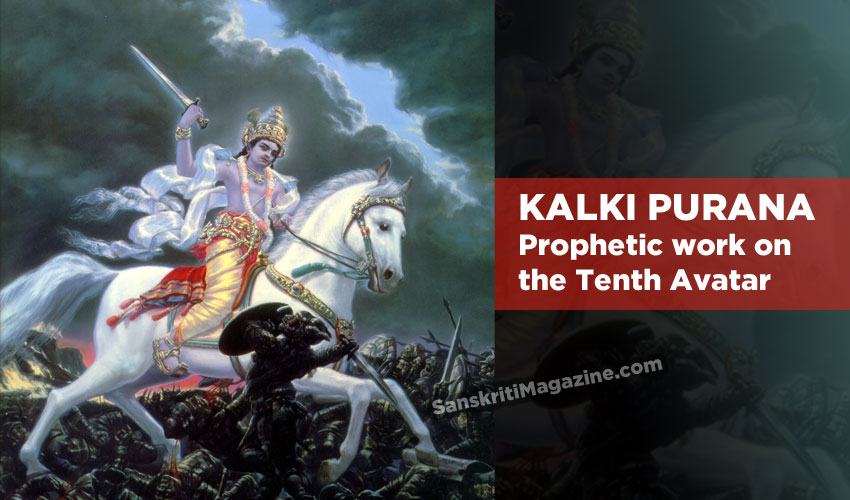
The Kalki Purana is a prophetic work in Sanskrit that details the life and times of Lord Kalki, the tenth and last of the Dasavatar, or ten primary Visnu avatars. Classified as one of the Upapurana, or ‘Lesser Puranas’, Kalki Purana is comprised of passages taken directly from the Vishnu Purana and the Bhagavata Purana ascribed to Srila Vyasadeva. The narrative is set in the distant 4,320th century, near the end of Kali Yuga, as revealed in advance by Sri Suta Goswami.
The extant text comprises three aṃśas (sections) consisting 7, 7 and 21 chapters respectively. The text is believed to have existed prior to the 16th Century, as parts of it were referenced in Avadhi, an ancient language spoken chiefly in the Awadh (Oudh) region of Uttar Pradesh and Nepal.
As a prophetic work, the Kalki Purana provides details about events that are predicted to occur in the future. The work primarily describes the onset and exponential increase of sinfulness and the demoniac element on the earth planet during the Kali-yuga, and the appearance, pastimes and disappearance of Kalki-avatar, Who will manifest to bring an end to the darkness of Kali Yuga, destroying the demoniac and heralding the start of Satya-yuga.
Chronologically, Krsna-Balarama is the eighth manifestation of Dasavatar, appearing in the Dvapara-yuga. (In order, the Dasavatar are: Varaha, Matsya, Kurma, Nrsimha, Vamana, Parasuram, Rama, Balarama, Buddha, and Kalki.)
According to Kalki Purana, the Gandharva demon Kali (not to be confused with the Goddess Kali) will rule the earth and bring sin and misery to the people. When the first stage of the Kali-yuga begins, the varnasrama system will deteriorate. The second, third, and fourth stages of Kali-yuga follow, bringing the progressive deterioration of society.
During the second and third stages, men will forget the name of God and will no longer offer yagna to the Devas. During the fourth stage, cannibalism will be virtually universal among the humans. To solve this problem the pious Devas will gather before Brahma for a solution. Near the end of this yuga, the Devas will then journey to Vaikunta to seek help from Lord Vishnu. Lord Vishnu will descend to Earth as Lord Kalki to end the Kali-yuga.
One of the main reasons Lord Vishnu would come to earth as Kalki is to destroy and defeat evil forces on earth. He would begin this with the battle, and eventual massacre, of the Sunyavadis, who have misled the people, at the city of Keekatpur. A war would later begin with the dark forces of Kali, including the demon generals Koka and Vikoka fighting against Kalki and the Devas. Koka and Vikoka would then be killed by Kalki. Thus, Kali will be defeated at the hands of Dharma, the personification of the Satya Yuga which is evil’s polar opposite. Finally, Kalki will be challenged by, and intentionally accept defeat from, Raja Shashidhwaja,[4] and marry the Raja’s daughter, his second wife Rama, before the start of the Satya Yuga.
At the start of Satya-yuga, the Golden Age, Lord Kalki will divide the planet into earthly kingdoms among his generals, then perform the Ashwamedha and Rajasuya sacrifices for the Devas. His parents, Sumati and Vishnuyasha will then travel to the holy place of Badrikashram, where they will live until their death. After fathering His sons, Meghamaal and Balahaka, Lord Kalki will reign on earth for 1,000 years as the king of Shambhala. Concluding His mission of restoring peace, Kalki will appear in His four-armed form, then return to Vaikuntha.
The appearance, pastimes and disappearance of Kalki Avatara are described in the following chapters of Kalki Purana:
- A Description of Kali-Yuga
- The Birth and Sacred Thread Ceremony of Lord Kalki
- Lord Kalki Receives Benedictions From Lord Siva and Parvati
- Padmavati Receives a Benediction From Lord Siva
- Padmavati’s Svayamvara
- The Procedure for Worshiping Lord Visnu
- The Meeting of Lord Kalki and Padmavati
- The Story of Ananata and How He was Influenced by Maya
- Lord Kalki Conquers the Buddhists Who Opposed Him
- The Killing of the Raksasi, Kuthodari
- Lord Kalki Goes Out to Conquer Kali and His Allies
- The Devotion of Sasidhvaja And His Previous History
- The Glories of the Devotees of Lord Hari
- The Vow of Rukmini
- Lord Kalki Enjoys Pastimes With His Consorts
- Prayers Offered to Mother Ganga
- The Glories of Hearing Sri Kalki Purana
The Kalki Purana, compiled by Srila Vyasadeva, was translated to English by Bhumipati dasa. The xcerpts below are followed by the complete text:
“In the second quarter of Kali yuga, people will no longer chant the holy names of Lord Krsna. In the third quarter of Kali-yuga, there will be an upsurge of unwanted population, and in the final quarter of Kali-yuga there will be only one class of human being, because God consciousness will have been long forgotten. (1.38)
Suta Goswami said Thereafter, by the order of Lord Brahma, all the demigods sat in front of him and then explained how the observance of religious principles was declining at an alarming rate in Kali yuga. (2.1)
After hearing their words saturated with anguish, Lord Brahma said Let us all approach Lord Visnu. We should please him with our prayers so that He may act for our welfare. (2.2)
After saying this, Lord Brahma took all the demigods an went to the abode of Lord Hari known as Goloka. There, he offered prayers to the Supreme Lord, informing Him of the plight of the demigods. (2.3)
After hearing everything in detail, lotus eyed Lord Hari said O Brahma, rest assured that I will soon descend to the earth and appear in the village known as Sambhala. I will take birth in the house of a brahmana named Visnuyasa, from the womb of his wife, Sumati. (2.4)
My million will be to eliminate the wicked Kali, with the help of My four brothers. O demigods, your expansions should also take birth on the earth to assist Me in My mission. (2.5)
My consort, the beloved lotus eyed Kamala devi, will also appear on the earth, having the name Padma. She will be born from the womb of Kaumadi, the wife of Brhadratha, the king of Simhala. (2.6)
O demigods, you should not delay. By your plenary portions, take birth on the earth. Later on, I will entrust the responsibility for ruling the earth to two powerful kings named Maru and Devapi. (2.7)
I will then again establish Satya-yuga, and thus reinstante the principles of religion as they were before. Rest assured that I will return to Vaikuntha only after destroying the poisonous snake, Kali.” (2.8)