We live most of our life through three states of consciousness: waking, dreaming and sleeping.
In the waking state of consciousness, we experience the world through the five senses. We seek elevation and joy from these senses. If any one of the senses is missing, the entire dimension of that sense is lost. One who cannot hear is bereft of the whole arena of sound. Similarly, he who cannot see is deprived of all the beautiful sights and colors. So, the sense is more important and much bigger than the object of the sense.
The mind is higher than the senses. The mind is infinite, its desires are many, but the capacity of the senses to enjoy is limited. Greed is wanting more and more of sensory objects. Even though one can only enjoy a limited amount during a lifetime, one wants all the wealth in the world.
Giving too much importance to sensory objects leads to greed; giving too much importance to the senses leads to lust; and giving too much importance to the mind and its desires leads to delusion.
We hold on to the concepts of the mind and want things to happen in a certain way. Thus, the concepts in our mind impede us from perceiving the infinite consciousness that is a part of us. This is not to say that the senses or the mind are bad. But we must learn to discriminate between things and be aware of what is happening at all times; that is when clarity dawns on us. This is the first step toward the higher state of consciousness.
In the waking state, one is constantly engaged in looking, eating, working, etc. The other extreme is the sleeping state where one is completely cut off and dull. The dullness and heaviness linger even after waking. The more one sleeps, the duller one feels since a lot of energy is expended in sleep. Then there is the dreaming state where one is neither asleep nor awake. Here, you neither feel at rest nor are aware of your surroundings.
Meditation
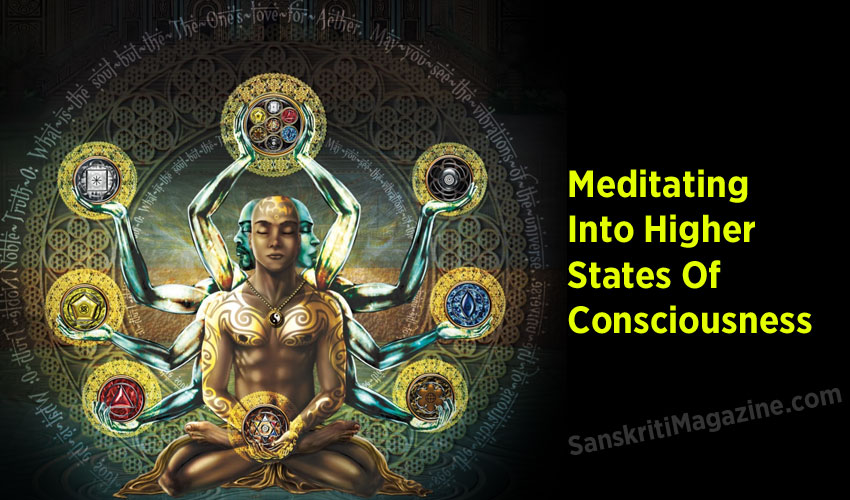
The higher state of consciousness is somewhere in between the waking, sleeping and dreaming states. Here, we know we “are” but we don’t know “where” we are. This knowledge that I “am,” but I don’t know “where” I am or “what” I am, is called Shiva. This state gives the deepest possible rest that one can experience. And one can achieve this through meditation.
Meditation helps in two ways — it prevents stress from entering the system and simultaneously releases accumulated stress. With the assimilation of meditation into daily life, a higher state of consciousness called cosmic consciousness dawns within us. Cosmic consciousness perceives the whole universe as part of oneself. When we perceive the world as a part of us, love flows strongly between the world and us. This love empowers us to overcome the opposing forces and the disturbances in life. Anger and disappointments become fleeting emotions that occur momentarily and then vanish.
A higher state of consciousness will not simply happen one fine morning. The sapling of consciousness is within you — it needs to be nurtured through spiritual practices like meditation. Some coconut trees yield in three years, and some in 10 years. And those that are not nurtured never yield, they simply exist.
Attaining higher states of consciousness does not require any complicated strategy; one just needs to learn the art of letting go. The confluence of knowledge, understanding and practice makes life complete. When you grow into higher states of consciousness, you find that you are no longer thrown off-balance by different situations and disturbances. You become strong yet soft — a delicate and beautiful individual capable of accommodating different values in life without any conditions. As your consciousness opens and the whole system gets physically, mentally and spiritually elevated, your life truly becomes worth living.
~ Sri Sri Ravi Shankar