
IndianSanskriti
Buddha's discourse on the end of the world

Buddha’s discourse on the end of the world

Many religions predict the end of the world. According to Hinduism, at the end of each cycle of creation. which spans billions of years, Brahman in his aspect as Rudra will destroy the worlds and withdraws them into himself. According to Christianity the world will come to an end through a series of cataclysmic events followed by resurrection of departed souls and judgment day.

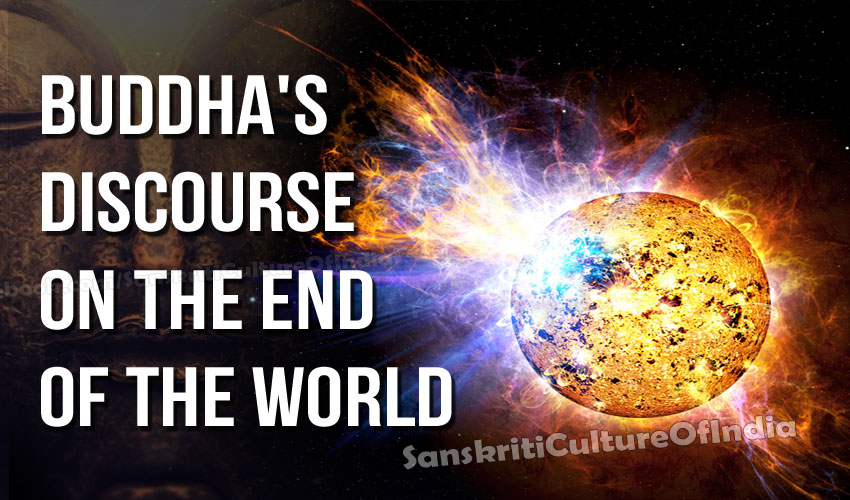
According to Vedic tradition, Aditi is mother of eight Adityas or solar deities (suns). At the end of creation these eight suns will shine together in the skies. In the following sermon, the Buddha speaks of how seven suns will appear in the sky and how the planet earth will eventually be destroyed, after many hundreds and thousands of years, through a series of cataclysmic events which are described below.

  • The earth will suffer from a severe drought due to lack of rains. All vegetation and life forms will disappear and vanish from the planet.
  • A second sun will appear in the horizon, resulting in the evaporation of many streams and ponds.
  • A third sun will appear resulting in the evaporation of many great rivers like the Ganges.
  • After a long lapse of time, a fourth sun will appear in the sky resulting in the evaporation of great lakes.
  • After another long lapse of time, a fifth sun will appear and the oceans will dry up slowly till they will become a finger deep.
  • After another long lapse of time, a sixth sun will appear. The earth crust and core will heat up to intense temperatures resulting in many volcanic explosions, scorched earth and smoke filled skies.
  • After another vast interval, a seventh sun will appear. The earth will become a fiery ball of flame and expand. Its flames will spread far and wide. Finally it will explode and disappear altogether.

The manner in which the Buddha predicted the end of the earth sounds very much like a modern scientific theory on the destruction of planets and the entire solar system. The Buddha also clearly mentions that all life forms will vanish before the appearance of the second sun. Thereafter the earth will be a dead planet ready for its eventual destruction.

The seven suns mentioned in the discourse probably are various planets of the solar system that would become hot and shine like stars due to some changes in the activity of the sun or its gravitational force.

The manner in which the drying up of the planet earth is described reminds one of the greenhouse effect and the events that might have happened on planets like Mars which had once oceans and rivers and probably life forms.

The Buddha delivered this sermon to remind his disciples of the impermanent nature of the world and of our existence, which is subject to decay and renewal and from which even a god like Brahma is not free unless he overcomes it by practicing Dhamma and following the eight-fold path.
You may also like

Search the website

Like us on Facebook

Get daily updates via Email

Enter your email address:

Recent Posts

Yogini Ekadashi 2026 — The Yaksha Who Missed the Morning Flowers, and the Ekadashi That Undid His Curse

On Friday, July 10, 2026, the rare Krishna Paksha Ekadashi of Nija Ashadha arrives. The Padma Purana tells the story of Hemamali — the Yaksha gardener of Bhagavan Kubera in Alaka, whose single morning of distraction with his wife Vishalakshi cost him his form, his wife, and his celestial city. Cursed to wander the earth of Bharata as a leper for a long time, he was at last shown the way back by Sage Markandeya — a single sincere keeping of Yogini Ekadashi.

Jamai Shashthi 2026 — The Story of Maa Shashthi, the Cat, and the Wife Who Was Forgiven

Jamai Shashthi 2026 — The Story of Maa Shashthi, the Cat, and the Wife Who Was Forgiven

On Saturday, June 20, 2026, Bengali households across Bharata will welcome their married daughters and sons-in-law home for the legendary jamai-aador feast and perform the Shashthi Vrata. But behind the warmth lies a story most Bengalis know by heart and most non-Bengalis have never heard — the wife who stole the hilsa, blamed the cat, lost six sons to Maa Shashthi’s wrath, and was finally forgiven. The Vrat Katha, the vidhi, the mantras, and the deeper teaching.

Vat Purnima 2026 — The Wife Who Argued Yama Into Returning Her Husband’s Life

On Monday, June 29, 2026, women across Maharashtra, Gujarat, and southern Bharata will tie red thread around banyan trees and hear the story of Savitri — the wife who walked behind Yamaraja Himself when He came for her husband, and out-argued the Lord of Dharma into returning Satyavan’s life. The Mahabharata’s Pativrata Mahatmya Parva, the vrat vidhi, and why the banyan witnessed everything.

Nija Jyeshtha 2026 — The Real Jyeshtha Begins, and the Calendar Resumes

Nija Jyeshtha 2026 — The Real Jyeshtha Begins, and the Calendar Resumes

With Adhik Maas now closed on the Somvati Amavasya of June 15, the long-postponed festivals of Jyeshtha return — Vat Purnima (June 29, the Savitri-Yamaraja katha), Jamai Shashthi (June 20, the Bengali festival of Maa Shashthi), Sankashti Chaturthi (June 28), Yogini Ekadashi (July 10), and Devshayani Ekadashi (July 16, opening the four-month Chaturmas of Bhagavan Vishnu’s yoga-nidra). A guide to what the next four weeks hold and what the household that kept Purushottam Maas now carries forward.

The Closing of Purushottam Maas 2026 — Adhik Amavasya and the Sealing of the Month-Long Vrat

On Monday, June 15, 2026 — a rare Somvati Amavasya — the intercalary month that bears Bhagavan Vishnu’s own name comes to its close. The Acharyas teach that a vrat is not measured by its duration but by its closing. Here are the Padma Purana’s instructions for sealing the month-long Purushottam Maas vrat: the morning snan, the closing puja with the Vishnu Sahasranama, the day of dana, the Somvati Amavasya gift, and the final sarva-arpana — the offering of all merit at the feet of the Lord.

css.php





