With the evolution of civilization and advancement of technology, life has become more unpredictable and prone to stress. The current economic crisis is one of the biggest causes of worry for people, even in the most advanced countries. The World Health Organization predicts that stress will be the number one killer in the world by the year 2020. This prediction itself is reason enough to be distressed.
So, it is high time that we turn to ancient Indian wisdom to learn how to de-stress ourselves and lead a happy life. But before we move on to talking about a working solution for stress, let us analyze it at its fundamental level.
Analyzing Stress
Mind is the fountainhead of desires and emotions. It seems it cannot survive without them. Desires appear in the mind incessantly, like the waves in an ocean. Even while dreaming, we have desires. When a desire is fulfilled, we feel a sense of satisfaction, albeit, temporary. Soon we start dreaming again—this time for yet another desire.
Stress can begin when we foresee a sense of failure. An uneasy feeling develops in the mind. Feelings of dread and apprehension about the future, with or without any specific cause, disturb our mind. It becomes stressed, because it perceives some strong obstacles in the achievement of its goals. Although stress originates in the mind, it spreads its influence all over the body. Clinical studies have shown that stress is the root cause of more diseases than was previously thought.
When a person perceives danger, a chain reaction of signals within the body releases hormones, such as epinephrine (adrenaline), norepinephrine and cortisol from the adrenal glands. This enables the person to engage in either fighting back or fleeing. Consequently, it raises the heart rate, increases respiration and causes the glucose levels in the blood to shoot up. As these responses take in a lot of energy, cortisol orders other physical processes including digestion, reproduction, physical growth and some aspects of the immune system to slow or shut down.
Once the threat passes, the body’s stress thermostat adjusts accordingly. Cortisol levels return to normal, and the body resumes its usual functions. The problem occurs when stress is not released or the mind still perceives threat, even when it is not really there. This causes prolonged exposure to cortisol, which inhibits the growth of new neurons and can cause increased growth of the amygdala, the portion of the brain that controls fear and other emotional responses.
Hippocampus, an area that helps form new memories, also is affected. People are more likely to forget even familiar things, such as name of a relative, when stressed. Besides this, stress leads to depression, post traumatic stress disorder (PTSD), heart disease, intestinal problems, gum disease, erectile dysfunction, adult onset diabetes, growth problems and even cancer.
Eliciting a Solution
All the above give us a strong reason to nip stress in the bud. The ancient Indian knowledge-base in the form of Vedas, Upanishads, Vedangas, Puranas, and Bhagavad-Gita deals with the fundamental human problems and has solutions to almost every possible problem that we are facing in this modern age. Through these sources, we can find an empirical answer to stress.
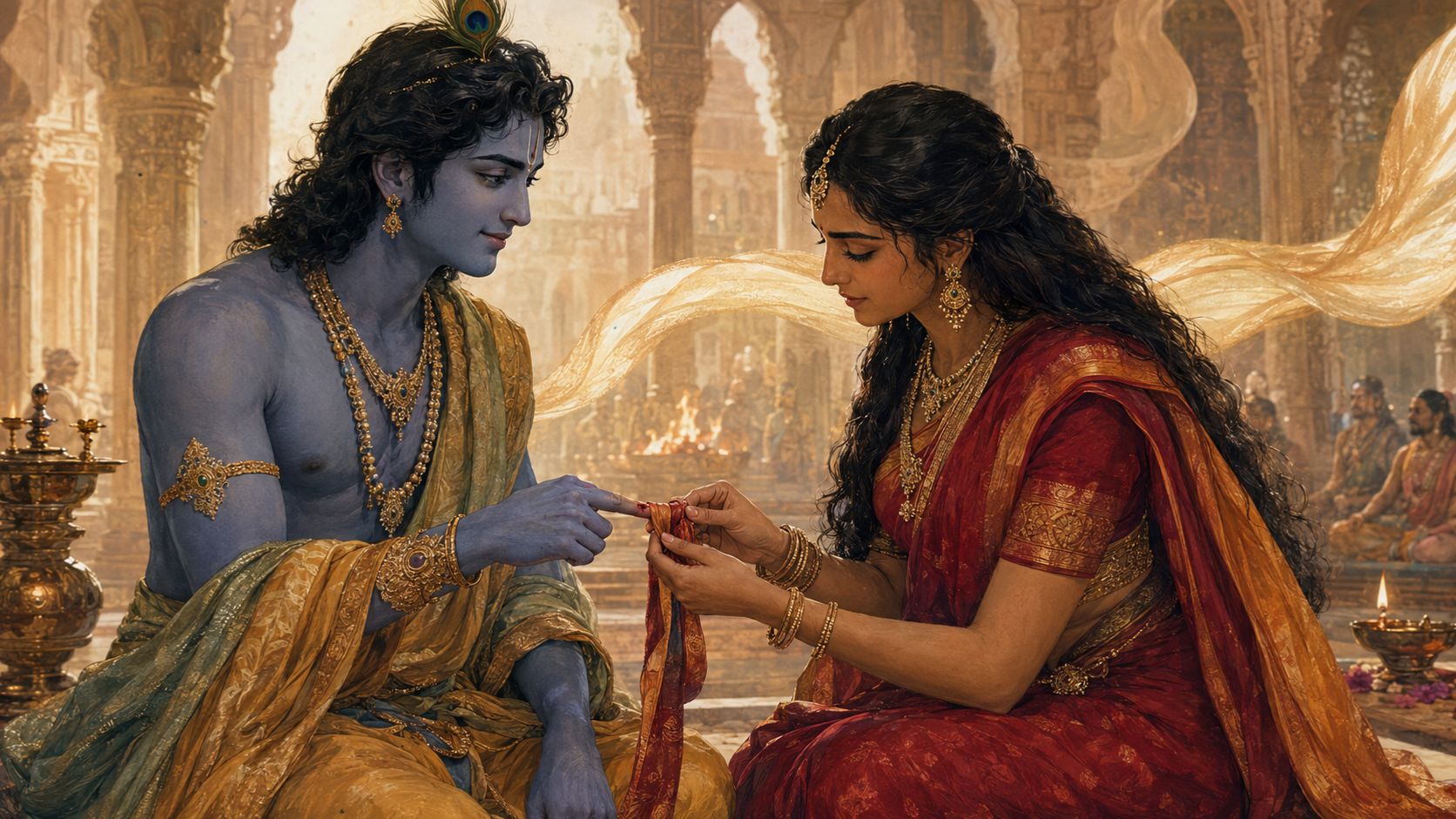
Lord Shri Krishna gives us a golden formula to combat stress. He says, “tasmad apriharye’rthe na tvam shochitum arhasi” (Do not worry about things that are inevitable.) Most of the time the stress is just an outcome of our own stupidity, and therefore the solution also lies in the proper use of our discriminating faculty.
We often start worrying when we anticipate negative outcomes such as failing a final exam or not achieving the desired grades. But such worry is futile—it serves no purpose. Rather, it harms us and can lead to a self-fulfilling prophecy. We should pause for a moment instead and ask ourselves, “Is worry really going to help us achieve our goal or transcend imagined or real obstacles?” Mostly, the answer is a categorical “no”. Then, why worry and be stressful? Lord Krishna’s advice is to remain balanced in the face of the adversities which everyone is bound to experience.
The Story of a Successful, But Very Sad, Man
Today, survival seems to be the biggest concern and that depends on one’s economic stability. It is as if everybody has to compete in the rat race. Let me illustrate with a story:
Once there was a very successful man who had amassed riches and fame after a long struggling life. He spent most of his active life pursuing his career and climbing the professional ladder. As he grew old, he realized to his utter sorrow that his so-called success was hollow. Plus, he was obese, had heart disease and was constantly fatigued. He was separated from his spouse, estranged from his children, and had neglected his parents. He was frustrated, depressed and constantly stressed. His success had cost him his health, family relations, and peace of mind. He was a very sad man. He questioned if it had been wise to pursue wealth as he had. Was it at all worthwhile?
The moral is: By blindly hankering after worldly wealth and by amassing a huge fortune, one may feel victorious in the rat race, but becomes a loser on all other fronts. And even if one does win, one still remains but a rat!
A Balanced Life
It isn’t necessarily wrong to strive for a stable economic life, but we should lead balanced lives—we should maintain equilibrium between running after material wealth and seeking spiritual goals.
We should not devote all our time to earning wealth—we should also care for our health, family relations and mental peace as well. After all, we want money so that we can live a happy, healthy and peaceful life. Earning money should not destroy these very goals. For, ultimately, it is life that is priceless. And to take it lightly is unwise.
In the US, compensation for a knee injury can be up to $200,000. Imagine what the value is of, say, a damaged brain, an injured eye, a broken marriage or mental breakdown!
We should make a balance sheet of all these, along with our economic goals, and see if they are balanced or if we are in debt.
Lord Krishna advises us to lead a moderate life and according to him, “siddhyasiddhyoh samo bhutva samatvam yoga ucyate.” (Yoga is nothing but balanced life in the face of all successes and adversities.) His advice is as relevant today as it was when he gave it 5200 years ago. We have to learn to manage stress. We cannot cure it by popping a pill. One of the easiest ways to get relief from stress is meditation. It is a clinically proven fact.
Rooting Out Stress
To meditate you need not visit the mountains—it can be done even between your daily chores. Even simple meditative activities, such as closing the eyes, taking deep breaths and observing the breath flowing in and out through the nostrils, can work wonders and give you relief. You can practice it every day or whenever you are in need. One of the best ways to learn the simple techniques is to know about Ayurvedic lifestyle regimen. Dr. Partap Chauhan has propounded Jivananda, which is an excellent plan for working people.
The next important way is by engaging ourselves in some spiritual activities or doing seva (selfless service). Doing some good for others and wanting nothing in return gives a sense of joy and mental relief which can be best experienced rather than described. Give these a try and bust stress forever.