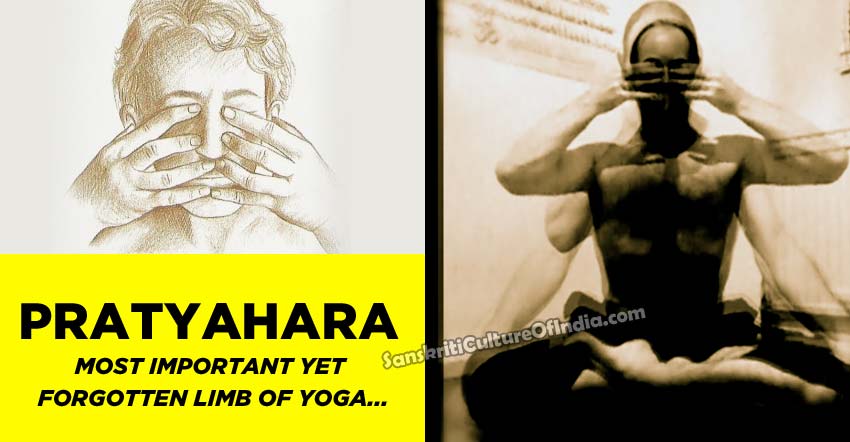
Pratyahara itself is termed as Yoga, as it is the most important limb in Yoga Sadhana. ~ Swami Shivananda
Yoga is a vast system of spiritual practices for inner growth. To this end, the classical yoga system incorporates eight limbs, each with its own place and function. Of these, pratyahara is probably the least known. How many people, even yoga teachers, can define pratyahara? Have you ever taken a class in pratyahara? Have you ever seen a book on pratyahara? Can you think of several important pratyahara techniques? Do you perform pratyahara as part of your yogic practices? Yet unless we understand pratyahara, we are missing an integral aspect of yoga without which the system cannot work.
As the fifth of the eight limbs, pratyahara occupies a central place. Some yogis include it among the outer aspects of yoga, others with the inner aspects. Both classifications are correct, for pratyahara is the key between the outer and inner aspects of yoga; it shows us how to move from one to the other.
It is not possible to move directly from asana to meditation. This requires jumping from the body to the mind, forgetting what lies between. To make this transition, the breath and senses, which link the body and mind, must be brought under control and developed properly. This is where pranayama and pratyahara come in. With pranayama we control our vital energies and impulses and with pratyahara we gain mastery over the unruly senses — both prerequisites to successful meditation.
What is Pratyahara?
The term pratyahara is composed of two Sanskrit words, prati and ahara. Ahara means “food,” or “anything we take into ourselves from the outside.” Prati is a preposition meaning “against” or “away.” Pratyahara means literally “control of ahara,” or “gaining mastery over external influences.” It is compared to a turtle withdrawing its limbs into its shell — the turtle’s shell is the mind and the senses are the limbs. The term is usually translated as “withdrawal from the senses,” but much more is implied.
In yogic thought there are three levels of ahara, or food. The first is physical food that brings in the five elements necessary to nourish the body. The second is impressions, which bring in the subtle substances necessary to nourish the mind — the sensations of sound, touch, sight, taste, and smell. The third level of ahara is our associations, the people we hold at heart level who serve to nourish the soul and affect us with the gunas of sattva, rajas, and tamas.
Pratyahara is twofold. It involves withdrawal from wrong food, wrong impressions and wrong associations, while simultaneously opening up to right food, right impressions and right associations. We cannot control our mental impressions without right diet and right relationship, but pratyahara’s primary importance lies in control of sensory impressions which frees the mind to move within.
By withdrawing our awareness from negative impressions, pratyahara strengthens the mind’s powers of immunity. Just as a healthy body can resists toxins and pathogens, a healthy mind can ward off the negative sensory influences around it. If you are easily disturbed by the noise and turmoil of the environment around you, practice pratyahara. Without it, you will not be able to meditate.
There are four main forms of pratyahara: indriya-pratyahara — control of the senses; prana- pratyahara — control of prana; karma-pratyahara — control of action; and mano-pratyahara — withdrawal of mind from the senses. Each has its special methods.
Control of the Senses (Indriya-pratyahara)
Indriya-pratyahara, or control of the senses, is the most important form of pratyahara, although this is not something that we like to hear about in our mass media-oriented culture. Most of us suffer from sensory overload, the result of constant bombardment from television, radio, computers, newspapers, magazines, books — you name it. Our commercial society functions by stimulating our interest through the senses. We are constantly confronted with bright colors, loud noises and dramatic sensations. We have been raised on every sort of sensory indulgence; it is the main form of entertainment in our society.
The problem is that the senses, like untrained children, have their own will, which is largely instinctual in nature. They tell the mind what to do. If we don’t discipline them, they dominate us with their endless demands. We are so accustomed to ongoing sensory activity that we don’t know how to keep our minds quiet; we have become hostages of the world of the senses and its allurements. We run after what is appealing to the senses and forget the higher goals of life. For this reason, pratyahara is probably the most important limb of yoga for people today.
The old saying “the spirit is willing but the flesh is weak” applies to those of us who have not learned how to properly control our senses. Indriya-pratyahara gives us the tools to strengthen the spirit and reduce its dependency on the body. Such control is not suppression (which causes eventual revolt), but proper coordination and motivation.
The three worlds are also called the three Waters or three oceans. Each form of Vayu is associated with a particular form of the Waters or the ocean. The Earthy or sacrificial form of Agni is associated with ground Water and with caves and springs and with the water and ghee (clarified butter) that is offered to the Fire. The Atmospheric wind (thunder) is associated with the ocean and the rains which are created by Water evaporating from the sea. The Heavenly (solar) wind is associated with the cosmic ocean and heavenly Waters which are also the Milky Way. Space is the Waters of Heaven through which the Sun moves like a boat.