IndianSanskriti

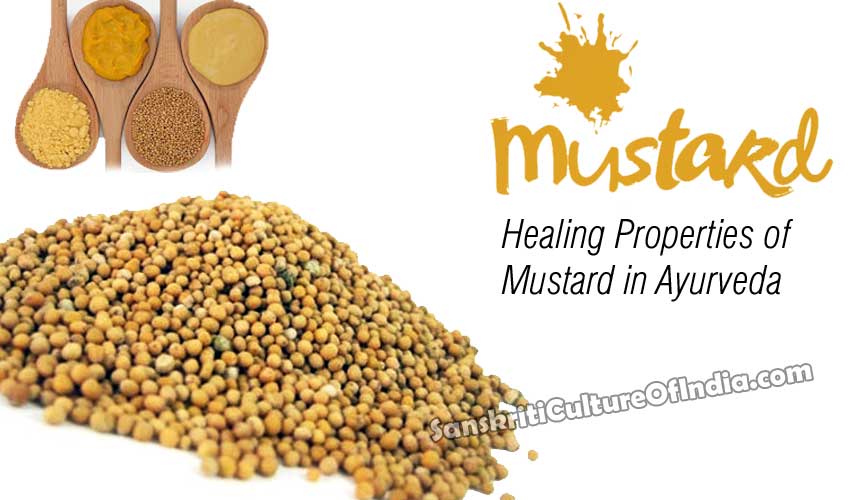
Healing Properties of Mustard in Ayurveda

.

Mustard in Ayurveda

Mustard or Rai is an annual plant cultivated as a spice all over the world. It has been used for centuries as a pungent condiment and healing herb by the Chinese, the Greeks and the Ayurvedics. Mustard is peculiar in that its strong taste develops only after the seeds are crushed and come into contact with water or saliva.

Properties:

Mustard is an antiseptic, warming, carminative, antibacterial and antiviral. It aids in digestion and eases gastric distention. It is an emetic, rubefacient, and a laxative. It acts as an irritant, encouraging blood flow toward the surface of the skin in cases of rheumatism, sciatica, peritonitis and neuralgia and for various muscle aches and pains. From the whole plant, only the seeds and pods are used.

Conditions Treated:

For centuries, mustard plasters have been used to treat chest colds and coughs. Mustard is also beneficial for backache, joint pain, digestive upsets, hiccups and as a laxative. Mustard eases constipation, minor aches and pains and muscle stiffness. It is used either as a spice or oil, in compresses and poultices. It can also be used along with aloe vera, ginger, garlic and onion. Poultices should be used only for 10-15 minutes at a time or blistering and irritation can occur.

Methods of Use:

Mustard reduces pitta and kapha, and has a neutral effect on vatta.

Mustard oil can be rectified with alcohol (1 part oil to 40 parts alcohol) and used as a lotion for joint pains, arthritis and sluggish circulation.

A mustard foot bath will clear blood congestion in the head, warm up cold feet and lower a fever in the early stages of illness. Put one-quarter of a cup of mustard seed in a small cloth bag or a large tea strainer. Steep in hot water for 5 minutes and soak feet until the water cools off.
p>
You may also like

Search the website

Like us on Facebook

Get daily updates via Email

Enter your email address:

Recent Posts

Yogini Ekadashi 2026 — The Yaksha Who Missed the Morning Flowers, and the Ekadashi That Undid His Curse

On Friday, July 10, 2026, the rare Krishna Paksha Ekadashi of Nija Ashadha arrives. The Padma Purana tells the story of Hemamali — the Yaksha gardener of Bhagavan Kubera in Alaka, whose single morning of distraction with his wife Vishalakshi cost him his form, his wife, and his celestial city. Cursed to wander the earth of Bharata as a leper for a long time, he was at last shown the way back by Sage Markandeya — a single sincere keeping of Yogini Ekadashi.

Jamai Shashthi 2026 — The Story of Maa Shashthi, the Cat, and the Wife Who Was Forgiven

Jamai Shashthi 2026 — The Story of Maa Shashthi, the Cat, and the Wife Who Was Forgiven

On Saturday, June 20, 2026, Bengali households across Bharata will welcome their married daughters and sons-in-law home for the legendary jamai-aador feast and perform the Shashthi Vrata. But behind the warmth lies a story most Bengalis know by heart and most non-Bengalis have never heard — the wife who stole the hilsa, blamed the cat, lost six sons to Maa Shashthi’s wrath, and was finally forgiven. The Vrat Katha, the vidhi, the mantras, and the deeper teaching.

Vat Purnima 2026 — The Wife Who Argued Yama Into Returning Her Husband’s Life

On Monday, June 29, 2026, women across Maharashtra, Gujarat, and southern Bharata will tie red thread around banyan trees and hear the story of Savitri — the wife who walked behind Yamaraja Himself when He came for her husband, and out-argued the Lord of Dharma into returning Satyavan’s life. The Mahabharata’s Pativrata Mahatmya Parva, the vrat vidhi, and why the banyan witnessed everything.

Nija Jyeshtha 2026 — The Real Jyeshtha Begins, and the Calendar Resumes

Nija Jyeshtha 2026 — The Real Jyeshtha Begins, and the Calendar Resumes

With Adhik Maas now closed on the Somvati Amavasya of June 15, the long-postponed festivals of Jyeshtha return — Vat Purnima (June 29, the Savitri-Yamaraja katha), Jamai Shashthi (June 20, the Bengali festival of Maa Shashthi), Sankashti Chaturthi (June 28), Yogini Ekadashi (July 10), and Devshayani Ekadashi (July 16, opening the four-month Chaturmas of Bhagavan Vishnu’s yoga-nidra). A guide to what the next four weeks hold and what the household that kept Purushottam Maas now carries forward.

The Closing of Purushottam Maas 2026 — Adhik Amavasya and the Sealing of the Month-Long Vrat

On Monday, June 15, 2026 — a rare Somvati Amavasya — the intercalary month that bears Bhagavan Vishnu’s own name comes to its close. The Acharyas teach that a vrat is not measured by its duration but by its closing. Here are the Padma Purana’s instructions for sealing the month-long Purushottam Maas vrat: the morning snan, the closing puja with the Vishnu Sahasranama, the day of dana, the Somvati Amavasya gift, and the final sarva-arpana — the offering of all merit at the feet of the Lord.

css.php