IndianSanskriti
93% of wild Ayurvedic medicinal plants in endangered list

93% of wild Ayurvedic medicinal plants in endangered list

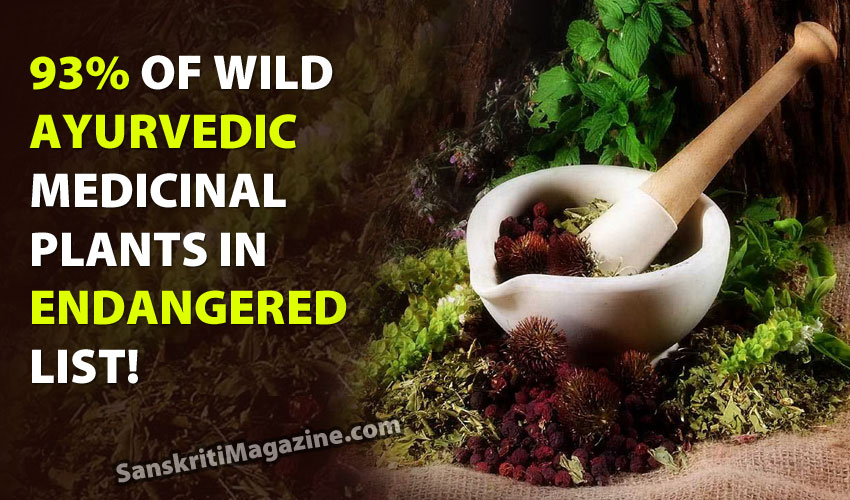
Ninety three percent of wild medicinal plants used for making ayurvedic medicines are endangered and efforts are being made to relocate them from their usual habitat to protect them. The threat to the plants came to the fore in an assessment exercise in different states carried out by the Botanical Survey of India.

Researchers have recently found that extinction rates are currently 1000 times higher than normal due to deforestation, changes in climate, and the depletion of ocean fisheries.

The assessments were done for a total of 359 prioritized wild medicinal plant species. Out of this, 335 have been assigned Red List status ranging from critically endangered, endangered, vulnerable to near-threatened.

In addition, a total of 15 such species recorded in trade have been found threatened, officials in the health ministry’s Ayush department said.

Some of the rare plants reported to be threatened, have been relocated during the last decade, including Utleria Salicifolia and Hydnocarpus Pentandra in Western Ghats, Gymnocladus Assamicus and Begonia Tessaricarpa from Arunachal Pradesh and Agapetes Smithiana in Sikkim.

The assessments have involved conducting Conservation Assessment and Management Prioritisation using International Union for Conservation of Nature and Natural Resources (IUCN) Red List Categories.

The IUCN Global Species Programme working with the IUCN Species Survival Commission (SSC) has been assessing the conservation status of species, subspecies, varieties, and even selected subpopulations on a global scale for the past 50 years in order to highlight taxa threatened with extinction, and thereby promote their conservation.

The officials said the medicinal plant resources are threatened by over exploitation to meet the demand of herbal industries.

As per the information received from the Ministry of Environment and Forests in India, about 95 percent of such plants are harvested from the wild, primarily from forests.

The National Medicinal Plants Board constituted in November 2000, has been implementing a Central sector scheme for development and cultivation of medicinal plants since 2000-01.

This scheme was revised and renamed as “Central Sector Scheme for Conservation, Development and Sustainable Management of Medicinal Plants” during 2008-09.

States forest departments have been given assistance for protection and propagation of such endangered species, especially used by the herbal industries.

Projects for setting up of 29 Medicinal Plants Conservation Areas (MPCAs) have also been implemented in the states covering mainly the medicinal plants viz Asoka, Guggal and Dashmool varieties.

In addition, a new “Centrally Sponsored Scheme of National Mission on Medicinal Plants” with a large outlay has been implemented since 2008-09 by National Medicinal Plants Board. A total of 24 states have been covered under the scheme.

The IUCN Global Species Programme maintains the information behind The IUCN Red List in a centralized database as part of the Species Information Service (SIS).
 

April McCarthy

You may also like

Search the website

Like us on Facebook

Get daily updates via Email

Enter your email address:

Recent Posts

Yogini Ekadashi 2026 — The Yaksha Who Missed the Morning Flowers, and the Ekadashi That Undid His Curse

On Friday, July 10, 2026, the rare Krishna Paksha Ekadashi of Nija Ashadha arrives. The Padma Purana tells the story of Hemamali — the Yaksha gardener of Bhagavan Kubera in Alaka, whose single morning of distraction with his wife Vishalakshi cost him his form, his wife, and his celestial city. Cursed to wander the earth of Bharata as a leper for a long time, he was at last shown the way back by Sage Markandeya — a single sincere keeping of Yogini Ekadashi.

Jamai Shashthi 2026 — The Story of Maa Shashthi, the Cat, and the Wife Who Was Forgiven

Jamai Shashthi 2026 — The Story of Maa Shashthi, the Cat, and the Wife Who Was Forgiven

On Saturday, June 20, 2026, Bengali households across Bharata will welcome their married daughters and sons-in-law home for the legendary jamai-aador feast and perform the Shashthi Vrata. But behind the warmth lies a story most Bengalis know by heart and most non-Bengalis have never heard — the wife who stole the hilsa, blamed the cat, lost six sons to Maa Shashthi’s wrath, and was finally forgiven. The Vrat Katha, the vidhi, the mantras, and the deeper teaching.

Vat Purnima 2026 — The Wife Who Argued Yama Into Returning Her Husband’s Life

On Monday, June 29, 2026, women across Maharashtra, Gujarat, and southern Bharata will tie red thread around banyan trees and hear the story of Savitri — the wife who walked behind Yamaraja Himself when He came for her husband, and out-argued the Lord of Dharma into returning Satyavan’s life. The Mahabharata’s Pativrata Mahatmya Parva, the vrat vidhi, and why the banyan witnessed everything.

Nija Jyeshtha 2026 — The Real Jyeshtha Begins, and the Calendar Resumes

Nija Jyeshtha 2026 — The Real Jyeshtha Begins, and the Calendar Resumes

With Adhik Maas now closed on the Somvati Amavasya of June 15, the long-postponed festivals of Jyeshtha return — Vat Purnima (June 29, the Savitri-Yamaraja katha), Jamai Shashthi (June 20, the Bengali festival of Maa Shashthi), Sankashti Chaturthi (June 28), Yogini Ekadashi (July 10), and Devshayani Ekadashi (July 16, opening the four-month Chaturmas of Bhagavan Vishnu’s yoga-nidra). A guide to what the next four weeks hold and what the household that kept Purushottam Maas now carries forward.

The Closing of Purushottam Maas 2026 — Adhik Amavasya and the Sealing of the Month-Long Vrat

On Monday, June 15, 2026 — a rare Somvati Amavasya — the intercalary month that bears Bhagavan Vishnu’s own name comes to its close. The Acharyas teach that a vrat is not measured by its duration but by its closing. Here are the Padma Purana’s instructions for sealing the month-long Purushottam Maas vrat: the morning snan, the closing puja with the Vishnu Sahasranama, the day of dana, the Somvati Amavasya gift, and the final sarva-arpana — the offering of all merit at the feet of the Lord.

css.php