IndianSanskriti
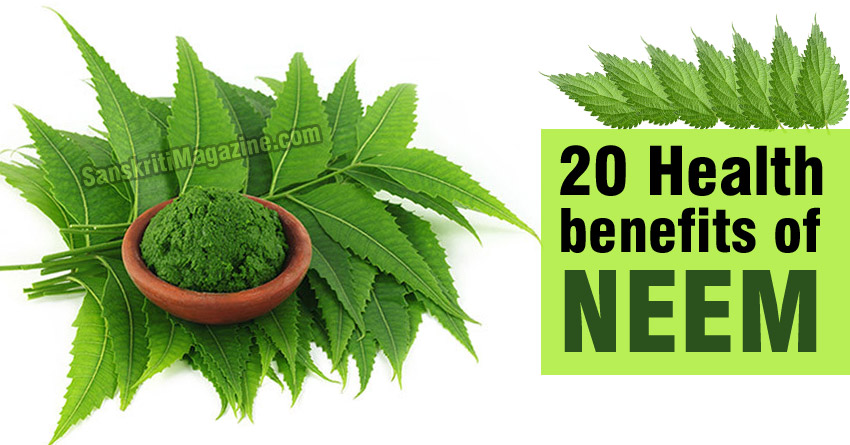
20 Health benefits of Neem

20 health benefits of Neem

Neem tree has been described in Ayurveda’s prime text, the Charaka Samhita, as sarva roga nivarini (that which keeps all diseases at bay) or arishtha (reliever of disease). 

Its extracts have been used in the Ayurvedic tradition for thousands of years for maintaining health and overall well-being. The roots, bark, gum, leaves, fruit, seed kernels and seed oil are all used in therapeutic preparations for both internal and topical use.

  1. Neem, a tree native to India, is a vital ingredient in Ayurveda. Regarded as a ‘one tree pharmacy’, the Neem tree has several medicinal uses and forms an integral part of home remedies for the hair and skin.
  2. Neem leaf has antifungal and antibacterial properties, making it effective in treating dandruff.
  3. It also relieves dryness and itching, strengthens hair and promotes hair growth.
  4. Traditionally, neem paste has been used to condition the hair and scalp.
  5. It also soothes irritation, prevents dryness and flaking.
  6. Neem is mentioned in most Ayurvedic formulations for the treatment of skin disorders because of its detoxifying properties.
  7. The growth of acne-causing bacteria such as propionibacterium acnes (P. acnes) and staphylococcus epidermidis is also inhibited by neem.
  8. The role of neem in acne is further supported by studies which have shown that it exhibits anti-inflammatory activity by suppressing P. acnes-induced reactive oxygen species (ROS) and the pro-inflammatory cytokines TNF-a and IL-8.
  9. Neem oil and neem leaves are excellent skin care ingredients. The oil relieves dry skin and soothes itchiness, redness and irritation.
  10. It also improves general skin health and immunity, combating bacterial infections such as acne, boils and ulcers.
  11. Its antimicrobial properties help heal wounds without causing any infections or septic conditions.
  12. For acne, neem tackles bacteria from the root and prevents the recurrence of pimples and blemishes.
  13. It is especially beneficial for skin disorders like eczema and minor skin infections. Neem leaves also eliminate acne-causing bacteria.
  14. It is also a gastro protective element and effective in healing ulcers.
  15. It contains high level of antioxidants that help protect skin from environmental damage and from aging.
  16. Neem oil contains fatty acid and vitamin E that gets absorbed easily into the skin, it helps rejuvenate skin cells and restore elasticity.
  17. It helps maintain a glowing skin and balance skin tone.
  18. The high fatty-acid content in neem oil helps prevent and treat scars from acne.
  19. Neem leaves are also excellent exfoliants; it tightens pores and removes impurities when used as a mask.
  20. It is an excellent healer of skin fungal infections.

~ Chandrika Mahendra, Senior Research Scientist, R & D, The Himalaya Drug Company
You may also like

Search the website

Like us on Facebook

Get daily updates via Email

Enter your email address:

Recent Posts

Yogini Ekadashi 2026 — The Yaksha Who Missed the Morning Flowers, and the Ekadashi That Undid His Curse

On Friday, July 10, 2026, the rare Krishna Paksha Ekadashi of Nija Ashadha arrives. The Padma Purana tells the story of Hemamali — the Yaksha gardener of Bhagavan Kubera in Alaka, whose single morning of distraction with his wife Vishalakshi cost him his form, his wife, and his celestial city. Cursed to wander the earth of Bharata as a leper for a long time, he was at last shown the way back by Sage Markandeya — a single sincere keeping of Yogini Ekadashi.

Jamai Shashthi 2026 — The Story of Maa Shashthi, the Cat, and the Wife Who Was Forgiven

Jamai Shashthi 2026 — The Story of Maa Shashthi, the Cat, and the Wife Who Was Forgiven

On Saturday, June 20, 2026, Bengali households across Bharata will welcome their married daughters and sons-in-law home for the legendary jamai-aador feast and perform the Shashthi Vrata. But behind the warmth lies a story most Bengalis know by heart and most non-Bengalis have never heard — the wife who stole the hilsa, blamed the cat, lost six sons to Maa Shashthi’s wrath, and was finally forgiven. The Vrat Katha, the vidhi, the mantras, and the deeper teaching.

Vat Purnima 2026 — The Wife Who Argued Yama Into Returning Her Husband’s Life

On Monday, June 29, 2026, women across Maharashtra, Gujarat, and southern Bharata will tie red thread around banyan trees and hear the story of Savitri — the wife who walked behind Yamaraja Himself when He came for her husband, and out-argued the Lord of Dharma into returning Satyavan’s life. The Mahabharata’s Pativrata Mahatmya Parva, the vrat vidhi, and why the banyan witnessed everything.

Nija Jyeshtha 2026 — The Real Jyeshtha Begins, and the Calendar Resumes

Nija Jyeshtha 2026 — The Real Jyeshtha Begins, and the Calendar Resumes

With Adhik Maas now closed on the Somvati Amavasya of June 15, the long-postponed festivals of Jyeshtha return — Vat Purnima (June 29, the Savitri-Yamaraja katha), Jamai Shashthi (June 20, the Bengali festival of Maa Shashthi), Sankashti Chaturthi (June 28), Yogini Ekadashi (July 10), and Devshayani Ekadashi (July 16, opening the four-month Chaturmas of Bhagavan Vishnu’s yoga-nidra). A guide to what the next four weeks hold and what the household that kept Purushottam Maas now carries forward.

The Closing of Purushottam Maas 2026 — Adhik Amavasya and the Sealing of the Month-Long Vrat

On Monday, June 15, 2026 — a rare Somvati Amavasya — the intercalary month that bears Bhagavan Vishnu’s own name comes to its close. The Acharyas teach that a vrat is not measured by its duration but by its closing. Here are the Padma Purana’s instructions for sealing the month-long Purushottam Maas vrat: the morning snan, the closing puja with the Vishnu Sahasranama, the day of dana, the Somvati Amavasya gift, and the final sarva-arpana — the offering of all merit at the feet of the Lord.

css.php