IndianSanskriti
Naga-Kataru

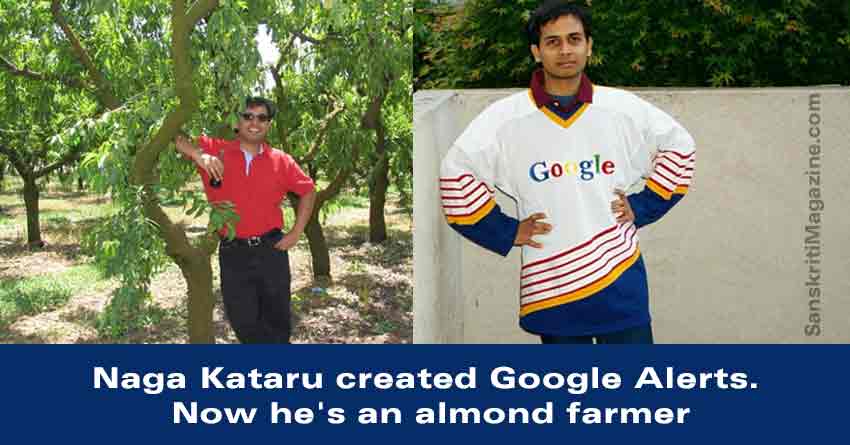
Naga Kataru created Google Alerts. Now he’s an almond farmer

When Naga Kataru first pitched the idea of Google Alerts, it was immediately rejected.

“My manager didn’t like it,” said Kataru. “He said Google makes money when people come to us. If we set alerts, then we’re losing money because we’re sending people away from Google.”
Kataru trusted his instincts anyway.

“I went to Sergey Brin and Larry Page. I said I had a cool prototype with a simple user interface to show them,” he said.

The Google founders tested it right away, said Kataru. In fact, the first keywords ever used to test Google Alerts were ‘”Google” and “Larry Page,” he said.
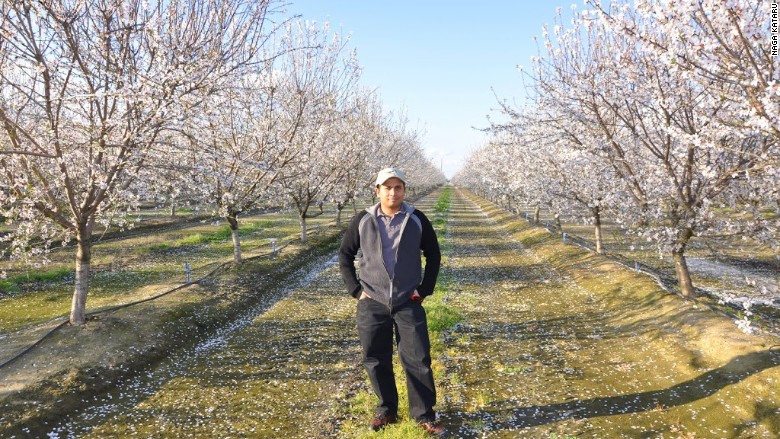
Naga Kataru on his farm in Modesto, California.

“They both loved it,” said Kataru, who is listed on three patents for Google Alerts.

Google (GOOGL, Tech30) launched Google Alerts in 2003. It’s become one of its most useful tools, with hundreds of millions of people using it to monitor the web for specific content.

When Google hired Kataru in 2000, he was the 40th engineer at the 110-employee startup.

But just getting to Google’s door was a remarkable feat for a 25-year-old engineer who first encountered a computer as an undergraduate in India.

Kataru grew up in Gampalagudem, a farming village in the southern Indian state of Andhra Pradesh. He was a gifted student in a high school where only half the students would show up for class, “because education wasn’t a priority for them,” he said.
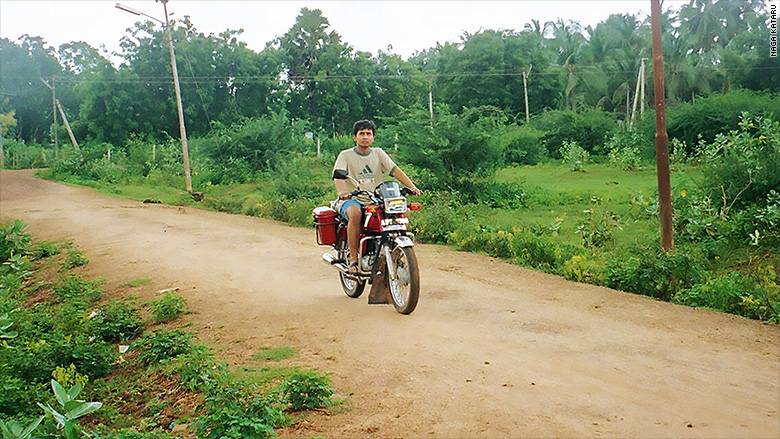
Kataru, as an undergraduate, on his way to college in India.

His father, the school’s principal, was determined to keep his son college-bound.

So Kataru graduated with a college degree in computer science and engineering and then enrolled at the Indian Institute of Technology, in one of the country’s best computer science programs.

Kataru credits Google for spurring his creativity as a technologist. “There was so much freedom to explore and invent,” he said.

But after eight years, Kataru grew restless.

“I felt I was stagnating,” he said. “I had worked one side of my brain for so long. I wanted to explore the other side.”

Kataru eventually left Google and jumped into completely new territories — documentary short films and improv theater.

He applied to and was accepted into a directing program at Second City, the world-famous improv group, whose alumni include Tina Fey and Amy Poehler.

Kataru’s latest career reincarnation is as a farmer. In 2008, he bought a 320-acre farm in Modesto, California. It was only meant to be a diversified investment.
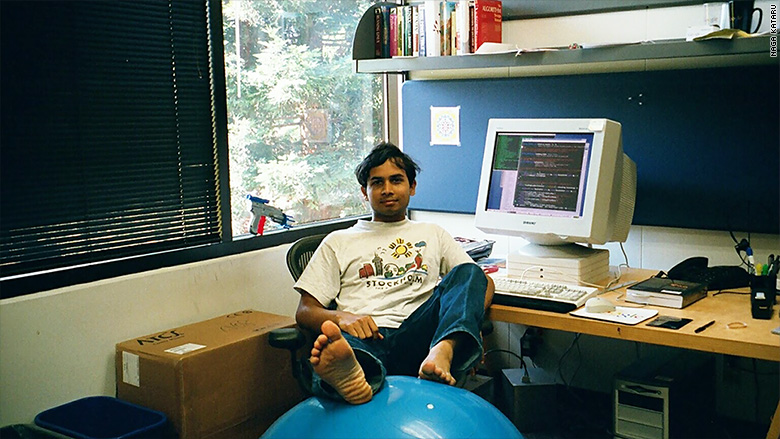
Kataru in his office in Google in 2001.

“I thought I would sell it after five years,” said Kataru.

But the farm reminded him of his life in India. “I missed the way the fruits and flowers smelled differently in India,” he said.

Instead of selling the money-losing farm, he converted it into an almond farm, which required one-third the labor.

“I didn’t know anything about farming. But I love education and I taught myself,” he said.

Today the farm, which also grows apricots, is profitable and has eight employees. It generates $2.5 million in annual revenue.

Kataru still isn’t resting on his laurels. He’s working on two degrees at Stanford — an MBA and an MS in Environment & Resources — to prepare him for his next challenge: making farming more tech-savvy.

“It’s ironic that even though there are farms just 90 miles outside of Silicon Valley, technology hasn’t been used much to improve processes and crop yields,” he said. “As a technologist, I think I can do something about it.”

(Source: CNN Money)
You may also like

Search the website

Like us on Facebook

Get daily updates via Email

Enter your email address:

Recent Posts

Jamai Shashthi 2026 — The Story of Maa Shashthi, the Cat, and the Wife Who Was Forgiven

Jamai Shashthi 2026 — The Story of Maa Shashthi, the Cat, and the Wife Who Was Forgiven

On Saturday, June 20, 2026, Bengali households across Bharata will welcome their married daughters and sons-in-law home for the legendary jamai-aador feast and perform the Shashthi Vrata. But behind the warmth lies a story most Bengalis know by heart and most non-Bengalis have never heard — the wife who stole the hilsa, blamed the cat, lost six sons to Maa Shashthi’s wrath, and was finally forgiven. The Vrat Katha, the vidhi, the mantras, and the deeper teaching.

Vat Purnima 2026 — The Wife Who Argued Yama Into Returning Her Husband’s Life

On Monday, June 29, 2026, women across Maharashtra, Gujarat, and southern Bharata will tie red thread around banyan trees and hear the story of Savitri — the wife who walked behind Yamaraja Himself when He came for her husband, and out-argued the Lord of Dharma into returning Satyavan’s life. The Mahabharata’s Pativrata Mahatmya Parva, the vrat vidhi, and why the banyan witnessed everything.

Nija Jyeshtha 2026 — The Real Jyeshtha Begins, and the Calendar Resumes

Nija Jyeshtha 2026 — The Real Jyeshtha Begins, and the Calendar Resumes

With Adhik Maas now closed on the Somvati Amavasya of June 15, the long-postponed festivals of Jyeshtha return — Vat Purnima (June 29, the Savitri-Yamaraja katha), Jamai Shashthi (June 20, the Bengali festival of Maa Shashthi), Sankashti Chaturthi (June 28), Yogini Ekadashi (July 10), and Devshayani Ekadashi (July 16, opening the four-month Chaturmas of Bhagavan Vishnu’s yoga-nidra). A guide to what the next four weeks hold and what the household that kept Purushottam Maas now carries forward.

The Closing of Purushottam Maas 2026 — Adhik Amavasya and the Sealing of the Month-Long Vrat

On Monday, June 15, 2026 — a rare Somvati Amavasya — the intercalary month that bears Bhagavan Vishnu’s own name comes to its close. The Acharyas teach that a vrat is not measured by its duration but by its closing. Here are the Padma Purana’s instructions for sealing the month-long Purushottam Maas vrat: the morning snan, the closing puja with the Vishnu Sahasranama, the day of dana, the Somvati Amavasya gift, and the final sarva-arpana — the offering of all merit at the feet of the Lord.

Parama Ekadashi 2026 — The Other Rare Ekadashi of Purushottam Maas, and the Poor Brahmin Who Kept It

Two weeks ago, Vaishnavas across Bharata kept Padmini Ekadashi — the rare Shukla Paksha Ekadashi of Adhik Maas. Padmini has a twin. On Thursday, June 11, 2026, the Krishna Paksha Ekadashi of the same intercalary month appears: Parama — the Supreme Ekadashi. The Padma Purana names it the rarer and more secret of the two, and reserves it for those whose poverty or sorrow has refused to lift in spite of every other vrat already kept. The story of Sumedha and Pavitra of Kampilya, the rishi Kaundinya, the prince sent by Bhagavan Brahma — and the vidhi for the day.

css.php