
- Genes reveal that a wave of Indian migrants arrived 4,230 years ago
- Up to 11 per cent of Aboriginal DNA derives from Indians
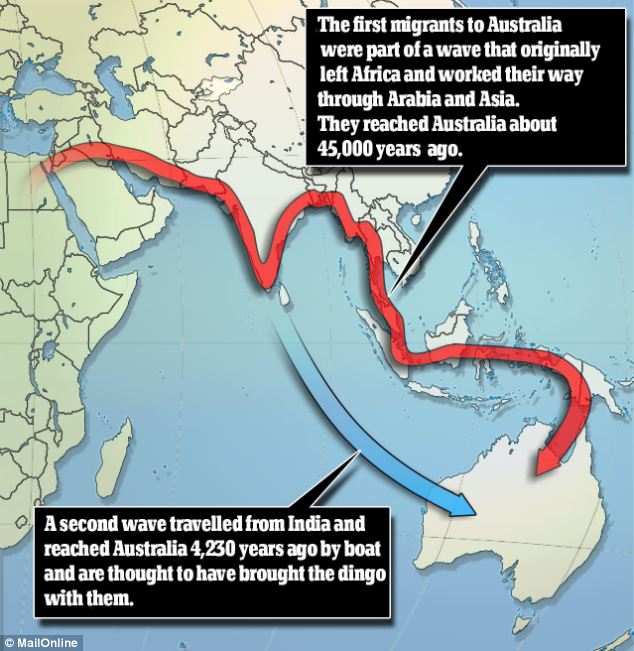
- An earlier wave of migrants arrived about 45,000 years ago
Australia was settled by a wave of immigrants from India little more than 4,000 years ago, a genetic study shows.
The finding overturns the view that the continent was isolated from the time it was first colonised about 45,000-50,000 years ago until Europeans discovered Australia in the eighteenth century.
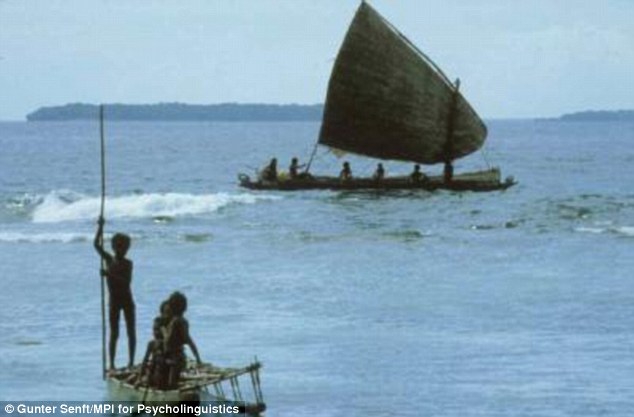
DNA evidence suggests that rather than complete most of the journey over several generations by foot, the Indian migrants came over by boat.
Australia’s first human colonisation was the culmination of the long walk out of Africa by the human species.
Humans are believed to have left Africa, via the Arabian coast and through India before reaching Indonesia and New Guinea and finally over an ancient land bridge to Australia.
Following their arrival there was, according to ‘the prevailing view’, little if any contact between Australia’s Aboriginal inhabitants and the rest of the world.
But DNA evidence has now revealed a second wave of human settlement took place about 4,230 years ago, long before the first European settled there.
Australia was first seen by a European in 1606 when it was sighted from a ship and a further 53 vessels arrived before Captain James Cook arrived in 1770 to claim it for Britain.
Analysis of DNA samples from Aboriginal people living in the Northern Territories of Australia today shows that they have up to 11 per cent of their genetic heritage is Indian
The new settlers came from India and the lack of their DNA in other parts of Asia suggests they sailed directly across the Indian Ocean rather than work their way towards Australia by foot.
Intriguingly, their arrival corresponds to evidence in the archaeological record that shows dingos reached Australia about the same time, suggesting they may have been transported by boat by the human settlers.
Dr Irina Pugach, of the Max Planck Institute for Evolutionary Anthropology in Leipzig, Germany, said the international research team calculated that the Indian DNA reached the Aboriginal population 141 generations ago.
Assuming that each generation is separated on average by 30 years the geneticists were able to conclude that the Indian population arrived on in Australia 4230 years ago.
‘Interestingly this date also coincides with many changes in the archaeological record of Australia, which include a sudden change in plant processing and stone tool technologies, with microliths appearing for the first time, and the first appearance of the dingo in the fossil record,’ she said.
‘Since we detect inflow of genes from India into Australia at around the same time, it is likely that these changes were related to this migration.’
Mark Stoneking, a geneticist at the Max Planck Institute, led the study and told Nature magazine: ‘Australia is thought to represent one of the earliest migrations for humans after they left Africa, but it seemed pretty isolated after that.’
DNA from 344 people was analysed for the study, published in the journal Proceedings of the National Academy of Sciences.
Samples were taken from people in Papua New Guinea, South East Asia, China, the US and Australia’s Northern Territory.