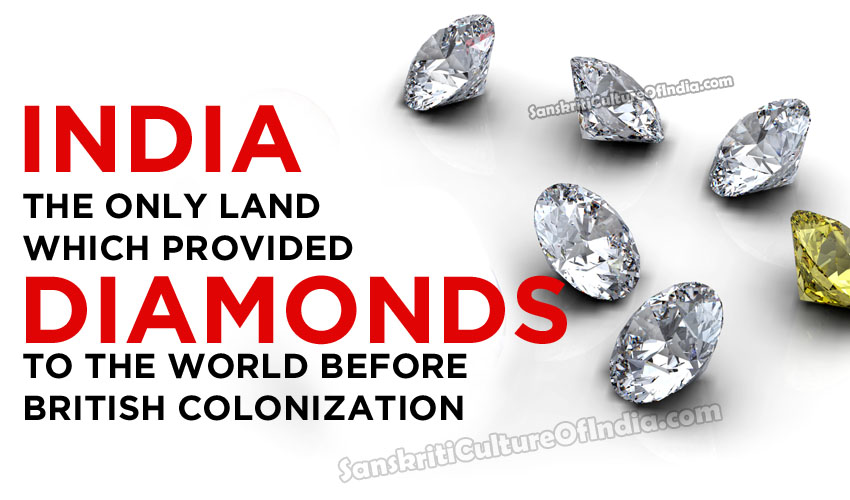
Before the British attempted to colonize India, this was the land of enchantment and mystery. It was a land known for its rich resources, mineral and vegetable, as well as a deep spiritual heritage. Diamonds were plentiful in India prior to the 19th century, and they were found along the banks and rivers of this exotic locale even though today they are absent. Other deposits of diamonds had yet to be discovered and for that reason India became synonymous with diamonds and their magical and mystical lore.
The first diamonds came from India. And for centuries, India was the only place one could find these precious stones. In 600 B.C. the Mahajanapada Empire had its own units of currency, and it’s own units of measurement for diamonds.
The ancient Indians used a Tandula as a unit of measure instead of the carat, which was equivalent to the weight of a grain of rice. Their currency was called the Rupaka, and according to a price list written in Sanskrit in the Third century, a diamond that weighed 20 Tandulas was worth 200,000 Rupaka.
For the wealthy citizens of the Mahajanapada, diamonds served a purpose – by converting their wealth into diamonds it allowed them to easier store, keep, and transport their riches. They did not have banks as we know them, and had to keep all the money they had. Diamonds made that task simpler, and thus represents the first time diamonds were used as an investment.
Since diamonds could not be cut, shaped, or polished, and thus were not used for jewelry or ornamentation, then why did the ancient Indians consider them so valuable? Two reasons: it’s usefulness as a tool, and its metaphysical properties.
The Mahajanapada was a very spiritual culture, and the diamonds were considered a profound source of luck. The Hindu religious scripture called the Garuda Purana is considered to be the authoritative reference for ancient Indian gemology, and it says that the owner of a flawless diamond will be blessed with wealth, livestock, good harvests, a wife, and many children. Furthermore, the diamond will protect the owner from both fear and sorcery.
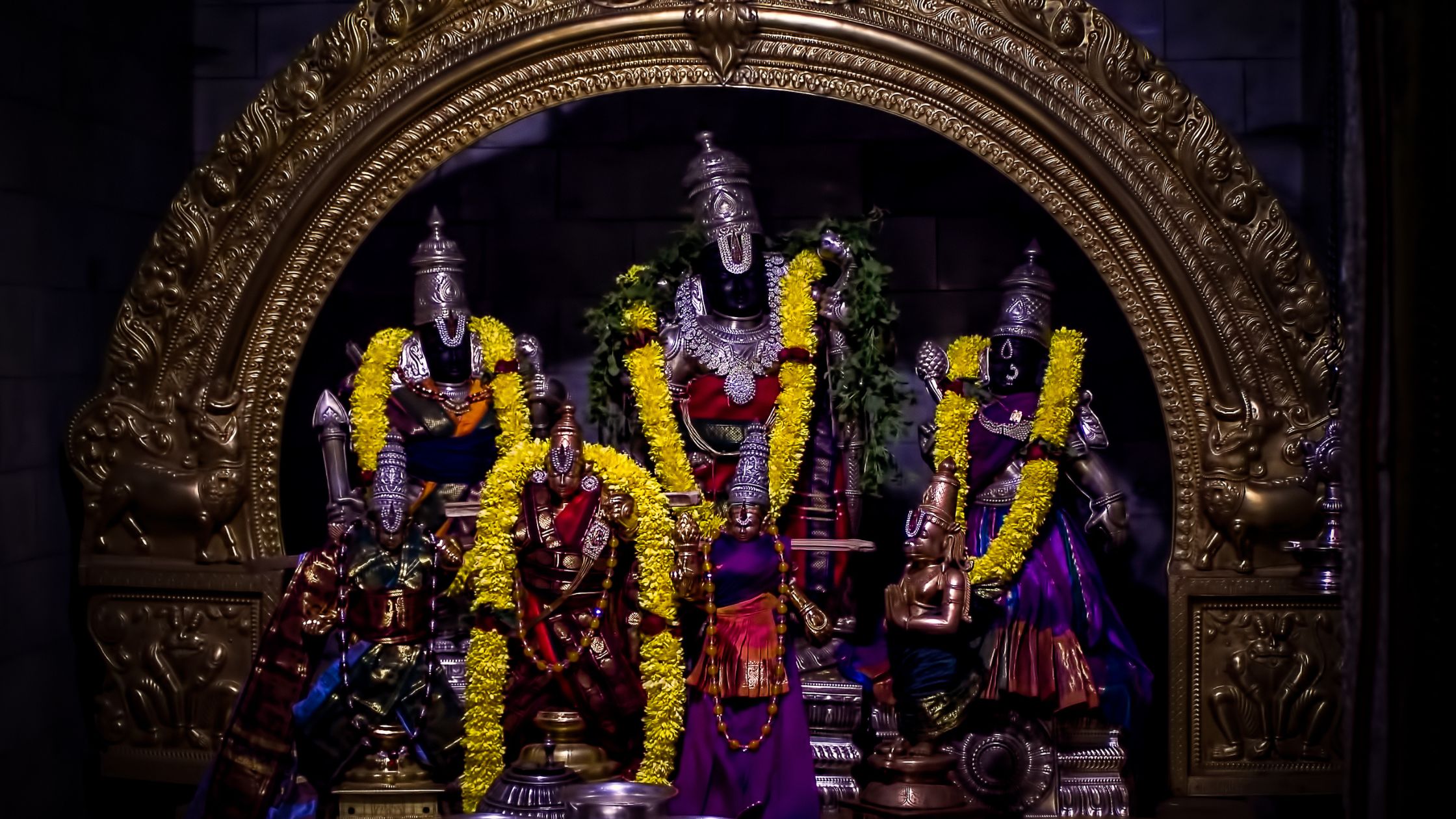
One of the world’s most infamous diamond is said to have possibly been cut from a much larger diamond that originated in India: the Blue Hope Diamond. This diamond was said to have been embedded in a religious idol as the eye and stolen later on. The diamond was then sold to Tavernier who sold it to Louis the XIV. The bad luck that followed the wearer of the Blue Hope Diamond gave rise to the legend that it had been cursed by the Indian priests to assure no one would own this religious object for long.
In the tradition of eastern medicine, diamonds also had many healing properties. They are said to transmit a color called indigo that is associated with cosmic energies. These energies help people with skin, lymph, reproductive, and bone problems. Even the shape of the diamond was said to be important, with some shapes being good for reproduction and other shapes being bad overall. For a diamond to be good for healing, it had to be without flaws or defects. Different colored diamonds also were said to aide people in different occupations. White diamonds enhanced intelligence and spirituality, while soldiers and administrators benefited from pink diamonds. Even the time of day one wore a diamond might have some significance. They were said to particularly good for people who had Venus rising in Pisces or Taurus in their astrological charts and were good to wear on Friday, Venus’s day.
For more practical-minded Indians, the diamond still had great value from being the hardest substance on earth. It could be used to carve, cut, and shape pearls and other gemstones, as well as in tool-making.
~ Abazias