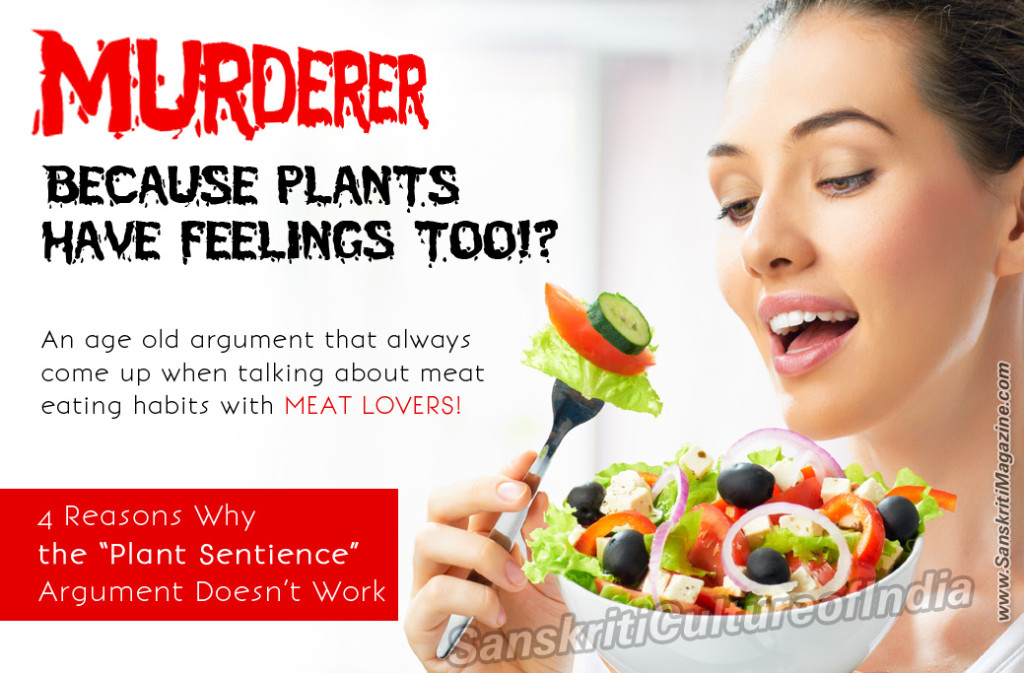
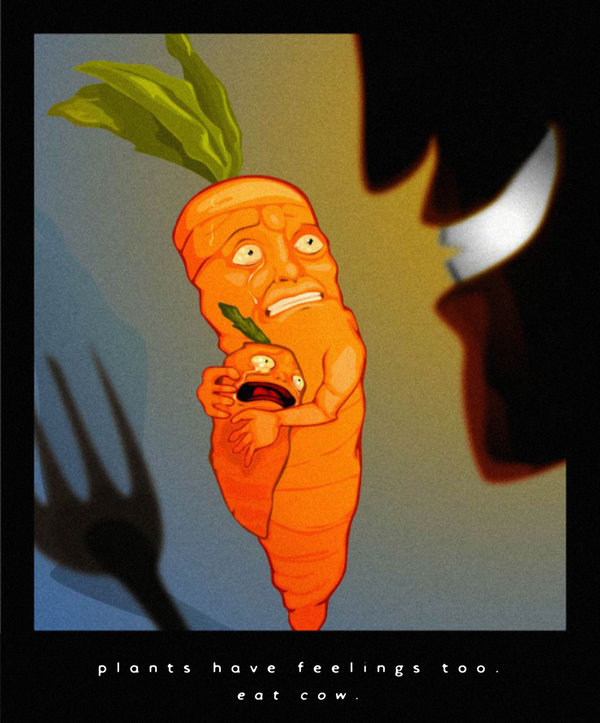
All vegans and vegetarians have heard it: “But what about the plants? What about their feelings? They feel pain, too. Don’t you feel bad for the carrots? You are killing them, you know.”
The issue of plant sentience is being brought up more and more as a reason to justify the continued consumption and use of animal products. There are, however, a few things wrong with this argument. Here are four reasons the “plant sentience” argument doesn’t work:
1. Plants are not truly sentient
Though certain scientific studies have shown that plants can react to stimuli, these reactions do not point to sentience because they lack three basic qualifications for requiring sentience:
- Sensory organs — Plants don’t have organs which enable them to see, hear, taste, etc. like animals do.
- Variability of response — Animals have a conscious perception which acts as an intermediary between their environment and their many different behavioral responses to it. Plants lack this variability in that they will react in the same manner regardless of different scenarios (ex.: growing toward the sun).
- Appetite and locomotion — Nature has enabled animals to be sentient because they have the ability to move around. As I discussed briefly in my post about “ethical meat”, pain exists to teach sentient creatures what stimuli to avoid in the same way that pleasure exists to teach sentient creatures what stimuli to seek.
Plants do not feel pain the way animals do because they have no reason for it. If a plant had the means to get up and walk away from an area that was too dry, wet or cold, it would make sense for nature to enable the plant to feel pain. Enabling a living organism to feel pain without the ability for that organism to alleviate that pain is not something done by nature unless by some sort of mutation (i.e.: a creature being born without limbs or with mental or physical disabilities).
 2. Logical fallacy: Tu Quoque
A person who uses the “plants have feelings too” argument is guilty of using the Tu Quoque (You Yourself Do It) logical fallacy. This fallacy has to do with accusing your critic of being guilty of doing the same thing they accuse you of, even though the two situations being compared are not identical. For example:
“If a vegan can kill plants, then I have the right to kill to animals.”
As I have illustrated above, plants are not sentient and comparing plant’s reactions to stimuli and animal’s proven sentience is not the same, and this renders your argument fallacious.
Taking the above into consideration, for the sake of argument I will ignore the fact that there are clear biological and ethical differences between killing a plant and killing an animal. Even if there was hypothetically no difference between the two, it still would not change the fact that two wrongs don’t make a right. For example, if I were to rob a convenience store would that somehow make it okay for you to steal someone’s car?
3. Non-vegans kill more plants than vegans do
Living a lifestyle which includes animal products kills more plants than living a vegan lifestyle because the animals used in these industries are almost exclusively herbivorous (plant-eaters), with many consuming huge amounts of grains, grasses and seeds to be converted into a much smaller amount of meat, dairy and eggs. Because of this, a non-vegan consumes more plants indirectly than a vegan does directly. In other words, vegans don’t filter their nutrients through someone else’s digestive system.
Furthermore, animal agriculture is not sustainable and is one of the leading causes of environmental damage, resource depletion, and ecological imbalance, which threatens all plant life, not just the ones consumed by humans.
- 70% of the crops grown in the US are grown to feed animals on feedlots [Plants, Genes, and Agriculture by Jones and Bartlet]
- 7 football fields worth of forest land is bulldozed every 60 seconds to create more room for farmed animals and the crops that feed them [The Smithsonian Institution]
- 80% of all agricultural land in the US is used to raise animals for food and grow grain to feed them — that’s almost 50% of the total land mass of the continental US [Major Uses of Land in the United States by Marlow Vesterby and Kenneth S. Krupa]
If you really care about plants, you should go vegan.
4. The possibility of plant sentience does not minimize the reality of animal sentience
The improbable and unproven sentience of plants has no influence on the proven and blatantly obvioussentience of animals. Regardless of whether you believe that someone mowing the lawn is decapitating thousands of blades of grass, it doesn’t change the fact that animals suffer so long as you continue to consume them.
As discussed above, unlike plants, animals do have reasons to be sentient.
- Sensory organs, to feel and perceive the world around them (ex.: ears to listen for lurking predators, eyes to spy on prey, etc.)
- Variability of response, to respond differently in different situations (ex.: a wildebeest will have different reactions depending on whether a wildebeest or a lion is approaching the herd)
- Appetite and locomotion, to seek food through foraging or hunting, which requires the ability to move around. In order for animals to learn what to move toward and what to move away from, they require the ability to perceive pain and pleasure in relation to the objects around them.
- In conclusion, because all living creatures must eat to survive, we must choose foods which cause the least amount of harm possible. Eating animal products causes an extreme amount of harm for not only animals, but for slaughterhouse workers, our planet, and our very own bodies. And while eating plants can certainly contribute to the harm of laborers, field mice, and the plants themselves, we must remember that this harm happens on a far larger scale in the production of animal products.
- Most importantly, we can’t forget that because animals are sentient and because they have the ability to suffer, we mustn’t deny them their basic right to own their own life — to be free from the unnecessary harm that is inherent in all industries which exploit animals. We must respect the rights of animals if we are indeed theethical creatures we claim to be.
by VEGAN RABBIT
YOU MAY ALSO WANT TO CHECK THE FOLLOWING:
Some of the most common arguments given by meat-eaters
Processed Meats Declared Too Dangerous for Human Consumption!