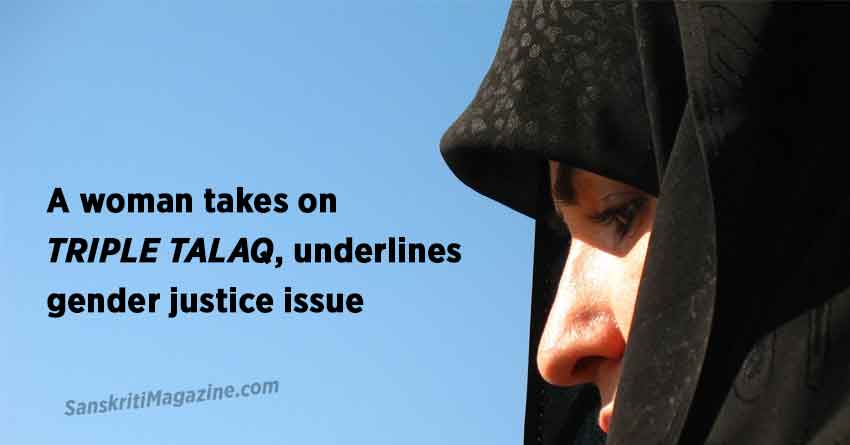
Shayara Banu’s case has seen the government being forced to dust off a year-old report that recommended a ban on the practice.
Shayara Banu had convinced herself that if she was docile enough, her husband would not carry out his oft-repeated threat of divorcing her. The mother of two, a sociology postgraduate, says she tried not to argue when she was told she could not work or visit relatives. Not even when she was routinely beaten, and forced to go through six abortions that made her a physical and mental wreck. Then, a year ago, when she was very sick, her husband sent her away from their home in Allahabad to her parents’ place in Uttarakhand. “Within months, he sent me a letter that had the word talaq written on it thrice, ending our 15-year marriage. I have not been allowed to see my children ever since,” Shayara says.
The 35-year-old has approached the Supreme Court seeking not just justice for herself, but a ban on triple talaq, polygamy and halala, the custom that mandates that if a woman wants to go back to her husband following divorce, she must first consummate her marriage with another man. While Muslim women have time and again taken legal recourse to seek maintenance, including in the historic Shah Bano case of 1985, Shayara’s is the first attempt at raising wider, more fundamental questions around such practices.
In the wake of the petition, the Supreme Court has forced the government to dust off a year-old comprehensive report by a high-level expert committee, whose recommendation to ban triple talaq and polygamy has not been acted upon so far.
Standing against Sharaya’s petition seeking enforcement of her fundamental right to equality and protection of life and liberty is the All India Muslim Personal Law Board (AIMPLB), which views such reforms as an infringement by the state on its fundamental right to religion. On Sharaya’s side are a few Muslim scholars and women’s organisations who hold that in Islam, a man’s right to three utterances of talaq holds only if spread over a period of 90 days, and after several attempts at reconciliation have failed.
A Muslim woman’s right to seek divorce (known as khula) has been codified under the Dissolution of Muslim Marriages Act, 1939, which requires them to approach the courts for initiating the process. On much else, the Muslim Personal Law (Shariat) Application Act, 1937, states that the shariat will govern Indian Muslims — without specifying what these laws actually are. This has created the scope for convenient patriarchal interpretations, whereby talaq is pronounced unilaterally and instantaneously and at times, even impersonally through SMSes, emails or over the phone.
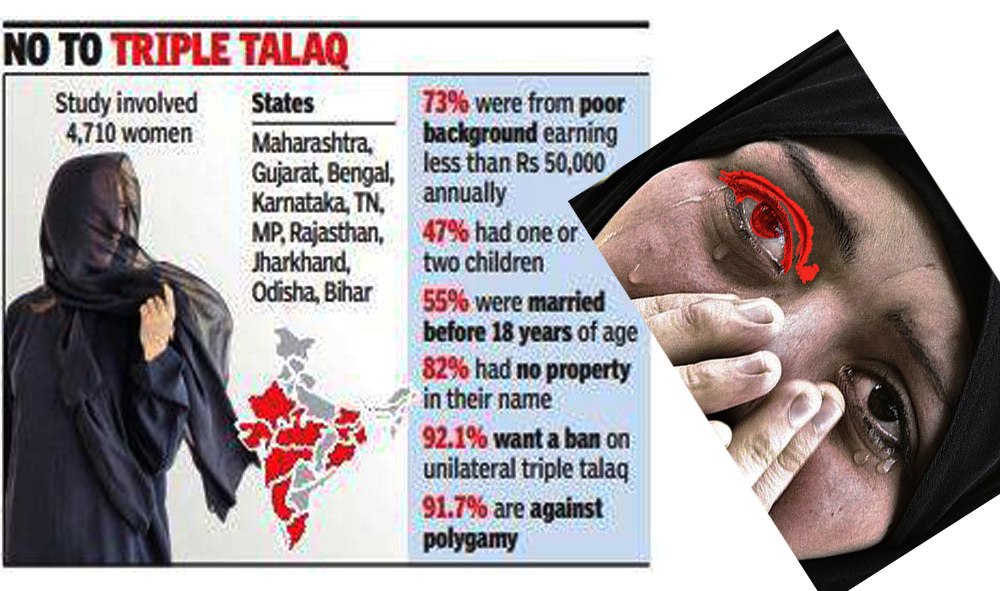
A 2015 survey of 4,710 women spread across 10 states by the autonomous national coalition, the Bharatiya Muslim Mahila Andolan (BMMA), found that over 90 per cent wanted an end to polygamy and triple talaq. Of the 525 divorced women among the respondents, 78 per cent had been given triple talaq; 76 of these women had had to consummate a second marriage so that they could go back to their former husbands.
On polygamy, the last available data from the census of 1961 shows the incidence among Muslims to be lower than among Adivasis, Buddhists and even Hindus. BMMA co-founder Zakia Soman, however, says that there is often a link between the high rate of triple talaq and polygamous marriages that Muslim men keep under wraps.
Most Muslim countries including Pakistan and Bangladesh have outlawed such exploitative practices. Tahir Mahmood, an internationally acclaimed author of several books on Sharia law and a former Minorities panel chairperson, points out that in India, orthodox community leaders hold triple talaq to be effective once uttered, as they consider it bad in theology but good in law. He attributes the practice to the upholding, by the Caliph Omar in the 7th century AD, of a few stray utterances by men — only because their wives no longer wanted to be with them.
“Irrespective of the government in power, the only choice given to Muslims in India is either maintaining status quo or going for a Uniform Civil Code,” said Mahmood, who has been vocal in his demand for doing away with the AIMPLB, a body that comprises just 12 per cent women. Mahmood terms “over-sensitivity” by successive governments as the “minority syndrome” that is evident in Pakistan and Bangladesh too, where Muslim laws have undergone several changes, but laws governing the Hindu minority have remained largely untouched.
The issue of a Uniform Civil Code, as envisioned in Article 44, is likely to remain contentious. It raises fears of a majoritarian Hindu jurisprudence; besides, such a code requires a willingness to purge Hindu personal law of its own anti-women dogmas in marriage, inheritance and guardianship laws, and to give up the tax benefits enjoyed by the Hindu Undivided Family.
The high level expert panel noted in its report: “The approach should not be one of ensuring that there is one law for all, but rather, that all women, whether they choose to be governed by secular laws or their personal laws, enjoy equality which the Indian Constitution promises them.”