IndianSanskriti

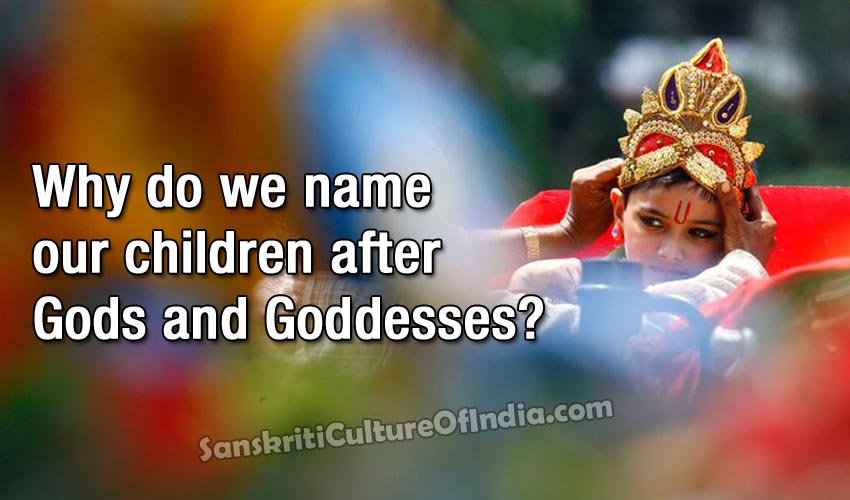
Why Do We Name Our Children After Gods and Goddesses ?

With the aim of making this question more lucid; your attention will be drawn first to a familiar concept in self-help, that of affirmation.

An affirmation is a phrase or word repeated with the intention of bringing that item or quality about into our life. For example the affirmation ‘peace’ may be repeated. T he theory is that by repetition a new neural pathway is created moving away from unwanted qualities to those more desirable so that the positive focus becomes habitual.

Now imagine if one was faced with a newborn baby who was not exposed to any negativity in their life but a blank slate, what you want to the newborn to resonate with throughout their life? Perhaps one starts a trust for their education. In Hinduism there is often one important step, that of Namakarana or naming ceremony as can be seen in other religions.

Some may choose the highest quality they can think of, the English name Felicity comes to mind. For a Hindu, a God is a representation of the highest quality which any man can possess; hence, there are many Gods to represent these qualities. However this is just one stance on the complex issue.

Gods and Goddesses are often personifications of these qualities; such as ‘Lakshmi’, the Goddess of abundance, wealth and prosperity. One may want this to be the resonance for their child. The repetition of the child’s name is then also a spiritual practice, that of ‘japa’, or repetition of God’s name for spiritual advancement.

This affirmative name becomes part of the initial seat of consciousness for the child and without a doubt the child will be exposed to the lore of the Goddess, thus creating a subconscious archetype to identify with, an ideal to aspire to right from birth.

The Namakarana, or naming ceremony also needs careful preparation, often with the consultation of an astrologer. The astrologer looks at the chart of the child and sources another important vibration; that of child’s first name based on the sidereal star at birth in the chart.  This system is much akin to the western astrological tradition of fixed stars. Thus the first letter sound of a baby is also a ‘mantra’, an affirmative spiritual sound vibration. This combined with the name of a God or Goddess  (often the ‘personal deity’ also identified from the chart) and parents often feel fulfilled in giving the best start to their newborn.

~ Dhanjyoti Sanghvi
You may also like

Search the website

Like us on Facebook

Get daily updates via Email

Enter your email address:

Recent Posts

Yogini Ekadashi 2026 — The Yaksha Who Missed the Morning Flowers, and the Ekadashi That Undid His Curse

On Friday, July 10, 2026, the rare Krishna Paksha Ekadashi of Nija Ashadha arrives. The Padma Purana tells the story of Hemamali — the Yaksha gardener of Bhagavan Kubera in Alaka, whose single morning of distraction with his wife Vishalakshi cost him his form, his wife, and his celestial city. Cursed to wander the earth of Bharata as a leper for a long time, he was at last shown the way back by Sage Markandeya — a single sincere keeping of Yogini Ekadashi.

Jamai Shashthi 2026 — The Story of Maa Shashthi, the Cat, and the Wife Who Was Forgiven

Jamai Shashthi 2026 — The Story of Maa Shashthi, the Cat, and the Wife Who Was Forgiven

On Saturday, June 20, 2026, Bengali households across Bharata will welcome their married daughters and sons-in-law home for the legendary jamai-aador feast and perform the Shashthi Vrata. But behind the warmth lies a story most Bengalis know by heart and most non-Bengalis have never heard — the wife who stole the hilsa, blamed the cat, lost six sons to Maa Shashthi’s wrath, and was finally forgiven. The Vrat Katha, the vidhi, the mantras, and the deeper teaching.

Vat Purnima 2026 — The Wife Who Argued Yama Into Returning Her Husband’s Life

On Monday, June 29, 2026, women across Maharashtra, Gujarat, and southern Bharata will tie red thread around banyan trees and hear the story of Savitri — the wife who walked behind Yamaraja Himself when He came for her husband, and out-argued the Lord of Dharma into returning Satyavan’s life. The Mahabharata’s Pativrata Mahatmya Parva, the vrat vidhi, and why the banyan witnessed everything.

Nija Jyeshtha 2026 — The Real Jyeshtha Begins, and the Calendar Resumes

Nija Jyeshtha 2026 — The Real Jyeshtha Begins, and the Calendar Resumes

With Adhik Maas now closed on the Somvati Amavasya of June 15, the long-postponed festivals of Jyeshtha return — Vat Purnima (June 29, the Savitri-Yamaraja katha), Jamai Shashthi (June 20, the Bengali festival of Maa Shashthi), Sankashti Chaturthi (June 28), Yogini Ekadashi (July 10), and Devshayani Ekadashi (July 16, opening the four-month Chaturmas of Bhagavan Vishnu’s yoga-nidra). A guide to what the next four weeks hold and what the household that kept Purushottam Maas now carries forward.

The Closing of Purushottam Maas 2026 — Adhik Amavasya and the Sealing of the Month-Long Vrat

On Monday, June 15, 2026 — a rare Somvati Amavasya — the intercalary month that bears Bhagavan Vishnu’s own name comes to its close. The Acharyas teach that a vrat is not measured by its duration but by its closing. Here are the Padma Purana’s instructions for sealing the month-long Purushottam Maas vrat: the morning snan, the closing puja with the Vishnu Sahasranama, the day of dana, the Somvati Amavasya gift, and the final sarva-arpana — the offering of all merit at the feet of the Lord.

css.php