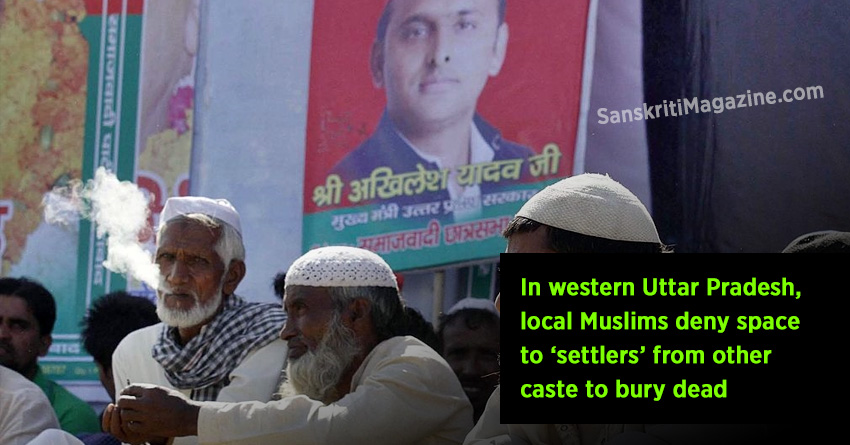
BUDHANA: A few months ago when 65 year old Mehrudin died in Kheda Mastan village in BUDHANA, his widow Asgari did not even get proper time to mourn. “We were running around finding space for his burial. The graveyard nearby for Qureshis has no space for us,” said Ahmed, his nephew.
 Finally, Mehrudin did get a resting place, but only after the family shelled out Rs 1200. From the dhobi community, Mehruddin and Ahmed are among the hundreds who migrated to Budhana after the Muzaffarnagar riots in 2013.
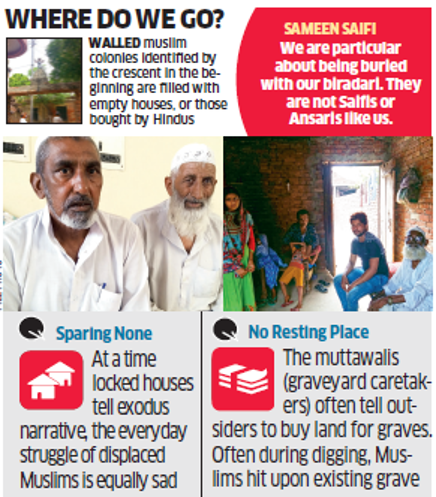
Nearly 400 families like theirs are trying to build their lives afresh in Budhana but are largely seen as outsiders in their own community, and often even denied space for burying their dead in Muslim graveyards. Several towns in western Uttar Pradesh, including Kairana that is under the siege of Muslims, have strictly different graveyards for different Muslim communities – Saifis, Ansaris, Qureshis, Kumbe,Abbasis, Sheikhs and others but none for the Muslims who have migrated to these places in the last few years. These communities have to be pay Rs 1000 to Rs 2000 to find a grave, or usually end up burying their dead on top of already existing graves in the outskirts of graveyards.
Death is an issue of dignity. Even mughal king Bahadur Shah Zafar who was banished to Rangoon by the British had lamented that he couldn’t be buried in his own country. The same worry plagues the large number of the dhobis – mostly labourers now and the Bisatis – a clan of ‘moving traders’ of clothes,nail polish,Bindis and other items, among the dominant castes among displaced and migrant Muslims in western UP.
Graveyards are a political issue in western UP. As soon as the samajwadi party government took charge in 2012 it started implementing its poll promise of renovating and beautifying Muslim graveyards as part of a Rs 300 crore project that is being countered by MP Sanjeev Baliyan who is building crematoriums for the hindus with his MP funds.
In July last year, Muslims and Sikhs clashed in UP’s Saharanpur when a structure was being constructed on a vacant plot that the Muslim community claimed was a graveyard.
“My forefathers came here from Pakistan during the time of Shahjahan and settled in Panipat, We are sheikhs too with knowledge of the best karigari(artistry) but the qureshis don’t consider us as one of them. The muttawali (graveyard caretaker) told us to buy land for our own graves. Often when we dig to find graves we hit upon an already existing grave… ,” Abdul Kamal, a garment trader in nayi tehsil in Budhana.
The gram pradhan here recently had allocated six bigha land for a “common cemetry” for all communities of Muslims on the outskirts of Budhana but it is still not easy finding space. “Especially if you have the body of a dhobi or a low born muslim woman they straightaway refuse any land,” said Tamanna Rashid in Khanpur.
A km away from Abdul’s house is the town’s main cemetry, where the saifis bury their dead. “The large number of muslims who have come to Budhana after 2013 belong to different communities, mostly of labourers. They are not saifis or ansaris like us. A graveyard for them will be good. We are particular about being buried with our biradari,” said Sameen Saifi, a small time trader in Budhana.