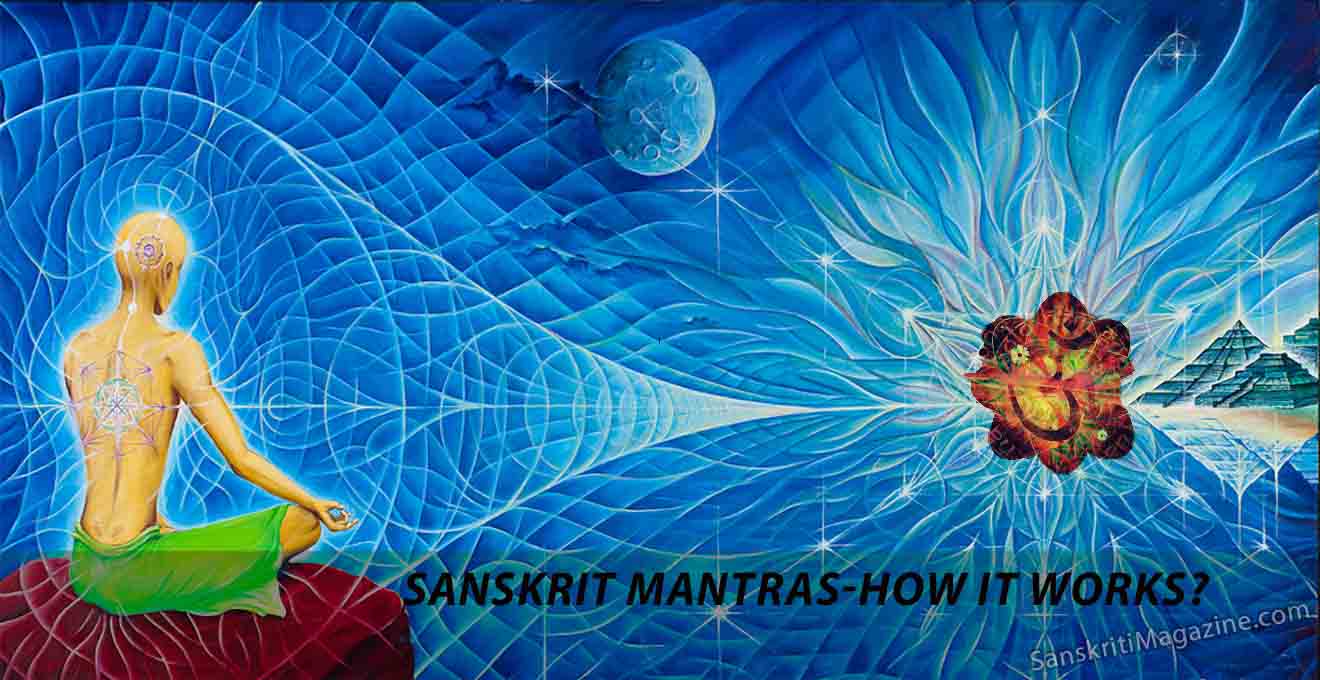
Long, long time ago, from the sparkling womb of Eternity, rose a profound rhyme. It circled the splendid Heavens spreading a rapture so divine that the mystic rishis bowed in veneration as they received the sacred “OM” in the deep recesses of their minds. Pondering on the pulsating rhythms and cosmic cadence of the great unknown, they created a new language Sanskrit to commune with the universe, and bring its resplendent knowledge and mystic secrets to the whole world. And thus began the fascinating ascent of Sanskrit.
Beginning with the Rig Veda, the Sanskrit juggernaut straddled the ancient world, bringing to life vast treasures of knowledge in every field of human endeavor. It has lent its resilience to incorporate a panorama of ideologies and learning, ranging from mammoth metaphysical and philosophical speculations, scientific and mathematical calculations, literary expressions, medicine and surgery, hypnotism and chess to name only a few. As early as the first century A.D., concepts of Algebra, infinity, negative numbers, the decimal system, value of pi, square roots, cube roots, Geometry, Trigonometry, Vedic Mathematics, Calculus, atomic and magnetic theory, radium, electronics, airship, Chemistry, Metallurgy, Medicine, Surgery, action of blood vessels with their circulation, processes such as tempering of steel and dyeing of cloth, use of metals and metallic compounds, and shipbuilding were all expressed in Sanskrit.
The Scientific potential of Sanskrit has not gone unnoticed. Modern Thailand has adopted Sanskrit words for technical, scientific and Governmental terms. Eulogies pour in from great Scientists of the world including Werner Heisenberg (quantum mechanics), Johnstone, Wilcox, Thoreau, Woodroffe and Einstein to name a few. The concept of “Shunya” or the Sanskrit equivalent of “zero” has been hailed the world over. Says Lancelot Hogben, a versatile British zoologist “There has been no more revolutionary contribution than the one which the Hindus made when they invented ZERO.”
Most of this is known to our countrymen as well as many scholars around the world.
Question is what happened afterward? With so much scientific terms in Sanskrit and in the heritage of India, why has there been no effort to promote Sanskrit? Why has the spiritual binding force which expressed the immortal Bande Mataram languishing in neglect? The answer is obvious. The politicians who ruled to loot have continued the line of the Mughals and the British.
Driven by greed for votes and straitjacketed by political correctness, the new Mughals have not only slaughtered the cultural odyssey of centuries, but have also left a damaging psyche filled with loathing for anything that even remotely smacks of Hinduism, and thus the medium of Hindu scriptures- Sanskrit.
Fortunately change comes, come what may. The new private players in India have seen the light. Modern Management institutes talk about the concepts of decentralization and delegation gleaned from scriptures such as Prashnopanishad. Amazing structures and principles are buried in Vedic Math. One enterprising student from IIM Bangalore has used the power of Vedic Math (via his site magicalmethods.com) to assist other students to pass the CAT exam. Several articles use ancient Sanskrit texts to study spiritual eco systems necessary to produce innovation, decision making and leadership qualities. Recognition is seeping in that there is a spiritual component to producing leaders and to promoting creativity. It is no coincidence that when Sanskrit was revered, India was the most prosperous and innovative nation on the earth, and all roads led to its beckoning frontiers.
Speaking of Management, it is also grappling with the rough reality of Intellectual Property Rights. For example, A Virginia based Pharmaceutical Company, Insmed Inc, uses Arhar extracts to cure Diabetes. But Arhar is used daily in India and Ayurvedic texts describe how to use Arhar to cure diabetes. However, the credit for Arhar is given to a 1968 journal in the West not to Ayurveda.
The culprit is not the West but a serious shortage of Sanskrit scholars and physicians, who could not present the case with required documentation. Also, tremendous amount of knowledge is out there in palm leaves and unearthed manuscripts, which foreigners are diligently picking up by training themselves in Sanskrit and building up a knowledge repertoire. A German firm has patented the Gayathri mantra, and patents are out for Yoga systems. And it is a matter of time before the knowledge hungry West burrows through volumes of Ayurveda and old scientific texts and produces the information in a new and disguised form, depriving India of valuable intellectual property rights.
“Knowledge Economy” is the new buzzword and the world is gearing up for it. The new rulers will not be those with big guns, but those who can tell a better story using their media expertise and technical skills to mine the world’s knowledge. Geopolitical conflicts would occur depending on the quantity of intellectual property rights a country owns. As the saying goes, “quantity has a quality all its own.”
The grand sweep of Sanskrit is evident in the unifying power of rituals. The mantras for marriages, funerals and the varied customs are the same from Kashmir to Kanyakumari providing a culturally and spiritually unifying force, the only strong link that fosters such an emotional unity throughout the length and breadth of India. This is no mean achievement for such a vast and diverse nation, a tribute to the formidable grit of our ancestors who kept Sanskrit alive at a great risk to their lives under the bigoted and cruel Aurangzeb and the Mughals.
Speaking of Aurangzeb, those were the times time when people valued principles. The courage and daring of Shivaji and the martyrdom of Sikhs sprang straight from the nurturing environment of classics. As early as the 13th century, the Western world was aware that the classics are priceless in encouraging a principled existence, nourishing human values and building character. Study of Latin and Greek writings propelled the rise of the West (via the Renaissance) from the dark ages to world leadership. Even the founding fathers in America promoted and valued classical texts and literature. Thomas Jefferson carried his Greek grammar book wherever he went. In 1750 Harvard, students were taught lessons in virtue and liberty from the works of Plutarch, Xenophon, Tacitus, Polybius, Sallust and Herodotus
Similarly, classics through the medium of Sanskrit has the potential to stoke the fires of renaissance. Ramayana and Mahabharata, the Gita and the Upanishads along with popular myths, legends, folklore, ballads in Sanskrit champion virtue, chivalry, justice and truth, providing spiritual nourishment to the vast and varied population of India. When India abandoned Sanskrit, it lost the virtues of truth and justice. From a country that produced martyrs, it went to producing men who disdainfully proclaim “Me first, country last.”
There are some stirring signs of awareness regarding the power and potential of Sanskrit. Many private organizations and institutions have informally promoted Sanskrit.The CBSE schools have designated a Sanskrit week from Aug 7th through the 13th. To stimulate interest and increase awareness, students will encourage speech competitions, compose poems, recite from texts, participate in essay contests, and develop apps and games to stimulate interest. It is a small spark fostered by a nascent nationalist Government that hopefully will blaze into the fiery brilliance and gigantic intellect of the rishis.
Even though Sanskrit lies buried under cultural wastelands, it still holds the roots of Indian cultural and philosophical renaissance. The upheavals of Time may have decayed some of the roots, but they are still there, waiting for the waters of revival. The sooner it comes, the faster it can rebuild the destiny of the nation.
As someone rightly said, “A race with its roots pulled out can have no future.”
~ Aneeta Chakrabarty lives in Houston with her husband and two daughters. She works in the Department of Education and also teaches Chemistry in the community college. Writing is her hobby.