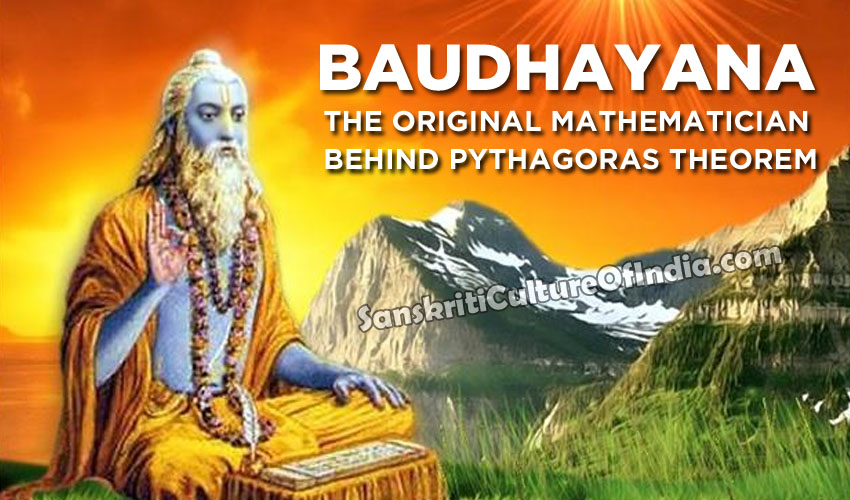
Baudhayana, (fl. c. 800 BCE) was an Indian mathematician, who was most likely also a priest. He is noted as the author of the earliest Sulba Sutra—appendices to the Vedas giving rules for the construction of altars—called the Baudhayana sulbasutra, which contained several important mathematical results. He is older than the other famous mathematician Apastambha and belongs to the Yajurveda school. Baudhayan was the first one ever to arrive at several concepts in Mathematics, which were later rediscovered by the western world. The value of pi was first calculated by him. As you know, pi is useful in calculating the area and circumference of a circle. What is known as Pythagoras theorem today is already found in Baudhayan’s Sulva Sutra, which was written several years before the age of Pythagoras.
Contribution of Baudhayana:
The Shrautasutra:
His shrautasutras related to performing Vedic sacrifices has followers in some Smarta brahmanas (Iyers) and some Iyengars of Tamil Nadu, Kongu of Tamil Nadu, Yajurvedis or Namboothiris of Kerala, Gurukkal brahmins, among others. The followers of this sutra follow a different method and do 24 Tila-tarpana, as Lord Krishna had done tarpana on the day before Amavasya; they call themselves Baudhayana Amavasya.
Pythagorean theorem:
The most notable of the rules in the Baudhayana Sulba Sutra says that, a rope stretched along the length of the diagonal produces an area which the vertical and horizontal sides make together. Bodhayana also states that if a and b be the two sides and c be the hypotenuse, such that ‘a’ is divisible by 4 (as in all pythogorean triplets one of the two shorter sides ateast is divisible by 4).
Now, c = (a – a/8) + b/2 This method makes us solve without using squares and square roots. This appears to be referring to a rectangle or a square (in some cases as interpreted by some people), although some interpretations consider this to refer to a square. In either case, it states that the square of the hypotenuse equals the sum of the squares of the sides. If restricted to right-angled isosceles triangles, however, it would constitute a less general claim, but the text seems to be quite open to unequal sides. If this refers to a rectangle, it is the earliest recorded statement of the Pythagorean theorem.
Baudhayana also provides a non-axiomatic demonstration using a rope measure of the reduced form of the Pythagorean theorem for an isosceles right triangle:
The cord which is stretched across a square produces an area double the size of the original square.
Circling the square:
Another problem tackled by Baudhayana is that of finding a circle whose area is the same as that of a square (the reverse of squaring the circle). His sutra i.58 gives this construction:
“Draw half its diagonal about the centre towards the East-West line; then describe a circle together with a third part of that which lies outside the square”.
Square root of 2:
Baudhayana gives the length of the diagonal of a square in terms of its sides, which is equivalent to a formula for the square root of 2. The measure is to be increased by a third and by a fourth decreased by the 34th. That is its diagonal approximately. That is 1.414216 which is correct to five decimals.
Other theorems include:
Diagonals of rectangle bisect each other, diagonals of rhombus bisect at right angles, area of a square formed by joining the middle points of a square is half of original, the midpoints of a rectangle joined forms a rhombus whose area is half the rectangle, etc.