The vibrant celebration of Holi is not just a festival of colors; it’s a manifestation of the divine love shared between Radha and Krishna. This story, deeply embedded in the cultural and spiritual history of India, symbolizes the joy, playfulness, and the deep, abiding love that transcends the physical realm. It’s a tale that resonates with the core essence of Holi, celebrating not just the coming of spring but the eternal love that binds the universe.
The Divine Play (Lila)
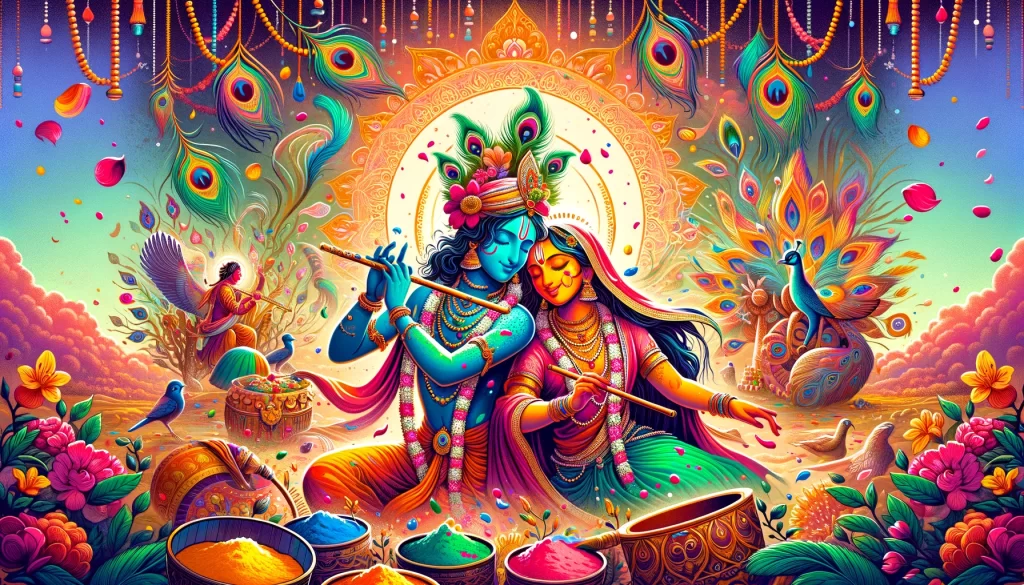
In the lush groves of Vrindavan, the young Krishna, with his mesmerizing flute, would often play with his beloved Radha and the Gopis (cowherd girls). It’s said that Krishna, distressed by his dark complexion, wondered if Radha and the Gopis would find him less appealing compared to themselves. To remedy this, Krishna’s mother suggested he color Radha’s face in any hue he desired. Taking this to heart, Krishna playfully applied colors to Radha and the Gopis, an act which transcended mere play and became a celebration of love, equality, and joy.
This playful act of coloring Radha’s face is believed to be the origin of Holi’s tradition of applying colors. It represents the divine love that sees beyond appearances, celebrating the spirit of unity and inclusiveness.
The Symbolism of Colors
The use of vibrant colors during Holi is deeply symbolic. Each color carries a meaning, reflecting aspects of life and emotion. Blue, the color of Krishna, symbolizes the divine; green stands for new beginnings and nature; red represents love and fertility; and yellow, the color of turmeric, signifies health and happiness. When we smear colors on each other during Holi, we replicate the divine play of Krishna and Radha, embracing the joy and love that defines our existence.
Celebrating Universal Love
The legend of Radha and Krishna during Holi transcends the boundaries of mere folklore, entering the realm of spiritual teaching. It teaches us about the power of unconditional love, the joy of togetherness, and the importance of looking beyond the superficial. Holi, in its essence, is a celebration of this divine love, encouraging us to open our hearts and embrace all of humanity with warmth and affection.
Reflections on the Celebration
As we immerse ourselves in the colors of Holi, let us remember the deep, spiritual love of Radha and Krishna. Their story is not just an ancient legend but a living, breathing ethos that celebrates love, equality, and the joy of being. Let us carry the spirit of their divine love in our hearts, spreading joy, color, and positivity in the world around us.
In this way, Holi becomes more than just a festival; it’s a celebration of life itself, inspired by the divine love story of Radha and Krishna. It invites us to embrace love in all its forms, celebrating the beauty of diversity and the joy of unity in our lives and communities.