IndianSanskriti

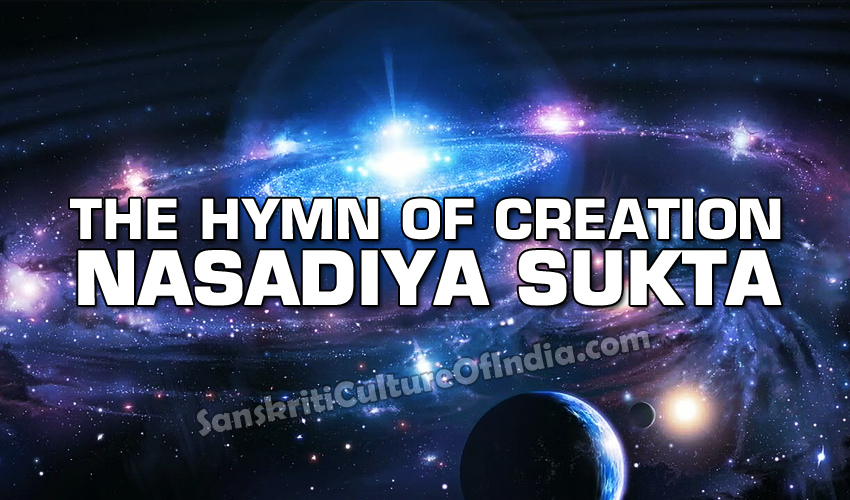
The Hymn of Creation: Nasadiya Sukta

Nasadiya Sukta is a famous hymn of the tenth mandala (Rig Veda 10:129), which is generally regarded as one of the later hymns, probably composed in the 9th century BCE.  “Not the Non-existent”, and is often given the English title Creation, because of its subject.

The hymn reveals an insoluble paradox in which the human mind of the past as well as the present easily gets trapped. Much of what puzzled people three thousand years ago, still puzzles us today. So, we should be wary of taking for granted that our ancestors were intellectually inferior to us. We have more facts, but they knew what we still would not know today, nor tomorrow.

That’s what this Creation hymn of Rig Veda points out.

नासदासीन् नो सदासीत् तदानीं नासीद् रजो नो व्योमापरो यत्
किमावरीवः कुह कस्य शर्मन्नम्भः किमासीद् गहनं गभीरम्

There was neither non-existence nor existence then.
There was neither the realm of space nor the sky which is beyond.
What stirred?  Where?  In whose protection?
Was there water, bottom-lessly deep?

न मृत्युरासीदमृतं न तर्हि न रात्र्या अह्न आसीत्प्रकेतः
आनीदवातं स्वधया तदेकं तस्माद्धान्यन् न परः किं चनास

There was neither death nor immortality then.
There was no distinguishing sign of night nor of day.
That One breathed, windless, by its own impulse.
Other than that there was nothing beyond.

तम आसीत् तमसा गूळमग्रेऽप्रकेतं सलिलं सर्वमाइदम्
तुच्येनाभ्वपिहितं यदासीत् तपसस्तन्महिनाजायतैकम्

Darkness was hidden by darkness in the beginning,
with no distinguishing sign, all this was water.
The life force that was covered with emptiness,
that One arose through the power of heat.

कामस्तदग्रे समवर्तताधि मनसो रेतः प्रथमं यदासीत्
सतो बन्धुमसति निरविन्दन् हृदि प्रतीष्याकवयो मनीषा

Desire came upon that One in the beginning,
that was the first seed of mind.
Poets seeking in their heart with wisdom
found the bond of existence and non-existence.

तिरश्चीनो विततो रश्मिरेषामधः स्विदासी दुपरिस्विदासी
रेतोधाआसन् महिमान आसन् स्वधा अवस्तात् प्रयतिः परस्तात्

Their cord was extended across.
Was there below? Was there above?
There were seed-placers, there were powers.
There was impulse beneath, there was giving forth above.

को अद्धा वेद क इह प्र वोचत् कुत आजाता कुत इयंविसृष्टिः
अर्वाग् देवा अस्य विसर्जनेनाथा को वेद यतआबभूव

Who really knows? Who will here proclaim it?
Whence was it produced? Whence is this creation?
The gods came afterwards, with the creation of this universe.
Who then knows whence it has arisen?

इयं विसृष्टिर्यत आबभूव यदि वा दधे यदि वा न
यो अस्याध्यक्षः परमे व्योमन् सो अङ्ग वेद यदि वा नवेद

Whence this creation has arisen
– perhaps it formed itself, or perhaps it did not –
the One who looks down on it,
in the highest heaven, only He knows
or perhaps He does not know.
You may also like

Search the website

Like us on Facebook

Get daily updates via Email

Enter your email address:

Recent Posts

Jamai Shashthi 2026 — The Story of Maa Shashthi, the Cat, and the Wife Who Was Forgiven

Jamai Shashthi 2026 — The Story of Maa Shashthi, the Cat, and the Wife Who Was Forgiven

On Saturday, June 20, 2026, Bengali households across Bharata will welcome their married daughters and sons-in-law home for the legendary jamai-aador feast and perform the Shashthi Vrata. But behind the warmth lies a story most Bengalis know by heart and most non-Bengalis have never heard — the wife who stole the hilsa, blamed the cat, lost six sons to Maa Shashthi’s wrath, and was finally forgiven. The Vrat Katha, the vidhi, the mantras, and the deeper teaching.

Vat Purnima 2026 — The Wife Who Argued Yama Into Returning Her Husband’s Life

On Monday, June 29, 2026, women across Maharashtra, Gujarat, and southern Bharata will tie red thread around banyan trees and hear the story of Savitri — the wife who walked behind Yamaraja Himself when He came for her husband, and out-argued the Lord of Dharma into returning Satyavan’s life. The Mahabharata’s Pativrata Mahatmya Parva, the vrat vidhi, and why the banyan witnessed everything.

Purushottam Maas — The Month No Deity Would Claim, and the Lord Who Made It Supreme

Every month of the Hindu calendar has a lord — except the rare thirteenth, the Adhika Maas, born an orphan and shunned as the “impure month.” The Puranas tell how this rejected month went in grief to Bhagavan Vishnu, who claimed it, gave it His own name — Purushottam — and made it the most fruitful month of all. The origin story, the teaching, and what it means for Purushottam Maas 2026 (May 17 – June 14).

Padmini Ekadashi 2026 — The Ekadashi Even the Devas Descend to Keep

Padmini Ekadashi 2026 — The Ekadashi Even the Devas Descend to Keep

The rarest Ekadashi of the entire Hindu calendar is three days away. The Padma Purana preserves a conversation between Bhagavan Krishna and Yudhishthira about a single Ekadashi the great Rishis spend lifetimes waiting for — Padmini. The Vrat Katha of Queen Padmini of Mahishmati, the lotus teaching, and why May 27, 2026 is the morning Vaishnavas across Bharata are preparing for.

Varada Chaturthi 2026 — The Rare Ganesha Day of Purushottam Maas

Varada Chaturthi 2026 — The Rare Ganesha Day of Purushottam Maas

Once every 2.5–3 years — when the rare 13th month of Adhika Maas opens — a thirteenth Vinayaka Chaturthi appears. The Mudgala Purana calls it Varada Chaturthi, the “boon-giving” Chaturthi, and holds it as the most fruit-bearing Ganesha day of the entire calendar. Today, Wednesday May 20, 2026, is that day.

css.php