The three humors are responsible for the functioning of the human organism according to the Ayurveda. When the three doshas Vata, Pitta and Kapha reside undisturbed in their proper organs and tissues, the organism is supported by them and is in balance. When disturbed, they cause disease and deterioration of the body.
Of all of them, Vata (Wind) is the key. Pitta and Kapha cannot move from their centers unless the air within the body carries them.
Through birth and prolonged specific behaviour, one dosha may dominant, or a combination of two doshas is dominant. Some people have all 3 doshas in relative balance. An ayurvedic doctor may establish your dominant body type through feeling the pulse. To give a very general idea, one might say that Vata dominated people are relatively thin, Pitta dominated people are relatively athletic and Kappha dominated people are relatively rounded
| DOSHA | ELEMENTS | SUBDOSHAS | ORIGIN |
| Vata (Wind) | Air and Akasha | Prana Vata | Chest region |
| Udana Vata | Thoracic and throat region | ||
| Samana Vata | Hearth and navel region | ||
| Vyana Vata | Hearth and circulatory vessels | ||
| Apana Vata | Pelvic region | ||
| Pitta (Bile) | Fire and Water | Pachaka Pitta | Liver and pancreas |
| Ranjaka Pitta | Liver and spleen | ||
| Sadhaka Pitta | Hearth | ||
| Alochaka Pitta | Eyes | ||
| Bhrajaka Pitta | Skin | ||
| Kapha (Mucus) | Water and Earth | Kledaka Kapha | Stomach |
| Avalambaka Kapha | Hearth, chest and lower back regions | ||
| Bodhaka Kapha | Mouth, Tongue and throat | ||
| Tarpaka Kapha | Head (cerebrospinal fluid) | ||
| Sleshaka Kapha | Joints |
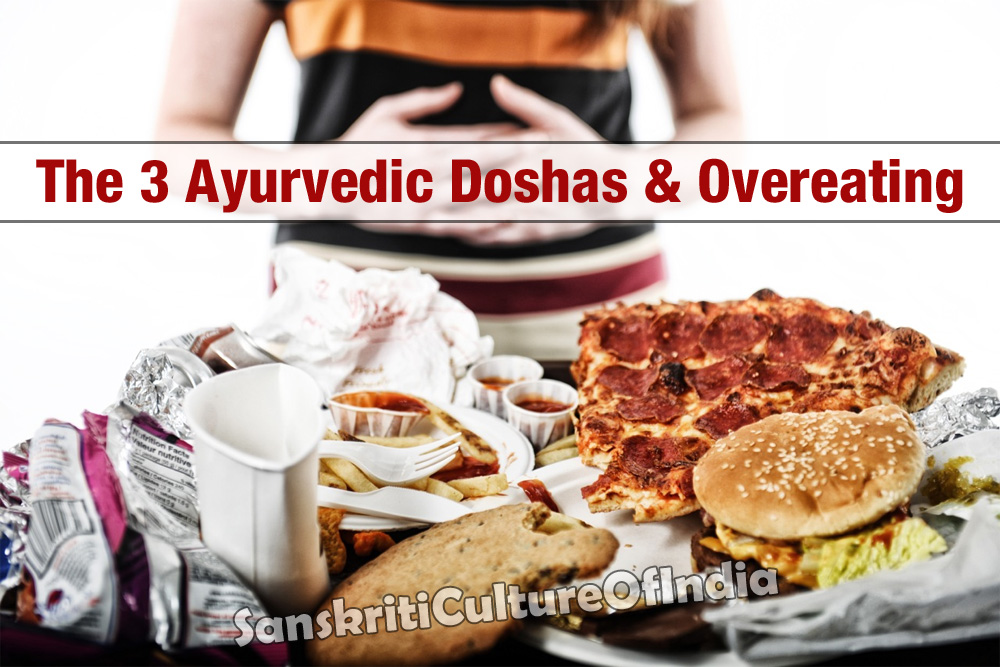
Overeating and Dosha Imbalance in Ayurveda
When it comes to ayurvedic diet and wellness, in a holistic sense, we should remember that we truly are what we eat. Overeating (regardless of food type) will have lasting effects on our strength, complexion, weight, longevity, virility, and ojas (the pure and subtle substance that’s extracted from completely digested food).
In terms of cause and effect (Kamma in Buddhism) overconsumption inevitably afflicts the body, mind, and senses; eventually bringing about harm to the dhatus (7 bodily tissues). Obstructions start forming in the stomach, moving through the upper and lower tracts; and in time the Srotamsi (Circulatory Channels) get all clogged up, leading to disease tendencies according to one’s dosha in Ayurveda:
For Vata – constipation, dry mouth, fainting, malaise, sudden giddiness, irregular digestion, stiffness and rigidity, hardening / contracting of vessels.
For Pitta – diarrhea, increased internal heat and burning sensation, deep thirst, feeling of intoxication, fever, delirium.
For Kapha – Vomiting , laziness, heaviness, anorexia, indigestion, cold fever, swelling.