IndianSanskriti

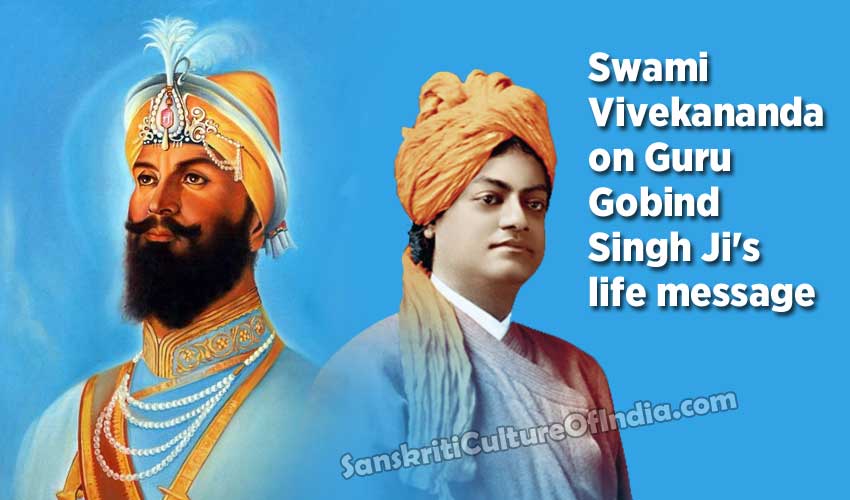
Swami Vivekananda on Guru Gobind Singh Ji’s life message


Swami Vivekananda, while strolling with some of his disciples on the roof of the late Balaram Basu’s house in Calcutta in 1882 recalled the life and message of Guru Gobind Singh ji.

He extolled the Tenth Guru and said:

“His self-sacrifice, austerity, self-discipline and his heroism resulted in the regeneration of the Sikhs as a nation.”*

He recited a passage which was current among the Sikhs: “Savaa lakh se ek ladda-on, tabh Gobind Singh naam kahaa-on!”

As he spoke about Guru Gobind Singh, Swami’s eyes flashed with a strange light, which fascinated his disciples, who gazed spellbound at his countenance and listened to him with rapt attention.

The Swami further said:

“Guru Gobind Singh gave them (the common people) that both the Hindus and Muslims of the time were living under the regime of intense oppression and injustice.

“Guru Gobind Singh not only created a common interest but also gave them the courage to realize it. So Hindus and Muslims alike followed him. He was a great devotee of God’s just power (sakti sadak). His type is rare in India’s history.”

“Here it was that, in later times, the gentle Nanak, preached his marvelous love for mankind. Here it was that his broad heart was opened, and his arms outstretched to embrace the whole world. Here it was that one of the last – and one of the most glorious heroes of our race – Guru Gobind Singh arose.

“The great Guru after shedding his blood, and that of his dearest and nearest, for the cause of religion, for the sake of the down-trodden, the victimized, even when deserted by those for whom this blood was shed, retired into the South, without a word of complaint against his country or his men, without a single word of murmur.

“For India’s re-glorification, you must, each one of you, become Guru Gobind Singh – his true follower.”
You may also like

Search the website

Like us on Facebook

Get daily updates via Email

Enter your email address:

Recent Posts

Yogini Ekadashi 2026 — The Yaksha Who Missed the Morning Flowers, and the Ekadashi That Undid His Curse

On Friday, July 10, 2026, the rare Krishna Paksha Ekadashi of Nija Ashadha arrives. The Padma Purana tells the story of Hemamali — the Yaksha gardener of Bhagavan Kubera in Alaka, whose single morning of distraction with his wife Vishalakshi cost him his form, his wife, and his celestial city. Cursed to wander the earth of Bharata as a leper for a long time, he was at last shown the way back by Sage Markandeya — a single sincere keeping of Yogini Ekadashi.

Jamai Shashthi 2026 — The Story of Maa Shashthi, the Cat, and the Wife Who Was Forgiven

Jamai Shashthi 2026 — The Story of Maa Shashthi, the Cat, and the Wife Who Was Forgiven

On Saturday, June 20, 2026, Bengali households across Bharata will welcome their married daughters and sons-in-law home for the legendary jamai-aador feast and perform the Shashthi Vrata. But behind the warmth lies a story most Bengalis know by heart and most non-Bengalis have never heard — the wife who stole the hilsa, blamed the cat, lost six sons to Maa Shashthi’s wrath, and was finally forgiven. The Vrat Katha, the vidhi, the mantras, and the deeper teaching.

Vat Purnima 2026 — The Wife Who Argued Yama Into Returning Her Husband’s Life

On Monday, June 29, 2026, women across Maharashtra, Gujarat, and southern Bharata will tie red thread around banyan trees and hear the story of Savitri — the wife who walked behind Yamaraja Himself when He came for her husband, and out-argued the Lord of Dharma into returning Satyavan’s life. The Mahabharata’s Pativrata Mahatmya Parva, the vrat vidhi, and why the banyan witnessed everything.

css.php