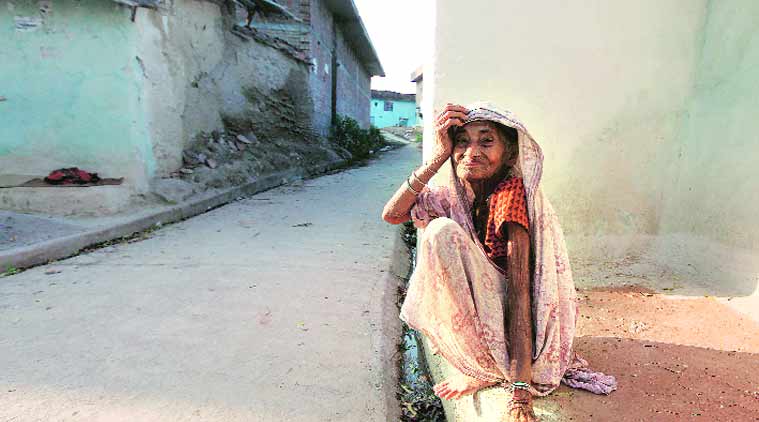
In Tamaura, over 20 of the 200-odd households are locked at any given time. People have migrated for jobs, in more numbers than ever, says the pradhan. Vishal Srivastav
The first month of 2016 had top politicians, including Rahul Gandhi and Akhilesh Yadav, make a beeline for Bundelkhand. But stuck between photo-ops and political blamegame are lives stifled by recurring droughts, crop failures, and lack of jobs. Ramendra Singh tells five stories of Bundelkhand’s daily battles
Akash, 12
Dressed in black thermals and tattered jeans, 12-year-old Akash is waiting for his friends outside his house in village Tamaura to play cricket. It’s only him and his grandfather “Daddi” in the two-room house now.
Of the 200-odd households in Tamaura, in Bundelkhand’s Mahoba district, over 20 are locked at any given time. In December, Akash’s parents Santram (32) and Kusuma (30) left too, with his three younger sisters and two brothers, to work in a brick kiln in Firozabad district, 300 km away.
Akash says he stayed back because he did not want to miss school. “I don’t want to be a labourer. I want to get a government job,” he smiles.
But for the Class VI student, life has changed. His grandfather is 65, and the 12-year-old must sweep the floor, prepare the hearth in the kitchen with cowdung cakes, and often make chapatis before he leaves for school at 8 am. “I know how to knead atta,” he says. “Today there were no vegetables, so we made chutney.”
Chaudhary Sundar Singh Inter-College where he studies is about 10 km away, and he cycles there. When he returns at 4 pm, the chapatis from the morning serve as meal.
Santram, who owns one bigha of land, and his family are among the over 1.83 crore residents of Bundelkhand struggling to make a living in the area drought-ravaged for close to a decade now.
Mahoba district in the UP part of Bundelkhand has been the worst hit, with at least 85 per cent of agricultural land not sown this year. This is the second straight year without income for farmers, whose crops were damaged by rains in February and March last year.
Santram and family will return only in June, when work at the brick kilns halts.
“This year nothing has been sown, increasing the migration to other states,” says pradhan Raju Dixit, adding that many in Mahoba have also disowned their cattle.
Santram’s neighbour Durga Prasad (24) and his brother Vinod (22) go to Delhi to find work as construction labourers. They belong to the Basor sub-caste of Dalits, who traditionally play dhols at marriages — a work that has dried up.
“Boys of our age are married and are fathers by now, but we don’t even have enough food,” says Durga Prasad.
This hour of the evening though, Akash’s mind is on only cricket. His neighbour complains that children like Akash don’t touch them because they are Dalits. Akash intervenes, “This only happens in the village, not at school.”
Later, Akash gets back to his studies, but must start preparing for dinner by 7 pm. “When there is electricity, it is easy to cook. Otherwise, we use the kerosene lamp,” he says. A single bulb hangs outside the kitchen.
Most days, just before he turns in for the night, he speaks to his mother on his mobile phone.
Javitri, 18
Just before Diwali last year, trucks queued up outside Chichara village on NH 86, just like the past few years. Among the villagers who left on it for brick kilns of Rajasthan were parents of 18-year-old Javitri.
Last year the crops on their one-bigha land were damaged by rains, and this time, the fields were not sown because of lack of water.
Village pradhan Narendra says nearly 30 per cent of the residents of Chichara, that has a population of about 3,500, have left in search of work. Villagers say earlier only the poor migrated, now even landowning communities do. “Even Thakurs and Brahmins have left,” says Dinesh Dwivedi.
Javitri, who dropped out of school in 2014 after Class XI as her family couldn’t afford her studies, lives alone in the family’s two-room home now. Her aunt and uncle live next door.
“The school was about 6 km away. I took lifts in vehicles passing by,” says Javitri, who hopes to join a new school in their village soon.
Children dropping out of school is a lesser-known fact of Bundelkhand’s perennial drought, with Mahoba among the worst districts of UP. A 2013 report of the state Planning Department says the junior basic school dropout rate in the region went up from 24.41 per cent in 2009-10 to 36.69 per cent in 2012-13 (smaller children move with their families); and from 45.13 per cent to 47.80 per cent in senior basic schools.
Javitri’s 13-year-old brother Chandra Prakash, a Class V student, is among those to have left with the family.
Whenever she can, Javitri borrows her uncle Kamlesh’s phone to speak to her parents. “It is not often,” she says.
Dhalchand Patel, 46
Dhalchand Patel’s father Chaturbhuj had taken a loan of Rs 2 lakh using his Kisan credit card four years ago. The Patels own 10 acres in Ghutai village of Mahoba. Chaturbhuj died in summer last year, leaving behind a family of six and the unpaid loan.
On December 21, Dhalchand, 46, was found dead on a railway track nearby.
His family members say he had got a notice to attend a Lok Adalat in connection with the loan. “The night before his death, he spoke to me about the loan. He was worried,” says Pratap Singh, Dhalchand’s uncle and the village pradhan.
Four of his daughters are married, but Dhalchand was tense about the remaining two. Mamata,16, in Class IX, has been living with a relative in Madhya Pradesh for one and half years. Kusum, 18, who stays with the family, stopped going to school in 2014 when money became tight. She was in Class VIII.
“We are a landowning community, but what we can do? We have been buying wheat to feed ourselves,” says Pratap, who is as worried about his cattle.
In January, UP Chief Secretary Alok Ranjan came visiting, after which the administration distributed fodder for animals.
Mahoba DM Vireshwar Singh insists the situation is not all that bad. “We have been investigating the farmer deaths, but they are not related to agricultural distress.”
Ram Babu Upadhyay, 40
In Kalipahadi village near Mahoba town, Ram Babu Upadhyay, 40, had been struggling to irrigate his eight bigha land, on which he had sown wheat. On January 21, while discussing his problem, Upadhyay fainted, and died before reaching hospital.
“The wheat crop is our only hope,” says his widow Pinki, holding their two-year-old son Manav.
Most of the tubewells have dried up here, with handpumps only providing enough water for drinking. Most of the seven rivers in Mahoba are also dry. The biggest irrigation project, Arjun Sahayak Pariyojana, inaugurated in 2009, is still not complete. The budget was recently doubled to around Rs 1,600 crore.
The Rs 7,266-crore Bundelkhand Package, also announced in 2009, kept aside Rs 3,506 crore for the UP districts. It has proved ineffectual in this round of droughts.
While DM Vireshwar Singh promises the Arjun Sahayak project will be completed by June, disputes over land acquisition and the slow pace of work give hope to few.
Instead, residents worry, come summer, the handpumps too will dry up.
Rameshwar Prasad Rajput, 59
In 2008, during one of his first visits to Bundelkhand, Congress vice-president Rahul Gandhi had walked up to Rameshwar Prasad Rajput, 59, in Nakra village and expressed a desire to visit his house.
“He met my ailing daughter-in-law and had food with us — arhar dal and chapati. He offered Rs 1 lakh, but I declined,” he recalls.
Wearing a torn shirt and trousers, Rajput says his condition has only worsened since. “Both my sons work as labourers. I work as a security guard in Surat. My daughter-in-law’s two deliveries cost me Rs 80,000, and I had to pawn my four bighas.”
So while he voted for the Congress in 2009 and for Uma Bharti in 2012, in 2014, he voted for “Narendra Modi’s party”. The BJP holds all the four Lok Sabha seats in UP part of Bundelkhand, though the Assembly seats are split between the Samajwadi Party and BSP.
Still, when Rahul came this time, to Laadpur village in Mahoba, a hopeful Rajput again lined up.
He sold 1 kg urad dal to arrange money for travel. “I tried to meet him after his speech, but policemen stopped me,” Rajput says. “I am an old man, I cannot fight policemen.”