India is rich not only in its culture and traditional values but also in the vast knowledge ancient Vedic scriptures have to offer.
Among the four Vedas, the Rig Veda is the oldest. The others are Yajur, Sama and Atharva. They are a compilation of suktas or hymns from many different Sages over a vast span of historical time which is evident by different astronomical reference presented. Rishi Ved Vyas bundled these various hymns into different groups much after their creation.
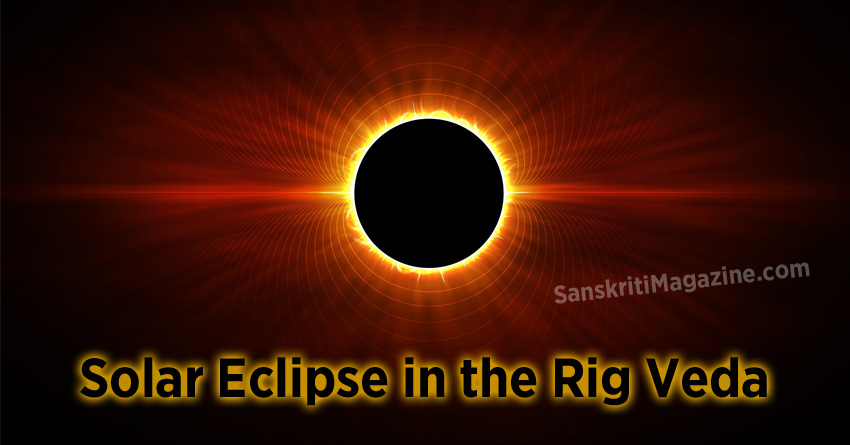
It is in Rig Veda that Rishi Atri, the human son of Brahma, speaks of eclipses in metaphors of demons and devas.
In Chapter 5, Hymn 40 the Sage explains:
यत तवा सूर्य सवर्भानुस तमसाविध्यद आसुरः |
yat tvā sūrya svarbhānus tamasāvidhyad āsuraḥ |
O Sūrya, when the Asura’s descendant Svarbhanu, pierced thee through and through with darkness
अक्षेत्रविद यथा मुग्धो भुवनान्य अदीधयुः ||
akṣetravid yathā mughdho bhuvanāny adīdhayuḥ ||
All creatures looked like one who is bewildered, who knoweth not the place where he is standing.
सवर्भानोर अध यद इन्द्र माया अवो दिवो वर्तमाना अवाहन |
svarbhānor adha yad indra māyā avo divo vartamānā avāhan |
What time thou smotest down Svarbhanu’s magic that spread itself beneath the sky, O Indra,
गूळ्हं सूर्यं तमसापव्रतेन तुरीयेण बरह्मणाविन्दद अत्रिः ||
ghūḷhaṃ sūryaṃ tamasāpavratena turīyeṇa brahmaṇāvindad atriḥ ||
By his fourth sacred prayer Atri disoovered Sūrya concealed in gloom that stayed his function.
मा माम इमं तव सन्तम अत्र इरस्या दरुग्धो भियसा नि गारीत |
mā mām imaṃ tava santam atra irasyā drughdho bhiyasā ni ghārīt |
Let not the oppressor with this dread, through anger swallow me up, for I am thine, O Atri.
तवम मित्रो असि सत्यराधास तौ मेहावतं वरुणश च राजा ||
tvam mitro asi satyarādhās tau mehāvataṃ varuṇaś ca rājā ||
Mitra art thou, the sender of true blessings: thou and King Varuṇa be both my helpers.
गराव्णो बरह्मा युयुजानः सपर्यन कीरिणा देवान नमसोपशिक्षन |
ghrāvṇo brahmā yuyujānaḥ saparyan kīriṇā devān namasopaśikṣan |
The Brahman Atri, as he set the press-stones, serving the Gods with praise and adoration,
अत्रिः सूर्यस्य दिवि चक्षुर आधात सवर्भानोर अप माया अघुक्षत ||
atriḥ sūryasya divi cakṣur ādhāt svarbhānor apa māyā aghukṣat ||
Established in the heaven the eye of Sūrya, and caused Svarbhanu’s magic arts to vanish.
यं वै सूर्यं सवर्भानुस तमसाविध्यद आसुरः |
yaṃ vai sūryaṃ svarbhānus tamasāvidhyad āsuraḥ |
The Atris found the Sun again, him whom Svarbhanu of the brood
अत्रयस तम अन्व अविन्दन नह्य अन्ये अशक्नुवन ||
atrayas tam anv avindan nahy anye aśaknuvan ||
Of Asuras had pierced with gloom. This none besides had power to do.
The Sage describes how Svarbhanu created eclipses of the Sun and Moon and how Sun appears after an eclipse in the sky.
Svarbhanu is Sva+Bha+Anu.
Sva means sky. Bha means light. Anu means follower. Compiled together it means follower of light that is present in the sky. This phenomenon of eclipse is seen due to this shadow where the word Asura stands for the shadow of the moon and not a demon.
Rig Veda says that Svarbhanu was not from the heaven but from the earth, which explains that the moon is a natural satellite of the earth and that it does not have its own brightness but rather reflects the light of the sun.
As shadow of the moon starts covering a large part of the sun, the red tinge of the solar chromosphere becomes visible which is described as the red sheep by Rishi Atri.
When the full solar eclipse takes effect, only the corona can be seen. This is described as the colour of silver sheep. When the eclipse is completely over, the sun is restored to its original bright lustre which is described as the colour of white sheep.
In the fifth stanza tells of all the creatures being frightened and in a terrible condition during the full solar eclipse. The Sage explains that the darkness at the time of this eclipse is different from the normal darkness of the night. The most affected by this darkness are the birds and animals.
It is a well known fact that India’s rich Vedic tradition has had a powerful influence in the field of astronomy and many eclipse events are well documented in the ancient scriptures.
(English translation of the Vedas by Ralph Griffith)