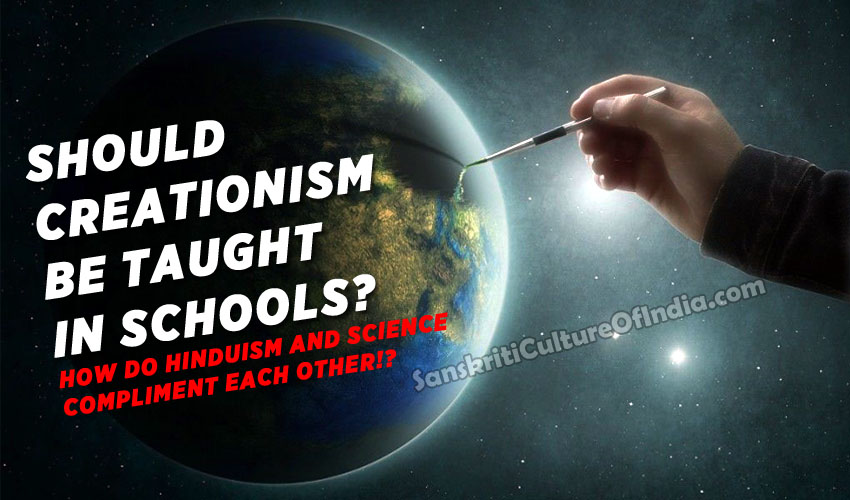
Recently there has been a resurgence of discussions on teaching creationism in science classes as a result of the Indiana senate bill. I would like to emphasize strongly that science teachers should not be required to teach these ideas in science classes. Such ideas have not met rigorous standards of scientific research. Let scientists decide what should be taught in science classes. Just saying that God created everything hardly explains anything. Everyone is welcome to challenge a scientific model, but then one has to provide an alternate model which explains the same or more data in a better way. People happily use results of scientific progress, such as technological products, drugs and medical procedures. Then they should also accept conclusions that follow from the scientific method. In science, you cannot pick and choose only the conclusions that are consistent with your beliefs. In addition, school children are not mature enough to understand the difference between rigorously established scientific models and individual beliefs. I am writing this as a scientist and a longtime member of the Hindu temple of central Indiana who believes that religion has a very important place in life, but it is not in the science classroom.
Now I would like to explain briefly concepts of Hinduism, since it is one of the religions mentioned in the bill. Many American readers may not know about Hinduism. Let me start by saying there is no essential conflict between Hindu philosophy and modern science. Hindus believe that there is a fundamental entity called Brahman (God) that created (actually manifested) the universe and pervades everything, living and nonliving. Interestingly this is similar to what modern physics says –i.e., everything is made out of the same constituent particles. You may worship Brahman in any form you choose. This is the reason why Hinduism allows worship of any god who symbolically represents Brahman. The law of Karma, which says there is a consequence to everything one does, is similar to the law of action and reaction of physics. As for creation, Hindu scriptures always maintained that there are cycles of creation and destruction lasting billions (not thousands) of years. According to modern physics, the age of the universe since the big bang is close to 14 billion years. Also, some of the philosophical descriptions of reality of nature in Hindu scriptures are remarkably similar to the description of reality in quantum physics.
Hindu belief is that the soul has to pass through 8.4 million species of living forms before getting to a human birth. Surprisingly, this number is close to the number of species known to biologists! Also, according to the mythological stories, avatars (incarnations) of God came to earth in the form of fish, land animals and eventually human beings. Of course, science would not go that far, but the progressive evolution through various species is the basis of theory of evolution. Thus Hindus have no problem with the theory of evolution. Darwin’s theory was remarkably prophetic, since, at that time, he did not know about DNA evidence of evolution, evolution of drug resistant bacteria or fossil evidence of transition of species etc. which came up much later (see, PBS program on “what Darwin never knew”).
Like other religions, Hinduism also has the usual commandments, such as speak truth, lead a responsible moral life, do not steal, do not commit unnecessary violence, etc.
Finally, we should recognize the differences in methods and domains of science and religion. Science always deals with sensory perceptions whereas, very often, religion deals with extra-sensory perceptions. Thus religion goes beyond verified science. From a scientific point of view, as yet, there is no understanding of consciousness, concept of soul or for that matter, what happens after we die. I believe, most scientists would not have any problem if there is a class on world religions in schools, and such things are discussed there. After all, religion does play an important role in our society. In my opinion, there is no conflict between belief in God (as long as it is consistent with laws of nature) and science.
~ Kashyap Vasavada is an emeritus professor of physics at Indiana-Purdue University, Indianapolis IN. He is a member of the Hindu temple of Central Indiana and past president of Geeta Mandal (a group associated with the temple).