Those shatkarma which effect purification of the body are secret. They have manifold, wondrous results and are held in high esteem by eminent yogis. ~ (Hatha Yoga Pradipika 2:23)
Yogic science gives as much importance to certain cleansing processes as it does to asana or pranayama. Without regular cleansing of the system one cannot gain maximum benefit from yoga practices. Without purification of the body one will not be ready for the higher practices of yoga.
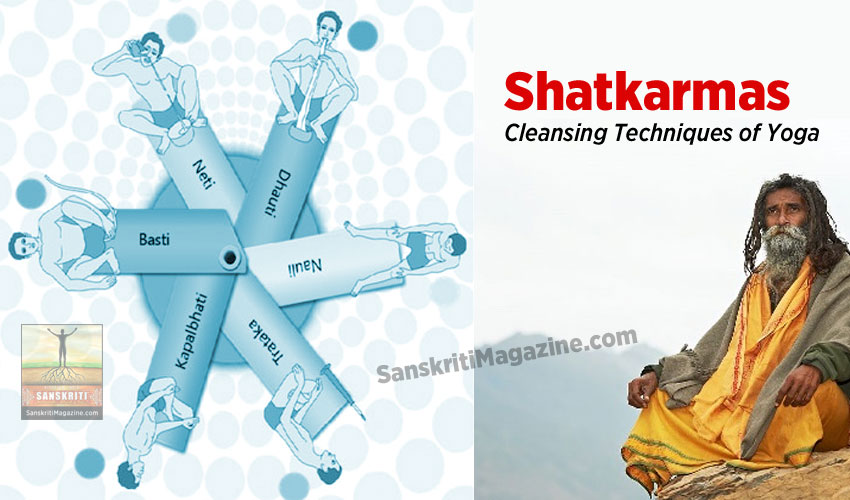
Body cleansing is brought about by the practice of the shatkarmas or six purificatory techniques which are very important from the point of view of physical and mental health. These simple techniques are also highly valuable in healing internal disorders. There are six main groups of shatkarmas or yogic cleansers as follows:
1. Neti: nasal cleaning, including jala neti and sutra neti.
2. Dhauti: cleansing of the digestive tract.
3. Nauli: abdominal massage.
4. Basti: colon cleaning.
5. Kapalbhati: purification and vitalisation of the frontal lobes.
6. Trataka: blinkless gazing.
Each of these groups contains more than one practice, such as jala neti, vaman dhauti (or kunjal kriya), moola shodhana etc. They are all excellent practices designed to purify the whole body and bring about first-class health. They also bring clarity and harmony to the mind.
‘Shatkarma’ (sometimes known as Shatkriya) is a compound word consisting of two components: ‘shat’ meaning ‘six’ and ‘karma’ meaning ‘art’ or ‘process’. The word ‘kriya’ or ‘karma’ is used in Hatha Yoga in a special technical sense regarding the techniques of cleaning. Although we have grouped them into six here, the ‘Gherand Samhita’ and ‘Hatha Yoga Samhita’ enumerate as many as twenty-one such practices, albeit under six broad headings. The ‘Shatkarma Samgraha’ describes no less than forty-six such processes, such as vamana, vireehana, gandusha, udgara, and raktasrava.
The ‘Hatha Yoga Pradipika’ however is the only authentic work which tends to limit itself exactly to six cleansing practice, ‘Pranatoshani’ refers to only five purificatory practices. Besides these works, a vernacular treatise, ‘Bhakti Sagram’ of Charana Das describes in detail the shatkarmas and in addition mentions four mere which it does not describe. Dhauti, basti, neti, trataka, nauli and kapalbhati are the six traditionally known processes.
The shatkarma affect and activate almost all of the vital systems in the body, especially the digestive, respiratory, circulatory and nervous systems. Every individual organ of importance, like the food pipe, stomach, colon, lungs, eyes and ears, receives equal attention. These purificatory processes are both preventive and curative.
The shatkarma are very powerful practices that can never be learned from books or taught by inexperienced people. Only these instructed by the guru can teach others. One may think that he has the capacity to teach but actually he may not have adequate experience or knowledge to guide ethers proficiently. This applies to the shatkarma in particular. If unqualified people teach them they are likely to make serious mistakes. Also, one can make mistakes if one practises them independently without the aid of a guru.
They are said to be ‘secret’ practices as one must be personally instructed how to perform them and how often, according to individual need. For this, a qualified and experienced teacher is essential. Those who sincerely want to learn the shatkarma will have to find a guru of hatha yoga, and they will have to search hard, for few teachers are expert in the shatkarma. There are three humors in the body: kapha (mucus), pita (bile), and vata (wind). In yoga and ayurveda they are called tridasha. A balanced proportion of these three facilitates body functions, but if there is excess of one and shortage of another, ailments develop due to overheating or not enough heat in the body. So, before commencing pranayama, any imbalance in the doshas should be removed.
The effects of the shatkarma can be summed up in one word – purification. When the different systems of the body have been purified, the overall result is that energy can flow through the body freely. One’s capacity to work, think, digest, taste, feel, experience, etc., increases and greater awareness develops. It is no wonder that the yogis who have attained perfection consider the shatkarma with great esteem.
~ Swami Niranjan