IndianSanskriti
What is the Significance of Mauli/Kalava

What is the Significance of Mauli/Kalava

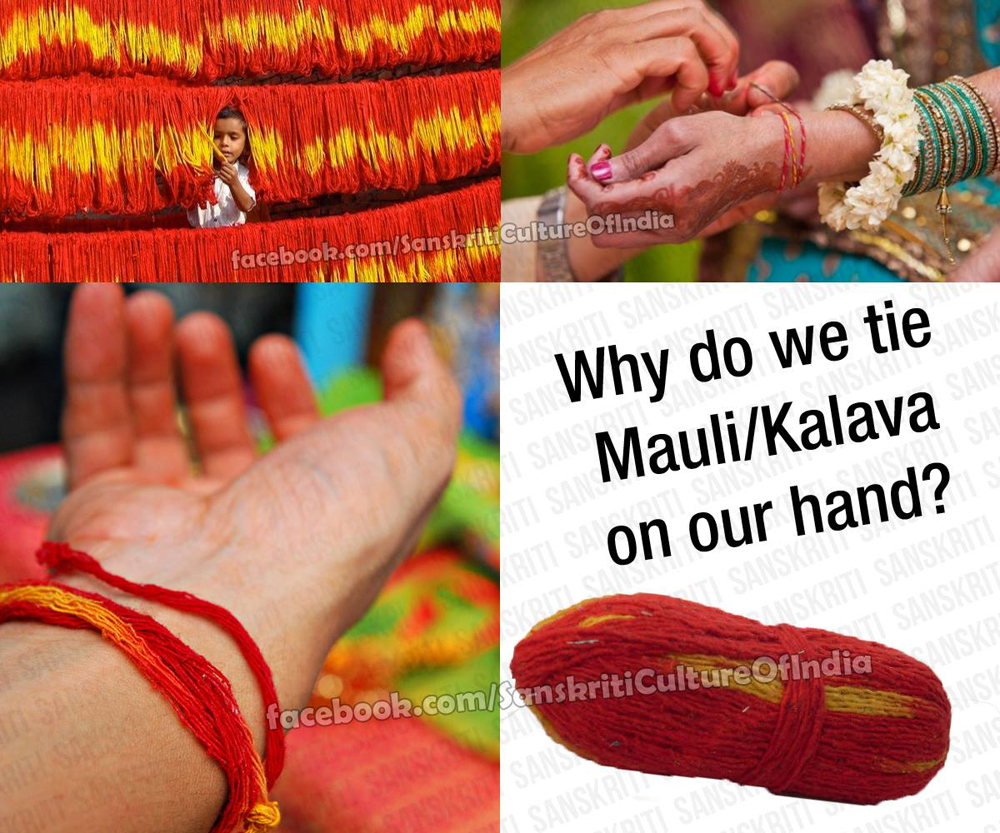
A red thread known as Mauli or Kalava or Charadu is tied on wrist by Hindus before the beginning of a religious ceremony. The thread is tied on the right hand by males and on the left hand by females. The thread is tied to invoke the blessings of the Hindu deities especially of the particular deity to whom the puja is dedicated.

There is also a popular belief that the sanctified red thread with blessing of the deity protects a person from diseases, enemies and other dangers.

By tying ‘Mauli/Kalava’ it is said that blessings of Trideva – Brahma, Vishnu and Mahesh and Tridevis – Saraswati, Lakshmi and Durga are received. From the blessings of Brahma we get fame, from the blessings of Vishnu we get defending power from evil and by the blessings of Shiva we get the power to destroy our own bad and negative qualities. By the blessings of Saraswati we get knowledge, by the blessings of Lakshmi we get wealth and from Durga we get power.

In ancient times it is said that God Vaman tied ‘Raksha Sootra’ (defending thread) in the form of ‘Mauli’, for the immortality of great chertiest demon king Bali. Since then custom of tying ‘Mauli’ is continued. It is also said in ‘Shastras’ that :

Yen baddho bali raja danvedro mahabalah|
Ten tvamanubadhnaami rakshe maachala maachala||

The literal meaning of mauli is ‘above all’. Here the reference is to the head that stands high. With the moon perched on top of Shiva’s head he is referred to as Chandramauli.

The thread can also be called a raksha or rakhi, and is put on the brother by the sister to show the sister’s familial love. The knots in the thread are said to hold the love of the sister when she tied the knot. Thus, the brother wears the rakhi as a sign of his sister’s love and wishes for protection. In other arrangements, the knots tied in the rakhi as the red strings are given to guests or tied around their wrists before a special ceremony or reception is also considered to hold the goodwill of those who offer it.
You may also like

Search the website

Like us on Facebook

Get daily updates via Email

Enter your email address:

Recent Posts

Purushottam Maas — The Month No Deity Would Claim, and the Lord Who Made It Supreme

Every month of the Hindu calendar has a lord — except the rare thirteenth, the Adhika Maas, born an orphan and shunned as the “impure month.” The Puranas tell how this rejected month went in grief to Bhagavan Vishnu, who claimed it, gave it His own name — Purushottam — and made it the most fruitful month of all. The origin story, the teaching, and what it means for Purushottam Maas 2026 (May 17 – June 14).

Padmini Ekadashi 2026 — The Ekadashi Even the Devas Descend to Keep

Padmini Ekadashi 2026 — The Ekadashi Even the Devas Descend to Keep

The rarest Ekadashi of the entire Hindu calendar is three days away. The Padma Purana preserves a conversation between Bhagavan Krishna and Yudhishthira about a single Ekadashi the great Rishis spend lifetimes waiting for — Padmini. The Vrat Katha of Queen Padmini of Mahishmati, the lotus teaching, and why May 27, 2026 is the morning Vaishnavas across Bharata are preparing for.

Varada Chaturthi 2026 — The Rare Ganesha Day of Purushottam Maas

Varada Chaturthi 2026 — The Rare Ganesha Day of Purushottam Maas

Once every 2.5–3 years — when the rare 13th month of Adhika Maas opens — a thirteenth Vinayaka Chaturthi appears. The Mudgala Purana calls it Varada Chaturthi, the “boon-giving” Chaturthi, and holds it as the most fruit-bearing Ganesha day of the entire calendar. Today, Wednesday May 20, 2026, is that day.

Padmini Ekadashi 2026 — The Rare Ekadashi That Comes Only in Purushottam Maas

Padmini Ekadashi 2026 — The Rare Ekadashi That Comes Only in Purushottam Maas

Padmini Ekadashi 2026 falls on Wednesday, May 27 — the Shukla Paksha Ekadashi of Adhika Maas, the rarest Ekadashi in the entire Hindu calendar (it appears only every 2.5–3 years). The Padma Purana conversation between Bhagavan Krishna and Yudhishthira, the Vrat Katha of Queen Padmini, complete vrat vidhi with jagrana, mantras, and the lotus symbolism that gives the Ekadashi its name.

Ganga Dussehra 2026 — The Day Maa Ganga Came Down to Bhagiratha

Ganga Dussehra falls on Monday, May 25, 2026 — commemorating the day Maa Ganga descended from Vaikuntha to the earth through the millennia-long tapasya of King Bhagiratha. The full account from the Valmiki Ramayana, snan vidhi, dana traditions, mantras, and the teaching of sustained sincerity.

css.php