IndianSanskriti
‘Ram-bhakts’-sent-2,000-cubic-feet-stones-for-Ram-temple-in-Ayodhya-from-Bharatpur-in-Rajasthan

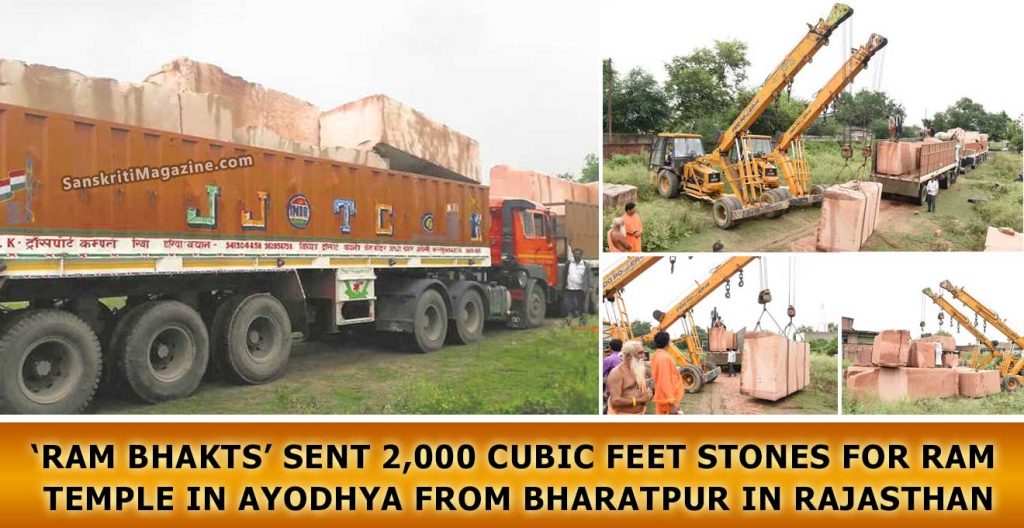
‘Ram bhakts’ sent 2,000 cubic feet stones for Ram temple in Ayodhya from Bharatpur in Rajasthan

Stones from Rajasthan arrive for Ram temple in Ayodhya VHP spokesperson Sharad Sharma said that ‘Ram bhakts’ have sent 2,000 cubic feet stones from Bharatpur in Rajasthan because Ram Janmabhoomi Nyas in June 2015 had appealed to them to donate stones instead of cash.

A FRESH CONSIGNMENT of 18 blocks of sandstones for carving out structures of the proposed Ram temple reached Ayodhya in three trucks on Wednesday. Four blocks of stones in two trucks had arrived in the temple city a week ago. All these sandstone blocks have been kept at Ramsevakpuram of Ram Janmabhoomi Nyas. Ramsevakpuram is barely 500-metre from the VHP workshop, where carving of stones for the temple is going on since 1990.
 
VHP spokesperson Sharad Sharma said that ‘Ram bhakts’ have sent 2,000 cubic feet stones from Bharatpur in Rajasthan because Ram Janmabhoomi Nyas in June 2015 had appealed to them to donate stones instead of cash.
 
Sharma said that the Commercial Tax department in the previous Samajwadi Party regime had stopped allowing Ram Janmabhoomi Nyas to bring sandstones from Rajasthan, citing the “status quo” ordered by the Supreme Court at the disputed site.

“From June this year, the department has started giving form 39 that allows bringing of stones from other states. It is happening because the new government in the state is dedicated to lord Ram, cow and nation,” he said. Sharma said that arrival of sandstones would continue in the future too.

According to VHP leaders, the previous state government did not give permission to bring stones from Rajasthan after two trucks laden with 35 tonnes of pink sandstones had arrived in Ayodhya in December 2015.
 
The carving of stones for the proposed temple is going on under the supervision of the Ram Janmabhoomi Nyas, an organisation of VHP leaders and saints to promote and oversee the development of Ram temple.

Nyas members, in a meeting in Ayodhya in June 2015, had resolved to collect donations for the temple in form of stones instead of cash from ‘Ram bhakts’. It had also issued a nationwide appeal to devotees to donate stones for the temple.

VHP leaders said that around 1.75 lakh cubic feet of stones were required to build the temple as per its proposed design. Since 1990, around 1 lakh cubic feet of stones has been purchased. The plan is to build a 268-foot long, 140-foot wide and 128-foot high two-storey temple, topped by a shikhar (dome). Ram Janmabhoomi Nyas is headed by Nritya Gopal Das, one of the accused against whom charges were framed by a Lucknow CBI court in Babri masjid demolition case recently.


You may also like

Search the website

Like us on Facebook

Get daily updates via Email

Enter your email address:

Recent Posts

Yogini Ekadashi 2026 — The Yaksha Who Missed the Morning Flowers, and the Ekadashi That Undid His Curse

On Friday, July 10, 2026, the rare Krishna Paksha Ekadashi of Nija Ashadha arrives. The Padma Purana tells the story of Hemamali — the Yaksha gardener of Bhagavan Kubera in Alaka, whose single morning of distraction with his wife Vishalakshi cost him his form, his wife, and his celestial city. Cursed to wander the earth of Bharata as a leper for a long time, he was at last shown the way back by Sage Markandeya — a single sincere keeping of Yogini Ekadashi.

Jamai Shashthi 2026 — The Story of Maa Shashthi, the Cat, and the Wife Who Was Forgiven

Jamai Shashthi 2026 — The Story of Maa Shashthi, the Cat, and the Wife Who Was Forgiven

On Saturday, June 20, 2026, Bengali households across Bharata will welcome their married daughters and sons-in-law home for the legendary jamai-aador feast and perform the Shashthi Vrata. But behind the warmth lies a story most Bengalis know by heart and most non-Bengalis have never heard — the wife who stole the hilsa, blamed the cat, lost six sons to Maa Shashthi’s wrath, and was finally forgiven. The Vrat Katha, the vidhi, the mantras, and the deeper teaching.

Vat Purnima 2026 — The Wife Who Argued Yama Into Returning Her Husband’s Life

On Monday, June 29, 2026, women across Maharashtra, Gujarat, and southern Bharata will tie red thread around banyan trees and hear the story of Savitri — the wife who walked behind Yamaraja Himself when He came for her husband, and out-argued the Lord of Dharma into returning Satyavan’s life. The Mahabharata’s Pativrata Mahatmya Parva, the vrat vidhi, and why the banyan witnessed everything.

Nija Jyeshtha 2026 — The Real Jyeshtha Begins, and the Calendar Resumes

Nija Jyeshtha 2026 — The Real Jyeshtha Begins, and the Calendar Resumes

With Adhik Maas now closed on the Somvati Amavasya of June 15, the long-postponed festivals of Jyeshtha return — Vat Purnima (June 29, the Savitri-Yamaraja katha), Jamai Shashthi (June 20, the Bengali festival of Maa Shashthi), Sankashti Chaturthi (June 28), Yogini Ekadashi (July 10), and Devshayani Ekadashi (July 16, opening the four-month Chaturmas of Bhagavan Vishnu’s yoga-nidra). A guide to what the next four weeks hold and what the household that kept Purushottam Maas now carries forward.

The Closing of Purushottam Maas 2026 — Adhik Amavasya and the Sealing of the Month-Long Vrat

On Monday, June 15, 2026 — a rare Somvati Amavasya — the intercalary month that bears Bhagavan Vishnu’s own name comes to its close. The Acharyas teach that a vrat is not measured by its duration but by its closing. Here are the Padma Purana’s instructions for sealing the month-long Purushottam Maas vrat: the morning snan, the closing puja with the Vishnu Sahasranama, the day of dana, the Somvati Amavasya gift, and the final sarva-arpana — the offering of all merit at the feet of the Lord.

css.php