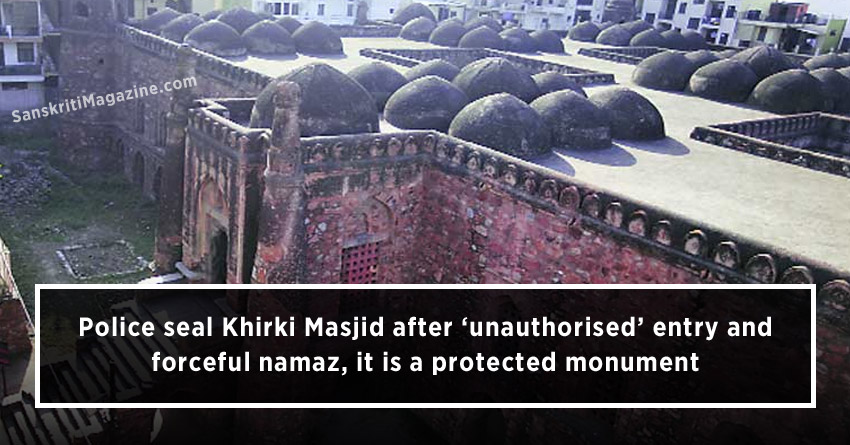
Two weeks after a group of people allegedly tried to offer prayers forcefully at Khirki Mosque — a protected monument near Saket in south Delhi — the heritage site, on Friday, was turned into a fortress with security personnel barricading all routes to the monument.
According to local residents and a letter written by the Archaeological Survey of India (ASI) to Delhi Police, “some people from muslim community” had “forcefully entered” the Khirki Masjid and “unauthorisedly offered prayers”.
“The advice of ASI staff was not heard and ASI chowkidar was pushed aside. The matter was brought to the notice of SHO, Malviya Nagar, by the local people and the timely intervention by the police force brought the situation under control,” the letter from Superintending Archaeologist Daljeet Singh’s office stated. Dated June 15, the letter was addressed to the deputy commissioner of police (south).
The letter further urges the police to “issue necessary instructions so as to ensure that there is no violation of the provisions of ‘Ancient Monument and Archaeological Site and Remains Act 1958, Rules 1959’ and ‘Ancient Monument and Archaeological Sites & Remain (Amendment and Validation) Act 2010’ and from law and order angle.
Meanwhile, boards carrying the content of this letter have been put up near the monument. Even as the protected monument is popularly known as Khirki Mosque, a section of residents call the monument a fort. Dating back to the second half of the fourteenth century, the monument is believed to be one of the seven mosques built by Khan-e-Jahan Junan Shah, who was the wazir or Prime Minister of Firoz Shah Tughlaq.
A document on monuments in the area published by the World Monuments Fund and created by INTACH states, “The mosque with its massive sloping rubble walls, corner towers and forbidding facade certainly looks less like a place of worship and more like a citadel.”
Although local residents affirmed that such an incident had taken place two weeks ago, they alleged that there was a conspiracy to polarise residents in the area on communal lines. “For decades, Muslims and Hindus have lived peacefully in the area. While Khirki village primarily have Hindu residents, Hauz Rani has a section of Muslim population. This is just an attempt to spoil the harmony in this place,” Pritam Singh, a resident of Khirki, said.
Voicing similar concerns, Billu Pradhan, a resident of Hauz Rani, said, “My family has been living here for generations. There has never been any friction between the two communities residing here. I am a Muslim and my father was the pradhan of Hauz Rani. We have never offered prayers at the Khirki Masjid. After we came to know about the incident, we spoke to the residents and urged them to offer prayers at the local mosques which they visit to offer Namaz.”
A senior police officer, late Friday evening, said, “We had deployed around 200 police personnel after we received information that some people might visit the monument to offer prayers. A few days ago, a group of people had reached the site to offer prayers. As per ASI rules, since it is a centrally protected monument, people are not allowed to offer prayers. Villagers had informed us about the incident as well. At present, the number of police personnel deployed in the area has come down to five.”