IndianSanskriti
Money-and-Maya

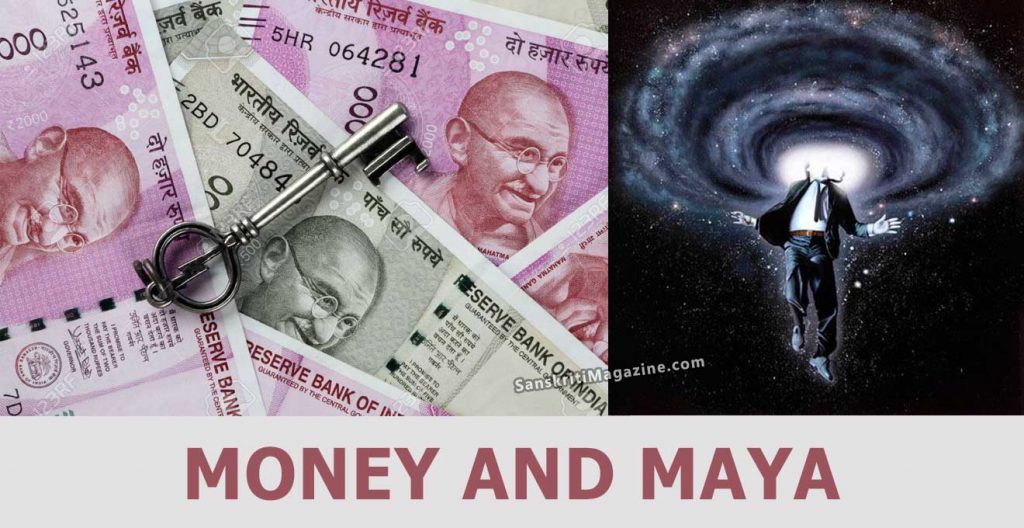
Money and Maya

by Sri Sri Ravi Shankar

Money gives us a sense of freedom and ownership. We feel that with money, we can own anything or put a price tag on anybody’s services.

Ownership of something means total control of its existence from beginning to end. How can you own something that outlives you?

Money also gives the idea that you are powerful and independent, blinding you to the fact that we live in a world of interdependence. The awareness of dependence makes one humble.

When people lack faith in divinity and in the goodness of society, they suffer from a deep sense of insecurity. Then, all that appears to provide security is money.

Due to the illusory notions of independence that it brings, money is considered a part of maya: miyate anaya iti maya means “that which can be measured is maya”.Human values are eroded when you try to put a price tag on all that cannot be measured, like truth, and life itself.

There are also those who blame money for all the ills of society. Not only does possessing money bring arrogance, rejecting it does, too.The ancient sages never denigrated money or maya. They honoured it as a part of the divine and thereby transcended the grip of its illusion.

They honoured wealth as Goddess Lakshmi, born out of Yoga. It is the wisdom of Yoga that transforms one from arrogance to self-confidence, from the burden of dependence to the realisation of interdependence, from craving for the freedom to the recognition of unbounded-ness, from a limited ownership to oneness with the whole.


You may also like

Search the website

Like us on Facebook

Get daily updates via Email

Enter your email address:

Recent Posts

Adi Shankaracharya Jayanti 2026 — Advaita Vedanta, Om symbol, and four Amnaya Peethas

Adi Shankaracharya — The Monk Who Reunited Bharata

Shankaracharya Jayanti 2026 — the 1238th birth anniversary of Adi Shankaracharya. His extraordinary life, the Digvijaya, the debate with Mandana Mishra, Advaita Vedanta, the four Amnaya Peethas, and his timeless literary legacy.

Akshaya Tritiya 2026 — royal purple hero banner with Akshaya Patra vessel and Devanagari text

Akshaya Tritiya 2026 — The Day That Never Diminishes

Akshaya Tritiya (April 19, 2026) is one of the most auspicious days in the Vedic calendar — when any act of dharma, dana, or japa yields imperishable merit. Discover the five sacred Puranic events, complete puja vidhi, timings, mantras, and the deeper spiritual teaching beyond gold-buying.

Baisakhi 2026 — Mesha Sankranti Hindu Solar New Year hero banner with rising sun, Om symbol and wheat harvest

Baisakhi 2026 — Harvest, Hope, and the Hindu Solar New Year

Baisakhi 2026 falls on Tuesday, April 14 — the day Bhagavan Surya enters Mesha Rashi at 9:39 AM, marking the Hindu Solar New Year. Discover the sacred science of Mesha Sankranti, the Punya Kaal rituals, and how this one cosmic moment is celebrated across Bharata as Vishu, Puthandu, Pohela Boishakh, Bohag Bihu, and Pana Sankranti.

Varuthini Ekadashi 2026 — sacred vrat guide hero banner with Vishnu Chakra mandala

Varuthini Ekadashi 2026 — The Sacred Vrat That Shields from Sin

Varuthini Ekadashi (April 13, 2026) is one of the most powerful Ekadashi vrats — dedicated to Lord Vamana, it dissolves lifetimes of karmic burden and shields the devoted soul with Bhagavan Vishnu’s protective grace. Complete vrat vidhi, timings, mantra, and the sacred Vrat Katha from the Bhavishya Purana.

css.php