IndianSanskriti

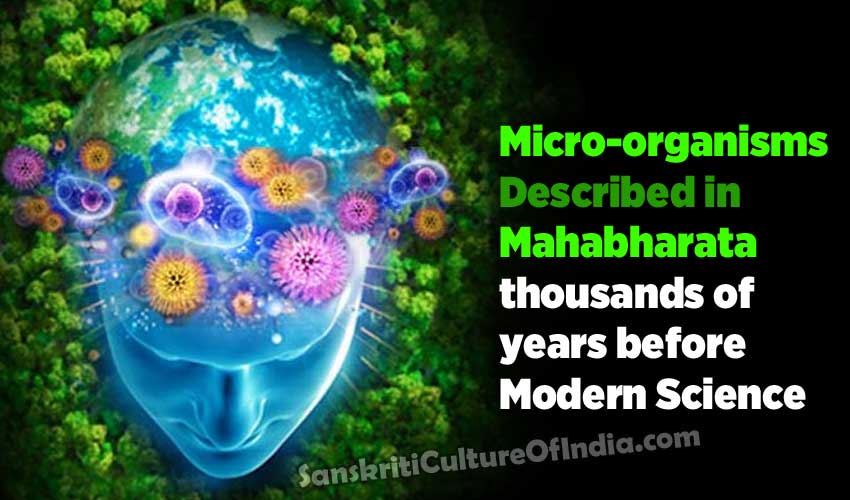
Micro-organisms Described in Mahabharata

Scientists found the existence of bacteria in the 17th century AD but these have been known as micro-organisms that were invisible to the naked eye with a life span of the blink of an eyelid in Hinduism.

Descriptions of various micro-organisms have been given in Mahabharata. In Santi Parva, Section XV, Arjuna talks about the nature of this world and the strongest species killing the weakest for its survival:

I do not behold the creature in this world that supports life without doing any act of injury to others. Animals live upon animals, the stronger upon the weaker. The mongoose devours mice; the cat devours the mongoose; the dog devours the cat; the dog again is devoured by the spotted leopard. Behold all things again are devoured by the Destroyer when he comes! This mobile and immobile universe is food for living creatures. This has, been ordained by the gods. The man of knowledge, therefore, is never stupefied at it. It behoveth thee, O great king, to become that which thou art by birth. Foolish alone, restraining wrath and joy take refuge in the woods. The very ascetics cannot support their lives without killing creatures. In water, on earth, and fruits, there are innumerable creatures. It is not true that one does not slaughter them. What higher duty is there than supporting one’s life?

He even talks about how gods are given powers to destroy, punish people in this world and ahimsa (non-violence) is not for everyone, especially for the kings, kshatriyas or the rulers.

सूक्ष्मयॊनीनि भूतानि तर्क गम्यानि कानि चित
पक्ष्मणॊ ऽपि निपातेन येषां सयात सकन्धपर्ययः

There are many creatures that are so minute that their existence can only be inferred. With the falling of the the eyelids alone, they are destroyed.


You may also like

Search the website

Like us on Facebook

Get daily updates via Email

Enter your email address:

Recent Posts

Jamai Shashthi 2026 — The Story of Maa Shashthi, the Cat, and the Wife Who Was Forgiven

Jamai Shashthi 2026 — The Story of Maa Shashthi, the Cat, and the Wife Who Was Forgiven

On Saturday, June 20, 2026, Bengali households across Bharata will welcome their married daughters and sons-in-law home for the legendary jamai-aador feast and perform the Shashthi Vrata. But behind the warmth lies a story most Bengalis know by heart and most non-Bengalis have never heard — the wife who stole the hilsa, blamed the cat, lost six sons to Maa Shashthi’s wrath, and was finally forgiven. The Vrat Katha, the vidhi, the mantras, and the deeper teaching.

Vat Purnima 2026 — The Wife Who Argued Yama Into Returning Her Husband’s Life

On Monday, June 29, 2026, women across Maharashtra, Gujarat, and southern Bharata will tie red thread around banyan trees and hear the story of Savitri — the wife who walked behind Yamaraja Himself when He came for her husband, and out-argued the Lord of Dharma into returning Satyavan’s life. The Mahabharata’s Pativrata Mahatmya Parva, the vrat vidhi, and why the banyan witnessed everything.

Purushottam Maas — The Month No Deity Would Claim, and the Lord Who Made It Supreme

Every month of the Hindu calendar has a lord — except the rare thirteenth, the Adhika Maas, born an orphan and shunned as the “impure month.” The Puranas tell how this rejected month went in grief to Bhagavan Vishnu, who claimed it, gave it His own name — Purushottam — and made it the most fruitful month of all. The origin story, the teaching, and what it means for Purushottam Maas 2026 (May 17 – June 14).

Padmini Ekadashi 2026 — The Ekadashi Even the Devas Descend to Keep

Padmini Ekadashi 2026 — The Ekadashi Even the Devas Descend to Keep

The rarest Ekadashi of the entire Hindu calendar is three days away. The Padma Purana preserves a conversation between Bhagavan Krishna and Yudhishthira about a single Ekadashi the great Rishis spend lifetimes waiting for — Padmini. The Vrat Katha of Queen Padmini of Mahishmati, the lotus teaching, and why May 27, 2026 is the morning Vaishnavas across Bharata are preparing for.

Varada Chaturthi 2026 — The Rare Ganesha Day of Purushottam Maas

Varada Chaturthi 2026 — The Rare Ganesha Day of Purushottam Maas

Once every 2.5–3 years — when the rare 13th month of Adhika Maas opens — a thirteenth Vinayaka Chaturthi appears. The Mudgala Purana calls it Varada Chaturthi, the “boon-giving” Chaturthi, and holds it as the most fruit-bearing Ganesha day of the entire calendar. Today, Wednesday May 20, 2026, is that day.

css.php