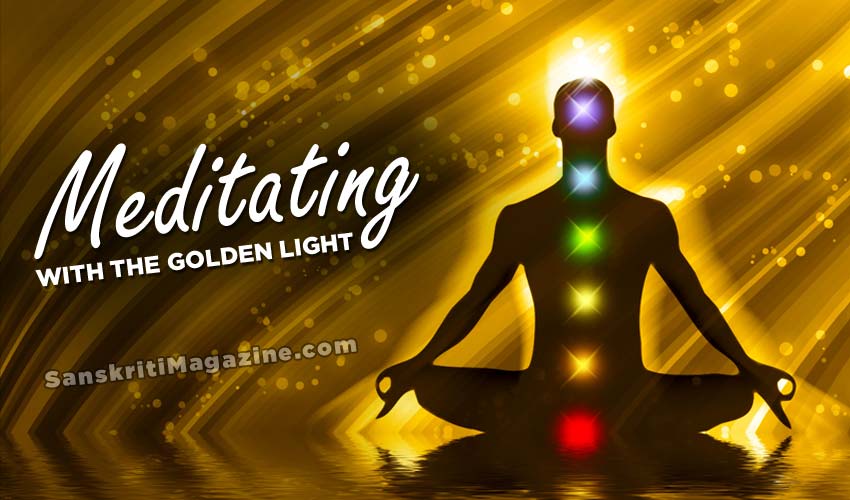
Morning is a sacred hour to meditate. One among a large number of meditations for this sacred hour, Osho explains the technique and the benefits of Golden Light Meditation.
The best time to begin is in the early morning, immediately, just when you are half-asleep, half-awake. And the process is so simple. It needs no posture, no yogasana, no bath is needed, nothing.
You simply lie down, as you are lying down in your bed, on your back. Keep your eyes closed. When you breathe in, just visualize great light entering from your head into your body, as if a sun has risen just close to your head — golden light pouring into your head. You are just hollow and the golden light is pouring into your head, and going, going, going, deep, deep, and going out through your toes. When you breathe in, do it with this visualization.
And when you breathe out, visualize another thing: darkness entering through your toes, a great dark river entering through your toes, coming up, and going out through the head. Do slow, deep breathing so you can visualize. Go very slowly. And just out of sleep you can have very deep and slow breaths because the body is rested, relaxed.
Let me repeat: breathing in, let golden light come into you through your head, because it is there that the Golden Flower is waiting. That golden light will help. It will cleanse your whole body and will make it absolutely full of creativity. This is male energy.
Then when you exhale, let darkness, the darkest you can conceive, like a dark night, river-like, come from your toes upwards — this is feminine energy: it will soothe you, it will make you receptive, it will calm you, it will give you rest — and let it go out of the head. Then inhale again, and golden light enters in.
Do it for twenty minutes early in the morning.
And then the second best time is when you are going back to sleep, in the night.
Lie down on the bed, relax for a few minutes. When you start feeling that now you are wavering between sleep and waking, just in that middle, start the process again, and continue for twenty minutes. If you fall asleep doing it, it is the best, because the impact will remain in the superconscious and will go on working.
And after a three-month period you will be surprised: the energy that was constantly gathering at the MULADHAR, at the lowest, the sex center, is no more gathering there. It is going upwards.
– OSHO, The Secret of Secrets Vol 2