
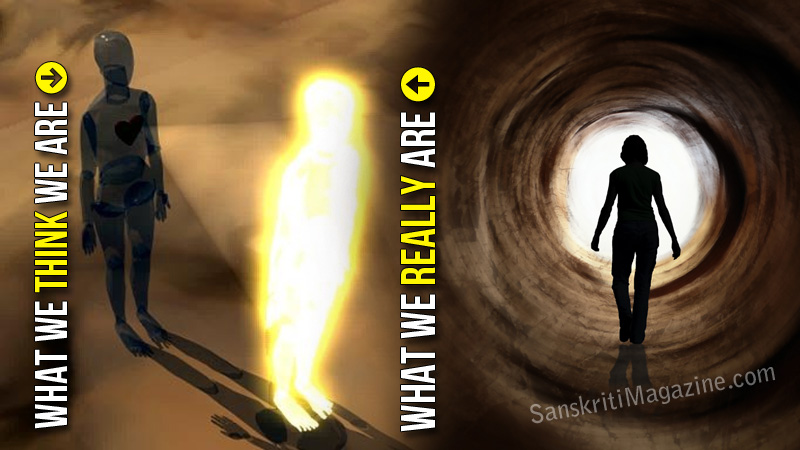
Ātman is a Sanskrit word that means ‘self’. In Hindu philosophy, especially in the Vedanta school of Hinduism, Ātman is the first principle, the true self of an individual beyond identification with phenomena, the essence of an individual. In order to attain salvation (liberation from the physical world), a human being must acquire self-knowledge (atma jnana), which is to realize that one’s true self (Ātman) is identical with the transcendent self Brahman.
In order to understand the Hindu worldview it is essential to grasp this first and foundational concept. Atman refers to the non-material self, which never changes. It is distinct from both the mind and the external body. This real self is beyond the temporary designations we normally ascribe to ourselves, in terms of race, gender, species and nationality.
The soul is not born, but always exists. It is the consciousness of life, and dwells in every heart; it is the master of all, the lord of all.
The soul is not made greater by good actions, nor diminished by bad actions. It is the supreme sovereign, and the protector of all living beings. It is the bridge between this world and the world beyond; and it is also the dike which separates them.
Those who love God, seek the soul through studying the sacred texts, through worship, through acts of charity, and through abstaining from pleasures. Those who find the soul, become sages. They demand nothing for themselves, because those who know the soul, possess the whole world. They do not desire offspring, and nor do they desire wealth; they regard all desire as empty.
The soul cannot be defined; it is not this or this. The soul cannot be comprehended, because it is beyond comprehension. The soul cannot pass away, because it is imperishable. The soul is free, because it has no bonds of attachment. The soul is serene, because it cannot suffer or fear suffering.
Those who know the soul, feel no grief at the evil they do, nor elation at the good they do; they are beyond good and evil. They are indifferent to what is done and left undone. They are masters of themselves, and they are utterly calm and tranquil. They see the soul within themselves, and they see the soul in all beings. – Brihadaranyaka Upanishad 4:4.22-23
The soul can pass through several types of life (animals, plants, human, rocks, etc. etc.), but only human life offers it the chance of learning this truth.
If you see the soul in every living being, you see truly. If you see immortality in the heart of every mortal being, you see truly. If you see God within every man and woman, then you can never do harm to any man or woman. If you see God in yourself, then you attain perfection.
When you see the soul in every living being, you see that all actions are performed by the soul’s energy -though the soul itself does not act. You see that the soul inspires every movement -though the soul itself does not move. When you see that amidst the variety of living beings the soul is the unity, then you attain fulfillment.
The soul has no birth; it cannot be divided into parts; and it has no death. It dwells in the body, but it is not touched by the body. It pervades the universe, but is not affected by anything in the universe. The soul can never be corrupted or stained.
As the sun lights up the world, the soul lights up the body. Those who possess the eye of wisdom, can distinguish the soul from the body -and therefore they can break free from the body.
Gita 13.27-34
The universe emerges from God, and will return to God; he is the beginning and the end. God is all, and all is God.
You are your deepest desire. Your deepest desire in this life will shape your next life. So direct your deepest desire to knowing the soul.
The soul can be known by those who are pure in heart. The soul is light and life, truth and space. The soul is the source of all activity, all desires, all fragrances and tastes. The soul is beyond words. From the soul comes eternal joy -and the soul dwells within every heart.
The soul is smaller than a grain of rice, smaller than a grain of barley, smaller than a mustard seed, smaller than a grain of millet, smaller even than the kernel of a grain of millet. Thus the heart has room for the soul. The soul is also larger than the earth, larger than the sky, larger than the entire universe.
Chandogya Upanishad 3: 14.1-4
So Hindus believe that they should utilize the opportunity offered by their birth as humans to understand brahman, soul, and their oneness with God.







