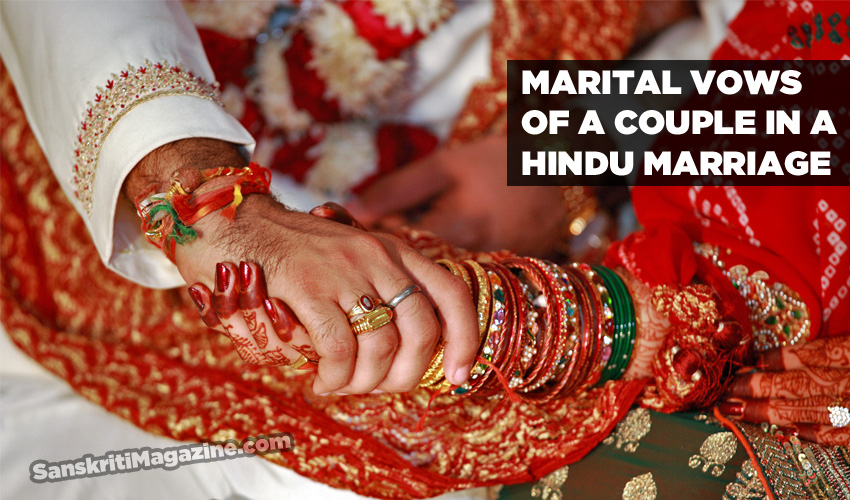
After the marriage ceremony is concluded the bride and groom are told about their duties and responsibilities in married life. To affirm their faith in building a lasting marital bond, both partners make separate vows. These vows direct the couple to a positive path of action. They help in promoting marital happiness for a lifetime. The priest reads the vows one by one and the individual accepts them by saying, “I agree to do so”, after each vow.
Vows by the Husband
- I will consider my wife to be the better half. I will look after her just as I look after myself.
- Accepting her as in-charge of the home, I shall plan things in consultation with her.
- I will never express dissatisfaction about any shortcomings in my wife. If there are any, I will explain them to her lovingly. I will support her in overcoming them.
- I will always have faith in my wife. I will never look at another woman with wrong intent, nor have an illicit relationship.
- I will be affectionate and treat my wife like a friend.
- I will bring home all my income to my wife. The household expenses will be incurred with her consent. I will always make an effort to ensure her comfort and happiness.
- I will not find fault or criticize my wife before others. We will sort out our differences and mistakes in privacy by ourselves.
- I will have a courteous and tolerant attitude towards my wife. I will always follow a compromising policy.
- If my wife is unwell, or is unable to fulfill some responsibility, or through some misunderstanding behaves wrongly, I will not withdraw support of refuse to fulfill my responsibilities towards her.
- I will always do my best to encourage my wife to find self-fulfillment. I will always behave in a kind and loving manner towards her.
Vows by the Wife:
- I will merge my personality with that of my husband, and truly become the better half. We will begin a new life together.
- I will always treat my husband’s relatives with coutesy, respect and generosity, and spare no efforts to keep them happy and content.
- I will work hard to perform the household work and support my husband. I will never be lazy.
- With complete faith in my husband, I will live just as he desires. I will always be faithful to him.
- I will always speak pleasantly, be service -minded, and have an attitude of contentment. I will never sulk, grumble or be jealous.
- I will be frugal in running my home, and will avoid wastefulness.
- I will never be indifferent towards my husband and will treat him like God. I will never insult or abandon him.
- If there are any differences with my husband, I will resolve them peacefully and never present them in a derogatory manner.
- I will always keep my husband content with humility and service.
- Even if my husband is indifferent towards me, without any consideration I will faithfully fulfill my responsibilities.
Your questions answered:
In the many rituals laid down for marriage, why is there no provision for divorce?
According to the Hindu way of life, marriage is a sacred union between a man and woman. Before marriage both the man and woman are incomplete. Only after marriage do they become complete. Both are assigned responsibilities to make marriages succeed. When one of the partners fails to fulfill the responsibilities, the marriage vows stand broken. Each partner is incomplete again. As punishment, suffering follows. The purpose of rituals is to promote happiness, not suffering. Divorce too is a form of suffering. Therefore, there is no provision for divorce in ritualistic way.
~ Prem Bhalla