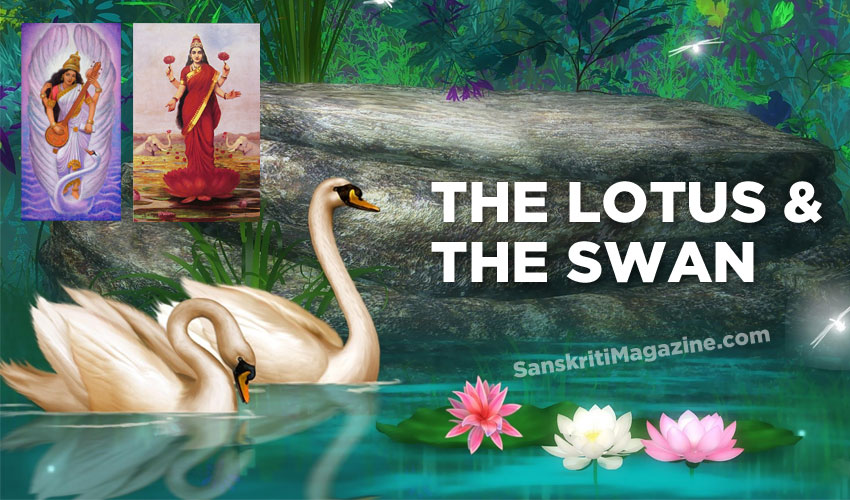
Some leaders of our country believe that schools should begin their day with prayers to Saraswati, goddess of knowledge. Why not with a hymn to Lakshmi? After all, isn’t wealth and power the motivation for parents to send their children to school? In universities, medical schools, engineering colleges, management institutes, art academies and other centers of learning, isn’t Saraswati being worshipped with Lakshmi in mind? Information no longer enlightens – it exploits. Education is no longer seen as something that opens the mind and expands the horizon. For the teacher, it has become the source of livelihood. For the student, it is merely an investment to reap a rich harvest. Few bother with philosophy and literature anymore. They don’t pay enough! Arts are being crafted to excite rich patrons. Skills are being prostituted. Knowledge is being sold to the highest bidder. Even textbooks have become battlegrounds for political power.
Lakshmi is without doubt an important goddess. Without her, trees would not bear fruit, animals would starve, kings would be shorn of splendour and sovereignty. When the gods churned her out of the ocean of milk, she brought with her the promise of affluence, abundance and authority. Not surprisingly, both the asuras and devas desired this goddess of fortune. She went from king to king, from god to god, offering each one moments of glory before turning away. Her restless spirit earned her the title Chancala, the fickle-one. The demons said, she was capricious; the gods accused her of being too demanding. Ultimately, Vishnu won her eternal affection.
Known for his uprightness, Vishnu is the guardian of the universe, tirelessly working to maintain order, dharma. Unlike other beings, Vishnu did not seek Lakshmi; the goddess chose him. She was attracted by his commitment to his work and his detachment from all rewards. There probably is a message in their union: that wealth and power help sustain life, they do not make up life. What then is life? If wealth and power are means, what is the end?
Who better to answer these questions than Saraswati, repository of all knowledge. Even Brahma sought her companionship to find his way out of the labyrinth of material passion. The story goes: Brahma was so enamoured by Shatarupa, goddess of material existence, that he sprouted five heads to look upon her at all times. He chased her wherever she went, but no matter how hard he tried, he could not possess this mercurial being. To restrain Brahma’s lust Shiva, the supreme ascetic, wrenched off one of Brahma’s heads. Sobered by the experience, Brahma took Saraswati and learnt to rein in his bewitched mind.
Unlike Lakshmi, Saraswati does not adorn herself with flowers or jewels. She wears a white sari, thus rejecting the cosmetic pleasures of life. She is not associated with any fertility symbol or any emblem of power. She rides a swan, symbol of discernment and detachment. Discernment because it is said that swans can separate milk from water and thus reality from illusion. Detachment because though swans need water for their survival, they can always fly away without a drop of water burdening their wings. Lakshmi and Saraswati embody the dual purpose of life: the demand to pleasure the senses and the need to liberate the soul, the desire to indulge the ego and the hope to transcend the flesh. It is difficult to find a compromise between the two. As the Jains say, “You cannot be the chakravarti (emperor) and tirhthankara (seer) at the same time.”
One way out was the ashrama system, when after enjoying the pleasures of the world as a householder, men renounced worldly life to become ascetics. However, looking at old politicians still clinging to power in the twilight of their life, it becomes apparent that such choices are not easy. One has to either fly on Saraswati’s swan or remain rooted in Lakshmi’s lotus.