A Hindu is any person who practices good Karma ~ the discipline of action, Bhakti ~ the spiritual practice of devotion to God or Gyana ~ the knowledge of the true self, for achieving Moksha ~ liberation from the cycle of birth and death and all the suffering and limitation entailed in embodied worldly existence. Chandrasekharendra Saraswathi Maha Swami of Kanchi kamakoti Peetam said “Religion is the means of realizing dharma, artha, kama and moksha. These four are called purusarthas. Moksha is the state of supreme bliss and there is no quest beyond it”
Bhagavad Gita Verse 71 Chapter 2 explains that man attains peace by abandoning all desires. On this verse Adi Sankara has commented as follows:
“That man of renunciation who entirely abandons all desires, goes through life contented with the bare necessities of life, who regards not as his, even those things which are needed for mere bodily existence, who is not vain of his knowledge – such a man of steady knowledge, that man who knows Brahman, attains peace, the end of all the misery of samsara. In short he becomes Brahman.” That is what is meant by Liberation.
Most people depart from this world without knowing what is happening to them and without any knowledge of the next world. Some great Gnanis know exactly what happens during life and during death. The way we live our present life and the deeds in past birth can influence opportunities in this life and the kind of death we would be subjected to.
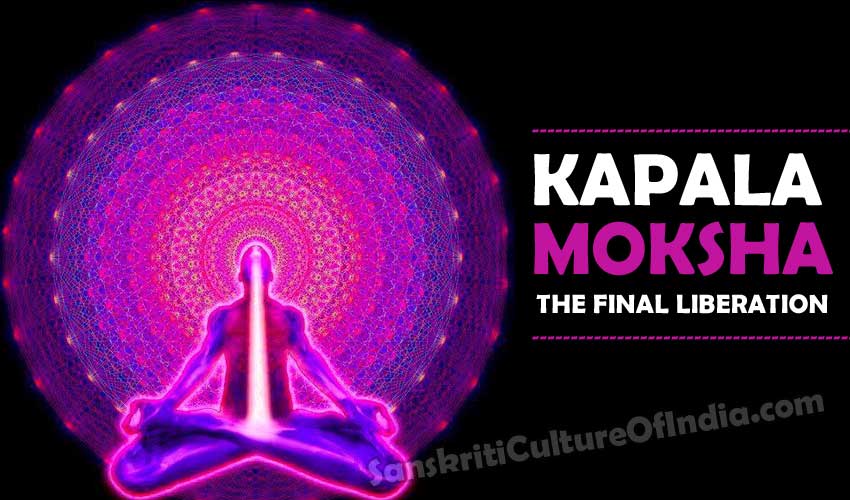
The Nadis control the integral support system of our body giving them life force. The Nabhi Kamalam in the naval region activates the Nadi Gantham or nerve centers of the body. This has been beautifully depicted in mythology where Brahma the creator is seen rising out of Lord Vishnu’s Nabi Kamalam. These Nadis all end in one of the nine openings of the human body called the nava dwaras. Scientifically, the Prana leaves through one of the nine orifices in a common man. For true great devotees and true renunciants, the life force does not exit through one of these nine orifices. There is one more gate at the top of the head the brahmarandhra also known as dasamadwara or the tenth gate. The chakras are energy centers along the spine representing the levels of consciousness. The Sahasrara Chakra is situated at the crown of the head at the dasamadwara.
Kapala means Head, Moksha is liberation. Liberation from a wheel of succeeding incarnations. Kapala Moksha or Brahma Sayujya happens when the life energy or prana leaves the body through the small crack in the Sahasrara chakra with the opening of the Bramha Ranthra in the crown of the skull. This is what is called salvation. When the Yogi separates himself from the physical body at the time of death, this Brahma Ranthra bursts open and Prana comes out through this opening (Kapala Moksha). They are Jeevan Mukthas. The Yogi who gets such a moksha enjoys the Supreme Bliss, Parama Ananda, super conscious state and the Highest Knowledge.
Meaning: A hundred and one are the nerves of the heart, of them one, that is the Sushumna penetrates the crown of the head. Going upwards through that nerve one attains immortality. The others depart differently. (Kathopanishad -A dialog with death by Swami Chinmayananda).
In Kundalini, the energy is brought up through the Sahasrara from Muladhara located at the base of the spine. Out of the innumerable Nadis 14 of them are said to be important. The Ida, Pingala and Sushumna are the three most important of those 14 Nadis. Sushumna extends from the Muladhara Chakra to Brahmarandhra. Ida and Pingala Nadis are on the left and right sides of the spine. All the three have their confluence at the base of the spine. In ordinary people the energy flows only through the two side ones and is expressed as ordinary worldly thoughts, feelings and activities. But for most of the Yogis the energy circulation current moves along the central channel up to Sahasra. When the breath flows through Sushumna, the mind becomes steady bringing the highest state of Yoga. This state gives Immortality. By contemplating on the Chakras, the Yogi attains the highest Bliss, which gives Moksha.
This kind of Moksha happens to only a very selected few who have a special blessing from the Lord to not have rebirth. Such Mahaans or ‘highly elevated souls’ are liberated from a wheel of succeeding incarnations. During the last days such yogis take only milk and tulsi water. Usually these gifted bhaktas, yogis and saints are able to predict the day and sometimes-even time of their death. For some it is said the skull softens at that time and symbolically before the burial of such divine saints, it was necessary as per the prescribed procedure, to break a coconut on the head to release the soul. There are a few Mahaans who have even attained a natural Kapala Moksha, witnessed by hordes of devotees, disciples and family members who have observed the brahma randra open and a Jyothi being released into the sky from their Kapalam during the time of their mukti.
Mahaans have attained Kapala Moksha by their self-realization, right knowledge, right actions, Service to the Lord, meditation and devotion. ‘Kapala Moksha’ is considered to be the highest method by which the soul can leave the body and can be attained only by overcoming ignorance and desires through God-realization.
~ C.R. Kaushik